Vriend Jerry, Ghavami Saeid, Marzban Hassan
Department of Human Anatomy and Cell Science, Rm129, BMSB, 745 Bannatyne Avenue, Winnipeg, MB, Canada.
Children's Hospital Research Institute of Manitoba (CHRIM), College of Medicine, Faculty of Health Sciences, University of Manitoba, Winnipeg, MB, R3E 0J9, Canada.
Mol Brain. 2015 Oct 17;8(1):64. doi: 10.1186/s13041-015-0155-5.
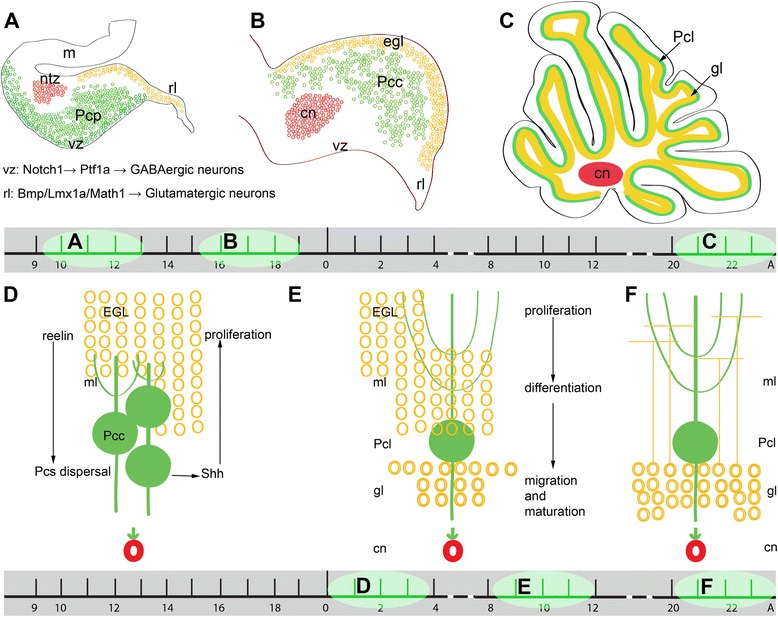
Cerebellar granule cells precursors are derived from the upper rhombic lip and migrate tangentially independent of glia along the subpial stream pathway to form the external germinal zone. Postnatally, granule cells migrate from the external germinal zone radially through the Purkinje cell layer, guided by Bergmann glia fibers, to the internal granular cell layer.Medulloblastomas (MBs) are the most common malignant childhood brain tumor. Many of these tumors develop from precursor cells of the embryonic rhombic lips. Four main groups of MB are recognized. The WNT group of MBs arise primarily from the lower rhombic lip and embryonic brainstem. The SHH group of MBs originate from cerebellar granule cell precursors in the external germinal zone of the embryonic cerebellum. The cellular origins of type 3 and type 4 MBs are not clear.Several ubiquitin ligases are revealed to be significant factors in development of the cerebellum as well as in the initiation and maintenance of MBs. Proteasome dysfunction at a critical stage of development may be a major factor in determining whether progenitor cells which are destined to become granule cells differentiate normally or become MB cells. We propose the hypothesis that proteasomal activity is essential to regulate the critical transition between proliferating granule cells and differentiated granule cells and that proteasome dysfunction may lead to MB. Proteasome dysfunction could also account for various mutations in MBs resulting from deficiencies in DNA checkpoint and repair mechanisms prior to development of MBs.Data showing a role for the ubiquitin ligases β-TrCP, FBW7, Huwe1, and SKP2 in MBs suggest the possibility of a classification of MBs based on the expression (over expression or under expression) of specific ubiquitin ligases which function as oncogenes, tumor suppressors or cell cycle regulators.
小脑颗粒细胞前体起源于上菱唇,沿软膜下流动途径独立于神经胶质细胞进行切向迁移,形成外生发层。出生后,颗粒细胞在伯格曼神经胶质纤维的引导下,从外生发层沿径向穿过浦肯野细胞层,迁移至内颗粒细胞层。髓母细胞瘤(MBs)是儿童最常见的恶性脑肿瘤。这些肿瘤中的许多都起源于胚胎菱唇的前体细胞。已识别出MB的四个主要类型。WNT型MB主要起源于下菱唇和胚胎脑干。SHH型MB起源于胚胎小脑外生发层的小脑颗粒细胞前体。3型和4型MB的细胞起源尚不清楚。
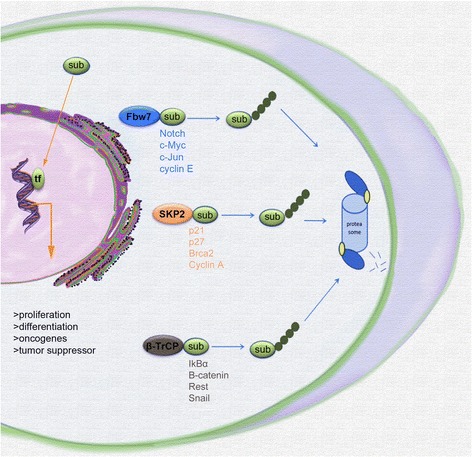
几种泛素连接酶被发现是小脑发育以及MB起始和维持的重要因素。发育关键阶段的蛋白酶体功能障碍可能是决定注定要成为颗粒细胞的祖细胞是正常分化还是成为MB细胞的主要因素。我们提出假说,蛋白酶体活性对于调节增殖颗粒细胞和分化颗粒细胞之间的关键转变至关重要,蛋白酶体功能障碍可能导致MB。蛋白酶体功能障碍也可能解释MB中由于MB发生前DNA检查点和修复机制缺陷而导致的各种突变。
显示泛素连接酶β-TrCP、FBW7、Huwe1和SKP2在MB中起作用的数据表明,有可能根据作为癌基因、肿瘤抑制因子或细胞周期调节因子的特定泛素连接酶的表达(过表达或低表达)对MB进行分类。