Martins Ana Raquel, Franco Nuno Henrique
Faculty of Sciences, University of Porto, Rua do Campo Alegre S/N, 4169-007 Porto, Portugal.
IBMC-Instituto de Biologia Molecular e Celular, University of Porto, Rua do Campo Alegre 823, 4150-180 Porto, Portugal.
Animals (Basel). 2015 Apr 30;5(2):315-31. doi: 10.3390/ani5020315.
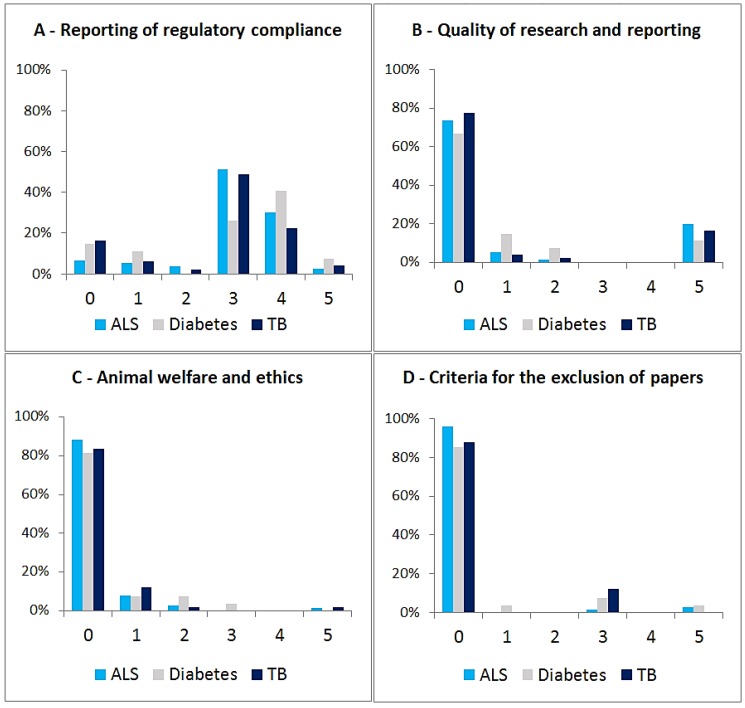
Animal research is not only regulated by legislation but also by self-regulatory mechanisms within the scientific community, which include biomedical journals' policies on animal use. For editorial policies to meaningfully impact attitudes and practice, they must not only be put into effect by editors and reviewers, but also be set to high standards. We present a novel tool to classify journals' policies on animal use-the EXEMPLAR scale-as well as an analysis by this scale of 170 journals publishing studies on animal models of three human diseases: Amyotrophic Lateral Sclerosis, Type-1 Diabetes and Tuberculosis. Results show a much greater focus of editorial policies on regulatory compliance than on other domains, suggesting a transfer of journals' responsibilities to scientists, institutions and regulators. Scores were not found to vary with journals' impact factor, country of origin or antiquity, but were, however, significantly higher for open access journals, which may be a result of their greater exposure and consequent higher public scrutiny.
动物研究不仅受到立法的监管,还受到科学界内部自我监管机制的约束,其中包括生物医学期刊关于动物使用的政策。要使编辑政策对态度和实践产生有意义的影响,它们不仅必须由编辑和审稿人付诸实施,而且还必须设定高标准。我们提出了一种新颖的工具——EXEMPLAR量表,用于对期刊关于动物使用的政策进行分类,并通过该量表对170种发表三种人类疾病(肌萎缩侧索硬化症、1型糖尿病和结核病)动物模型研究的期刊进行分析。结果表明,编辑政策更多地关注监管合规性而非其他领域,这表明期刊将责任转移给了科学家、机构和监管机构。研究发现,分数并不随期刊的影响因子、原产国或创刊时间而变化,然而,开放获取期刊的分数显著更高,这可能是由于它们的曝光度更高以及随之而来的更高公众监督。