Lu Min
a Department of Biochemistry & Molecular Biology , Rosalind Franklin University of Medicine & Science , Chicago , IL , USA.
Channels (Austin). 2016;10(2):88-100. doi: 10.1080/19336950.2015.1106654. Epub 2015 Oct 21.
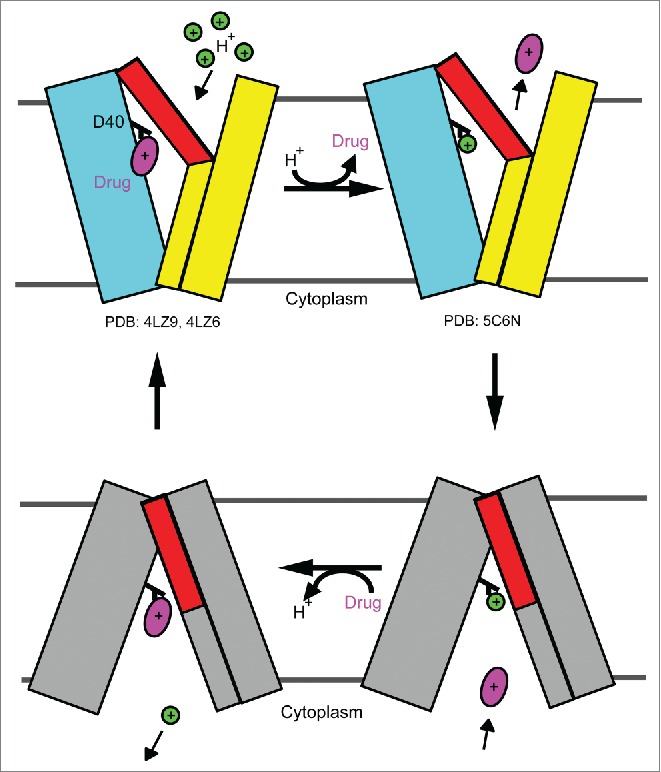
Multidrug resistance poses grand challenges to the effective treatment of infectious diseases and cancers. Integral membrane proteins from the multidrug and toxic compound extrusion (MATE) family contribute to multidrug resistance by exporting a wide variety of therapeutic drugs across cell membranes. MATE proteins are conserved from bacteria to humans and can be categorized into the NorM, DinF and eukaryotic subfamilies. MATE transporters hold great appeal as potential therapeutic targets for curbing multidrug resistance, yet their transport mechanism remains elusive. During the past 5 years, X-ray structures of 4 NorM and DinF transporters have been reported and guided biochemical studies to reveal how MATE transporters extrude different drugs. Such advances, although substantial, have yet to be discussed collectively. Herein I review these structures and the unprecedented mechanistic insights that have been garnered from those structure-inspired studies, as well as lay out the outstanding questions that present exciting opportunities for future work.
多重耐药性给传染病和癌症的有效治疗带来了巨大挑战。多药及毒性化合物外排(MATE)家族的整合膜蛋白通过将多种治疗药物转运出细胞膜,从而导致多重耐药性。MATE蛋白在从细菌到人类的生物中都保守存在,可分为NorM、DinF和真核亚家族。MATE转运蛋白作为遏制多重耐药性的潜在治疗靶点具有很大吸引力,但其转运机制仍然不清楚。在过去5年里,已报道了4种NorM和DinF转运蛋白的X射线结构,并指导了生化研究,以揭示MATE转运蛋白如何排出不同药物。尽管这些进展颇为显著,但尚未进行综合讨论。在此,我回顾这些结构以及从那些受结构启发的研究中获得的前所未有的机制见解,并列出那些为未来工作带来令人兴奋机遇的悬而未决的问题。