Schlenstedt Christian, Paschen Steffen, Kruse Annika, Raethjen Jan, Weisser Burkhard, Deuschl Günther
Department of Neurology, Christian-Albrechts-University, Kiel, Germany; Department of Sport Science, Christian-Albrechts-University, Kiel, Germany.
Department of Neurology, Christian-Albrechts-University, Kiel, Germany.
PLoS One. 2015 Oct 26;10(10):e0140584. doi: 10.1371/journal.pone.0140584. eCollection 2015.
Reduced muscle strength is an independent risk factor for falls and related to postural instability in individuals with Parkinson's disease. The ability of resistance training to improve postural control still remains unclear.
To compare resistance training with balance training to improve postural control in people with Parkinson's disease.
40 patients with idiopathic Parkinson's disease (Hoehn&Yahr: 2.5-3.0) were randomly assigned into resistance or balance training (2x/week for 7 weeks). Assessments were performed at baseline, 8- and 12-weeks follow-up: primary outcome: Fullerton Advanced Balance (FAB) scale; secondary outcomes: center of mass analysis during surface perturbations, Timed-up-and-go-test, Unified Parkinson's Disease Rating Scale, Clinical Global Impression, gait analysis, maximal isometric leg strength, PDQ-39, Beck Depression Inventory. Clinical tests were videotaped and analysed by a second rater, blind to group allocation and assessment time.
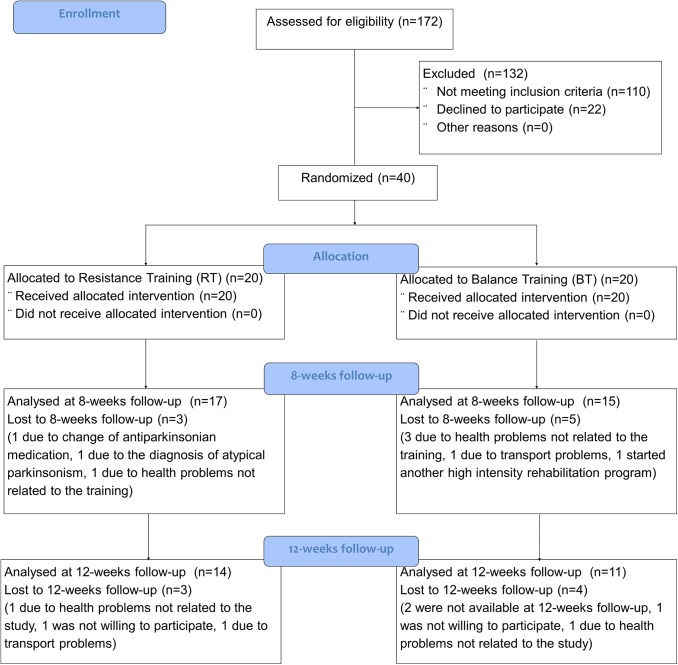
32 participants (resistance training: n = 17, balance training: n = 15; 8 drop-outs) were analyzed at 8-weeks follow-up. No significant difference was found in the FAB scale when comparing the effects of the two training types (p = 0.14; effect size (Cohen's d) = -0.59). Participants from the resistance training group, but not from the balance training group significantly improved on the FAB scale (resistance training: +2.4 points, Cohen's d = -0.46; balance training: +0.3 points, Cohen's d = -0.08). Within the resistance training group, improvements of the FAB scale were significantly correlated with improvements of rate of force development and stride time variability. No significant differences were found in the secondary outcome measures when comparing the training effects of both training types.
The difference between resistance and balance training to improve postural control in people with Parkinson's disease was small and not significant with this sample size. There was weak evidence that freely coordinated resistance training might be more effective than balance training. Our results indicate a relationship between the enhancement of rate of force development and the improvement of postural control.
ClinicalTrials.gov ID: NCT02253563.
肌肉力量下降是跌倒的独立危险因素,且与帕金森病患者的姿势不稳有关。抗阻训练改善姿势控制的能力仍不明确。
比较抗阻训练与平衡训练对帕金森病患者姿势控制的改善情况。
40例特发性帕金森病患者(Hoehn&Yahr分级:2.5 - 3.0级)被随机分为抗阻训练组或平衡训练组(每周2次,共7周)。在基线、随访8周和12周时进行评估:主要结局指标:富勒顿高级平衡(FAB)量表;次要结局指标:表面扰动期间的重心分析、起立行走测试、统一帕金森病评定量表、临床总体印象、步态分析、最大等长腿部力量、PDQ - 39、贝克抑郁量表。临床测试进行录像,由第二位评估者进行分析,该评估者对分组和评估时间不知情。
在随访8周时对32名参与者(抗阻训练组:n = 17,平衡训练组:n = 15;8名退出者)进行了分析。比较两种训练类型的效果时,FAB量表未发现显著差异(p = 0.14;效应量(科恩d值)= -0.59)。抗阻训练组的参与者在FAB量表上有显著改善,而平衡训练组则没有(抗阻训练组:提高2.4分,科恩d值 = -0.46;平衡训练组:提高0.3分,科恩d值 = -0.08)。在抗阻训练组中,FAB量表的改善与力量发展速率和步幅时间变异性的改善显著相关。比较两种训练类型的训练效果时,次要结局指标未发现显著差异。
对于本样本量,抗阻训练与平衡训练在改善帕金森病患者姿势控制方面的差异较小且不显著。有微弱证据表明自由协调的抗阻训练可能比平衡训练更有效。我们的结果表明力量发展速率的增强与姿势控制的改善之间存在关联。
ClinicalTrials.gov标识符:NCT02253563。