Jones Kelly W, Lewis David J
Department of Human Dimensions of Natural Resources, Colorado State University, Fort Collins, Colorado, United States of America.
Department of Applied Economics, Oregon State University, Corvallis, Oregon, United States of America.
PLoS One. 2015 Oct 26;10(10):e0141380. doi: 10.1371/journal.pone.0141380. eCollection 2015.
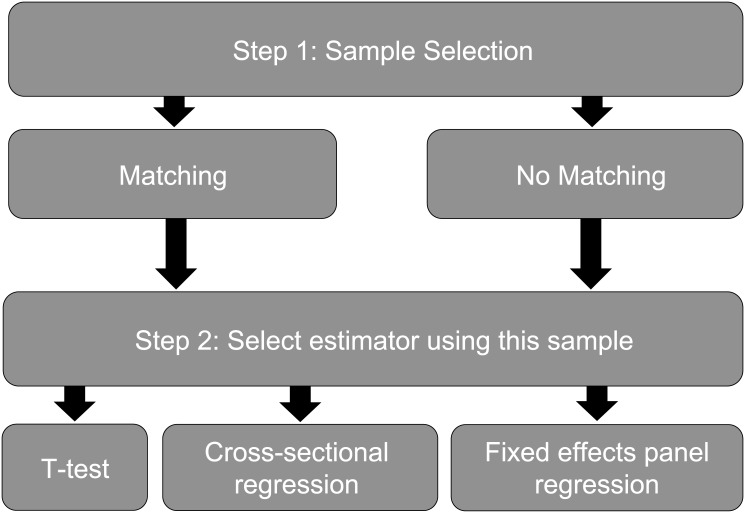
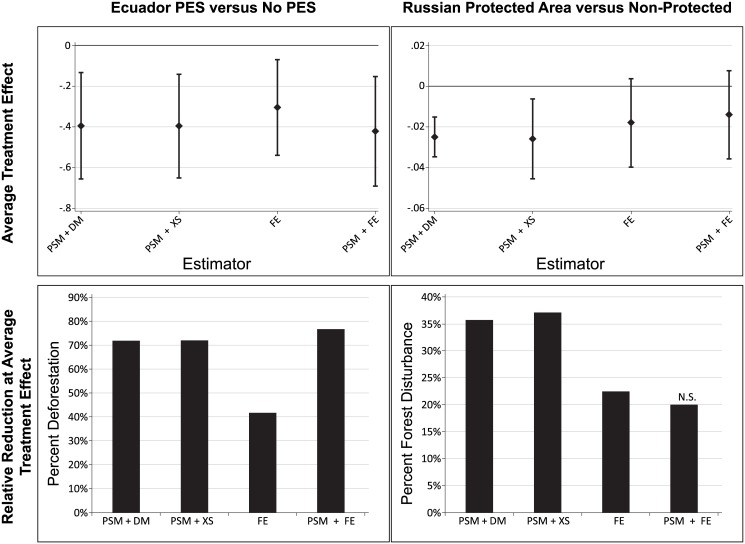
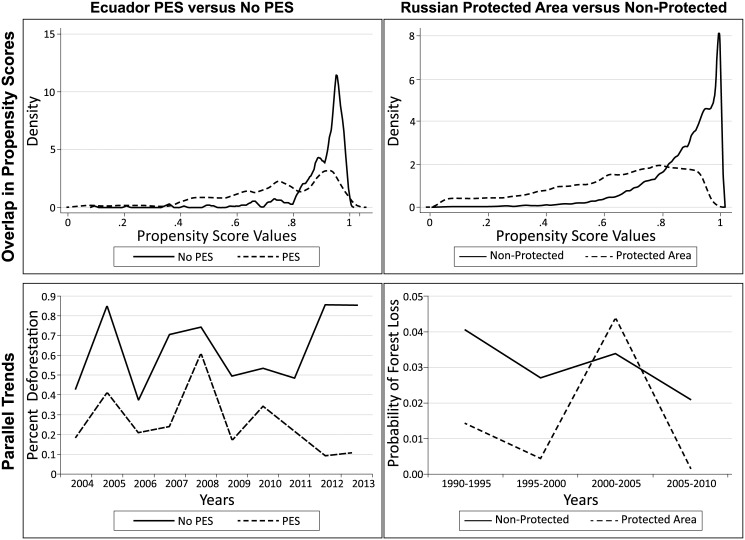
Deforestation and conversion of native habitats continues to be the leading driver of biodiversity and ecosystem service loss. A number of conservation policies and programs are implemented--from protected areas to payments for ecosystem services (PES)--to deter these losses. Currently, empirical evidence on whether these approaches stop or slow land cover change is lacking, but there is increasing interest in conducting rigorous, counterfactual impact evaluations, especially for many new conservation approaches, such as PES and REDD, which emphasize additionality. In addition, several new, globally available and free high-resolution remote sensing datasets have increased the ease of carrying out an impact evaluation on land cover change outcomes. While the number of conservation evaluations utilizing 'matching' to construct a valid control group is increasing, the majority of these studies use simple differences in means or linear cross-sectional regression to estimate the impact of the conservation program using this matched sample, with relatively few utilizing fixed effects panel methods--an alternative estimation method that relies on temporal variation in the data. In this paper we compare the advantages and limitations of (1) matching to construct the control group combined with differences in means and cross-sectional regression, which control for observable forms of bias in program evaluation, to (2) fixed effects panel methods, which control for observable and time-invariant unobservable forms of bias, with and without matching to create the control group. We then use these four approaches to estimate forest cover outcomes for two conservation programs: a PES program in Northeastern Ecuador and strict protected areas in European Russia. In the Russia case we find statistically significant differences across estimators--due to the presence of unobservable bias--that lead to differences in conclusions about effectiveness. The Ecuador case illustrates that if time-invariant unobservables are not present, matching combined with differences in means or cross-sectional regression leads to similar estimates of program effectiveness as matching combined with fixed effects panel regression. These results highlight the importance of considering observable and unobservable forms of bias and the methodological assumptions across estimators when designing an impact evaluation of conservation programs.
森林砍伐和原生栖息地的转变仍然是生物多样性和生态系统服务丧失的主要驱动因素。人们实施了一系列保护政策和计划——从保护区到生态系统服务付费(PES)——以遏制这些损失。目前,缺乏关于这些方法是否能阻止或减缓土地覆盖变化的实证证据,但对于进行严格的反事实影响评估的兴趣与日俱增,尤其是对于许多新的保护方法,如生态系统服务付费和减少毁林和森林退化所致排放量(REDD),这些方法强调额外性。此外,一些新的、全球可用的免费高分辨率遥感数据集提高了对土地覆盖变化结果进行影响评估的便利性。虽然利用“匹配”来构建有效对照组的保护评估数量在增加,但这些研究大多使用均值差异或线性横截面回归来估计使用该匹配样本的保护计划的影响,相对较少使用固定效应面板方法——一种依赖数据时间变化的替代估计方法。在本文中,我们比较了以下两种方法的优缺点:(1)通过匹配构建对照组并结合均值差异和横截面回归,这种方法控制了项目评估中可观察到的偏差形式;(2)固定效应面板方法,这种方法控制了可观察到的和时间不变的不可观察偏差形式,无论是否进行匹配来创建对照组。然后,我们使用这四种方法来估计两个保护计划的森林覆盖结果:厄瓜多尔东北部的一个生态系统服务付费计划和俄罗斯欧洲部分的严格保护区。在俄罗斯的案例中,我们发现不同估计方法之间存在统计学上的显著差异——由于存在不可观察的偏差——这导致了关于有效性结论的差异。厄瓜多尔的案例表明,如果不存在时间不变的不可观察因素,匹配结合均值差异或横截面回归会得出与匹配结合固定效应面板回归相似的项目有效性估计。这些结果凸显了在设计保护计划影响评估时考虑可观察和不可观察偏差形式以及不同估计方法的方法假设的重要性。