Jeon Hyeongseok, Shin Dong Ah
Department of Neurosurgery, Yonsei University Health System, Yonsei University College of Medicine, Seoul, Korea.
Korean J Spine. 2015 Sep;12(3):119-23. doi: 10.14245/kjs.2015.12.3.119. Epub 2015 Sep 30.
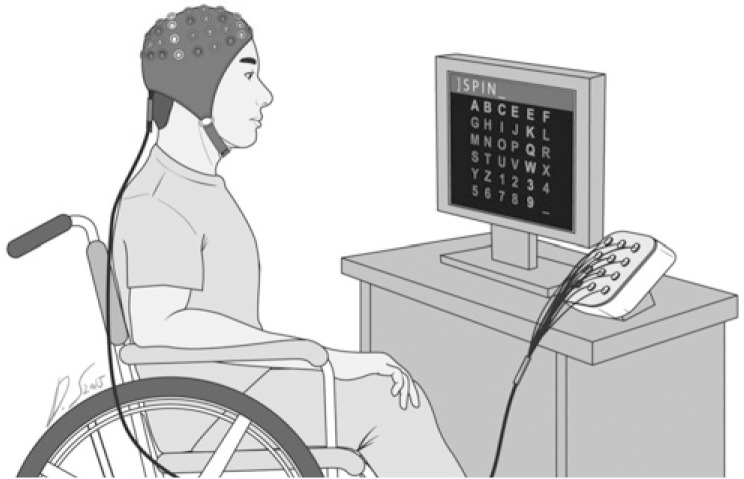
Brain computer interface (BCI) is one of the most promising technologies for helping people with neurological disorders. Most current BCI systems are relatively expensive and difficult to set up. Therefore, we developed a P300-based BCI system with a cheap bioamplifier and open source software. The purpose of this study was to describe the setup process of the system and preliminary experimental results.
Ten spinal cord-injured patients were recruited. We used a sixteen-channel EEG(KT88-1016, Contec, China) and BCI2000 software (Wadsworth center, NY, USA). Subjects were asked to spell a 5-character word using the P300-based BCI system with 10 minutes of training. EEG data were acquired during the experiment. After subjects spelled the word for ten trials, the spelling accuracy and information transfer rate (ITR) were obtained in each patients.
All subjects performed the experiment without difficulty. The mean accuracy was 59.4±22.8%. The spelling accuracy reversely correlated with the age. Younger subjects spelled with higher accuracy than older subjects (p=0.018). However, sex, injury level, time since injury and ASIA scale were not correlated with the accuracy. The mean of ITR was 2.26±1.22 bit/min.
This study showed that a BCI system can be set up inexpensively with a low-price bioamplifier and open-source software. The spelling accuracy was moderately achieved with our system. P300-based BCI is useful in young patients, but modification is necessary in old patients who have low ability of recognition and concentration.
脑机接口(BCI)是帮助患有神经系统疾病患者最具前景的技术之一。当前大多数BCI系统相对昂贵且难以设置。因此,我们开发了一种基于P300的BCI系统,该系统使用廉价的生物放大器和开源软件。本研究的目的是描述该系统的设置过程和初步实验结果。
招募了10名脊髓损伤患者。我们使用了一款16通道脑电图仪(KT88 - 1016,中国康泰)和BCI2000软件(美国纽约州沃兹沃思中心)。要求受试者使用基于P300的BCI系统拼写一个5字符的单词,训练时间为10分钟。实验过程中采集脑电图数据。在受试者拼写该单词进行10次试验后,获取每位患者的拼写准确率和信息传递速率(ITR)。
所有受试者均顺利完成实验。平均准确率为59.4±22.8%。拼写准确率与年龄呈负相关。年轻受试者的拼写准确率高于年长受试者(p = 0.018)。然而,性别、损伤水平、受伤时间和亚洲脊髓损伤协会(ASIA)分级与准确率无关。ITR的平均值为2.26±1.22比特/分钟。
本研究表明,使用低价生物放大器和开源软件可以低成本搭建BCI系统。我们的系统实现了适度的拼写准确率。基于P300的BCI对年轻患者有用,但对于识别和注意力能力较低的老年患者则需要改进。