Cruz Meenalosini Vimal, Jamal Suhaima, Sethuraman Sibi Chakkaravarthy
Department of Information Technology, BCI Lab, Georgia Southern University, Georgia, USA.
Department of Information Technology, Georgia Southern University, Georgia, USA.
J Med Signals Sens. 2025 Jun 9;15:16. doi: 10.4103/jmss.jmss_49_24. eCollection 2025.
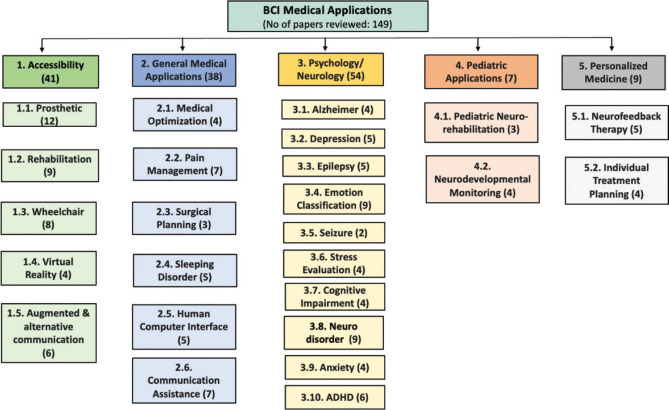
The brain-computer interface (BCI) technology has emerged as a groundbreaking innovation with profound implications across diverse domains, particularly in health care. By establishing a direct communication pathway between the human brain and external devices, BCI systems offer unprecedented opportunities for diagnosis, treatment, and rehabilitation, thereby reshaping the landscape of medical practice. However, despite its immense potential, the widespread adoption of BCI technology in clinical settings faces several challenges. These include the need for robust signal acquisition and processing techniques and optimizing user training and adaptation. Overcoming these challenges is crucial to unleashing the complete potential of BCI technology in health care and realizing its promise of personalized, patient-centric care. This review work underscores the transformative potential of BCI technology in revolutionizing medical practice. This paper offers a comprehensive analysis of medical-oriented BCI applications by exploring the various uses of BCI technology and its potential to transform patient care.
脑机接口(BCI)技术已成为一项具有开创性的创新,在各个领域都有深远影响,尤其是在医疗保健领域。通过在人脑与外部设备之间建立直接通信路径,BCI系统为诊断、治疗和康复提供了前所未有的机会,从而重塑了医疗实践的格局。然而,尽管BCI技术具有巨大潜力,但在临床环境中广泛应用该技术仍面临若干挑战。这些挑战包括需要强大的信号采集和处理技术,以及优化用户培训和适应过程。克服这些挑战对于释放BCI技术在医疗保健领域的全部潜力并实现其个性化、以患者为中心的护理承诺至关重要。这项综述工作强调了BCI技术在彻底改变医疗实践方面的变革潜力。本文通过探索BCI技术的各种用途及其改变患者护理的潜力,对面向医疗的BCI应用进行了全面分析。