Rahimdel Abolghasem, Zeinali Ahmad, Yazdian-Anari Pouria, Hajizadeh Rahele, Arefnia Ehsan
Neurologist, Assistant Professor, Department of Neurology, School of Medicine, Shahid Sadoughi University of Medical Sciences, Yazd, Iran.
Physiatrist, Assistant Professor, Department of Neurology, Shahid Sadoughi Hospital, Yazd University of Medical Science, Yazd, Iran.
Electron Physician. 2015 Oct 19;7(6):1344-8. doi: 10.14661/1344. eCollection 2015 Oct.
Migraine headache is a prevalent periodical and neurological impairment that is associated with functional disorders. Regarding the side effects of available medications, research is continuing in an effort to identify new, effective pharmaceutical regimens with limited side effects.
The aim of this study was to compare the effectiveness of vitamin B2 versus sodium valproate in migraine prophylaxis.
This was a single-blind clinical trial conducted on 90 migraine patients in two parallel groups. The first group underwent vitamin B2 treatment (400 mg/day) for three months, and the second group was treated with sodium valproate (500 mg/day). The patients were examined at the beginning of the study and 4, 8, and 12 weeks later. After the administration of the drugs in both groups, we recorded the duration of migraine pain, the frequency of migraine episodes, and the severity of the headaches. Potential complications of this study that were measured were weight gain, dizziness, and gastrointestinal problems.
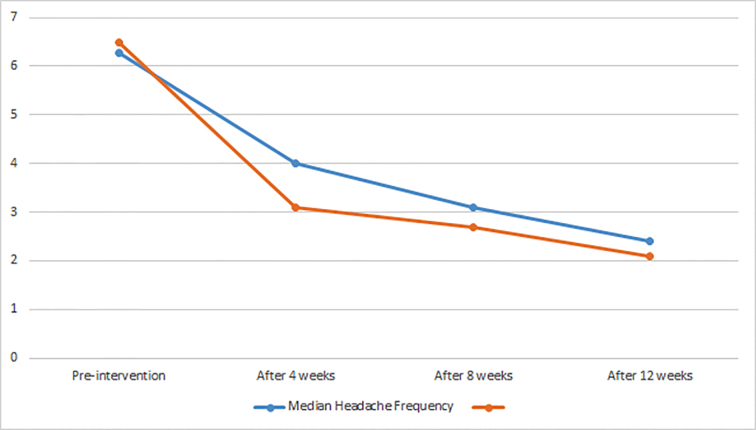
The findings showed that the frequency, median duration per month, and severity of the headaches decreased in both groups, but the difference between them was not significant (p > 0.05). However, there were significantly fewer side effects in vitamin B2 group (p = 0.005).
Sodium valproate and vitamin B2 have similar effects on the reduction of migraine attacks, but vitamin B2 had fewer complications and fewer adverse effects; therefore, vitamin B2 can be administered to patients who are prohibited from taking sodium valproate or who have adverse side effects when they take it.
偏头痛是一种常见的周期性神经功能障碍。鉴于现有药物的副作用,研究仍在继续,以寻找副作用有限的新型有效药物治疗方案。
本研究旨在比较维生素B2与丙戊酸钠预防偏头痛的效果。
这是一项对90例偏头痛患者进行的单盲临床试验,分为两个平行组。第一组接受维生素B2治疗(400毫克/天),为期三个月,第二组接受丙戊酸钠治疗(500毫克/天)。在研究开始时以及4周、8周和12周后对患者进行检查。在两组给药后,我们记录了偏头痛疼痛的持续时间、偏头痛发作的频率以及头痛的严重程度。本研究测量的潜在并发症包括体重增加、头晕和胃肠道问题。
研究结果表明,两组头痛的频率、每月中位数持续时间和严重程度均有所下降,但两组之间的差异不显著(p>0.05)。然而,维生素B2组的副作用明显较少(p = 0.005)。
丙戊酸钠和维生素B2在减少偏头痛发作方面具有相似的效果,但维生素B2的并发症和不良反应较少;因此,对于禁止服用丙戊酸钠或服用丙戊酸钠时有不良反应的患者,可以给予维生素B2。