Ultsch Alfred, Thrun Michael C, Hansen-Goos Onno, Lötsch Jörn
DataBionics Research Group, University of Marburg, Hans-Meerwein-Straße, Marburg 35032, Germany.
Institute of Clinical Pharmacology, Goethe-University, Theodor-Stern-Kai 7, Frankfurt am Main 60590, Germany.
Int J Mol Sci. 2015 Oct 28;16(10):25897-911. doi: 10.3390/ijms161025897.
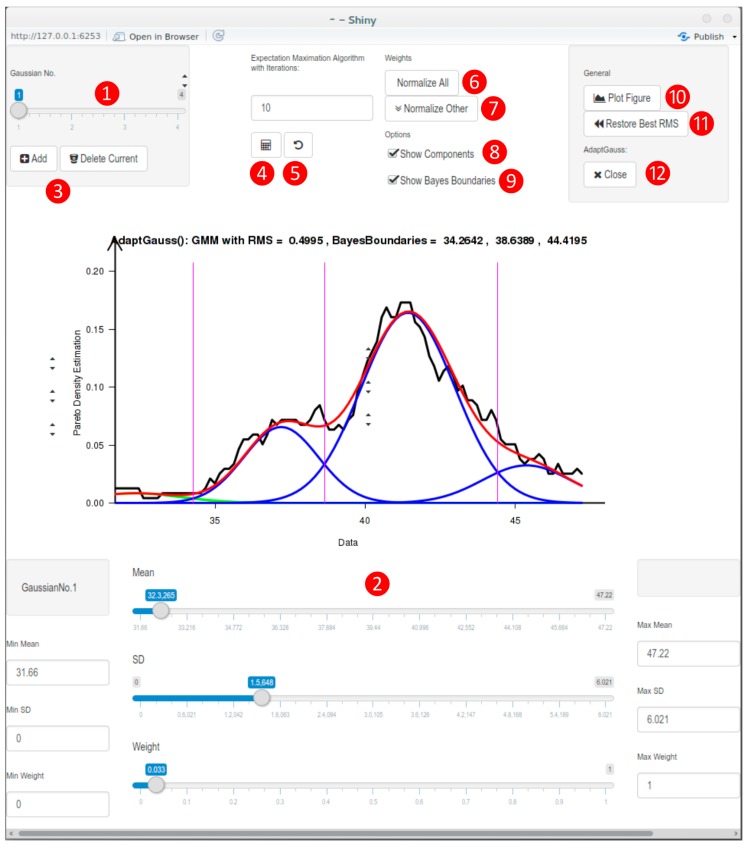
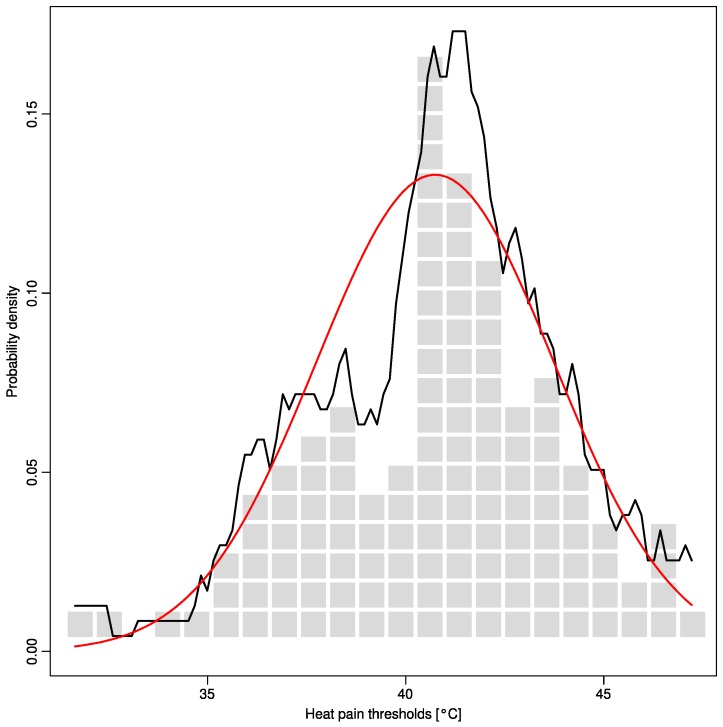
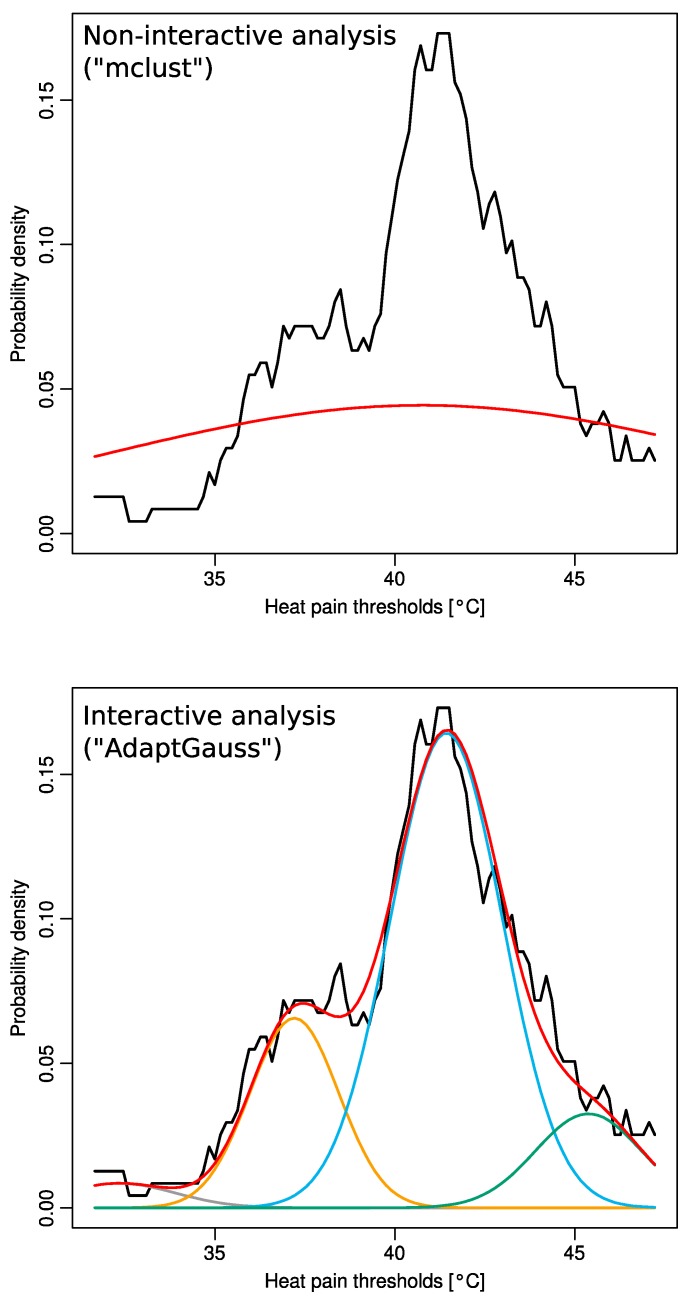
Biomedical data obtained during cell experiments, laboratory animal research, or human studies often display a complex distribution. Statistical identification of subgroups in research data poses an analytical challenge. Here were introduce an interactive R-based bioinformatics tool, called "AdaptGauss". It enables a valid identification of a biologically-meaningful multimodal structure in the data by fitting a Gaussian mixture model (GMM) to the data. The interface allows a supervised selection of the number of subgroups. This enables the expectation maximization (EM) algorithm to adapt more complex GMM than usually observed with a noninteractive approach. Interactively fitting a GMM to heat pain threshold data acquired from human volunteers revealed a distribution pattern with four Gaussian modes located at temperatures of 32.3, 37.2, 41.4, and 45.4 °C. Noninteractive fitting was unable to identify a meaningful data structure. Obtained results are compatible with known activity temperatures of different TRP ion channels suggesting the mechanistic contribution of different heat sensors to the perception of thermal pain. Thus, sophisticated analysis of the modal structure of biomedical data provides a basis for the mechanistic interpretation of the observations. As it may reflect the involvement of different TRP thermosensory ion channels, the analysis provides a starting point for hypothesis-driven laboratory experiments.
在细胞实验、实验动物研究或人体研究中获得的生物医学数据通常呈现出复杂的分布。研究数据中亚组的统计识别带来了分析挑战。在此,我们介绍一种基于R的交互式生物信息学工具,名为“AdaptGauss”。它通过对数据拟合高斯混合模型(GMM),能够有效地识别数据中具有生物学意义的多峰结构。该界面允许对亚组数量进行有监督的选择。这使得期望最大化(EM)算法能够拟合比非交互式方法通常观察到的更复杂的GMM。对从人类志愿者获取的热痛阈值数据进行交互式拟合GMM,揭示了一种分布模式,其中四个高斯模式分别位于32.3、37.2、41.4和45.4°C的温度处。非交互式拟合无法识别有意义的数据结构。获得的结果与不同TRP离子通道的已知活性温度相符,这表明不同热传感器对热痛感知的机制贡献。因此,对生物医学数据模态结构的精细分析为观察结果的机理解释提供了基础。由于它可能反映了不同TRP热感觉离子通道的参与,该分析为假设驱动的实验室实验提供了一个起点。