Lötsch Jörn, Dimova Violeta, Lieb Isabel, Zimmermann Michael, Oertel Bruno G, Ultsch Alfred
Institute of Clinical Pharmacology, Goethe-University, Theodor-Stern-Kai 7, 60590, Frankfurt am Main, Germany; Fraunhofer Institute for Molecular Biology and Applied Ecology IME, Project Group Translational Medicine and Pharmacology TMP, Theodor-Stern-Kai 7, 60596, Frankfurt am Main, Germany.
Institute of Clinical Pharmacology, Goethe-University, Theodor-Stern-Kai 7, 60590, Frankfurt am Main, Germany; Department of Anesthesiology, Intensive Care Medicine and Pain Therapy, University Hospital Frankfurt, Theodor-Stern-Kai 7, 60590, Frankfurt am Main, Germany.
PLoS One. 2015 May 20;10(5):e0125822. doi: 10.1371/journal.pone.0125822. eCollection 2015.
It is assumed that different pain phenotypes are based on varying molecular pathomechanisms. Distinct ion channels seem to be associated with the perception of cold pain, in particular TRPM8 and TRPA1 have been highlighted previously. The present study analyzed the distribution of cold pain thresholds with focus at describing the multimodality based on the hypothesis that it reflects a contribution of distinct ion channels.
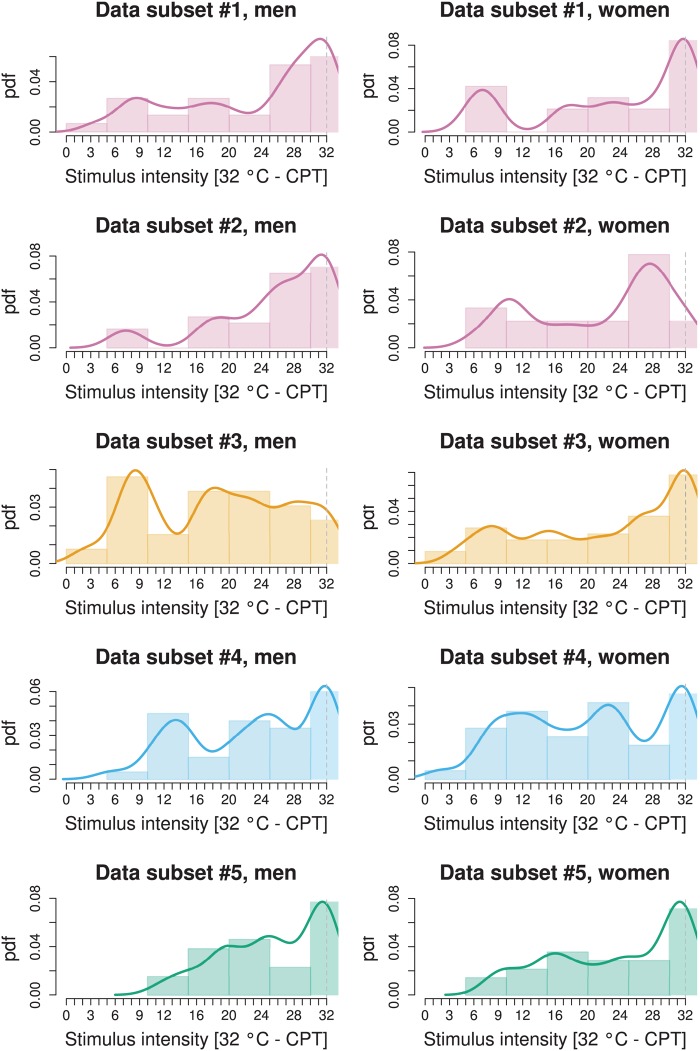
Cold pain thresholds (CPT) were available from 329 healthy volunteers (aged 18 - 37 years; 159 men) enrolled in previous studies. The distribution of the pooled and log-transformed threshold data was described using a kernel density estimation (Pareto Density Estimation (PDE)) and subsequently, the log data was modeled as a mixture of Gaussian distributions using the expectation maximization (EM) algorithm to optimize the fit.
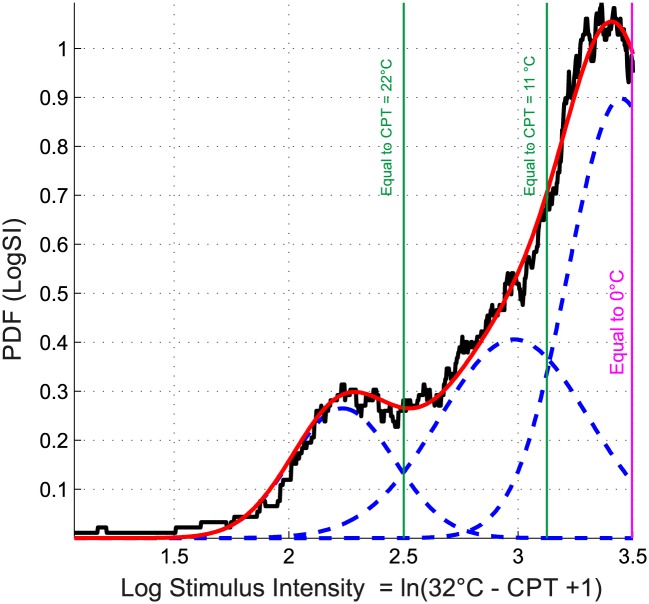
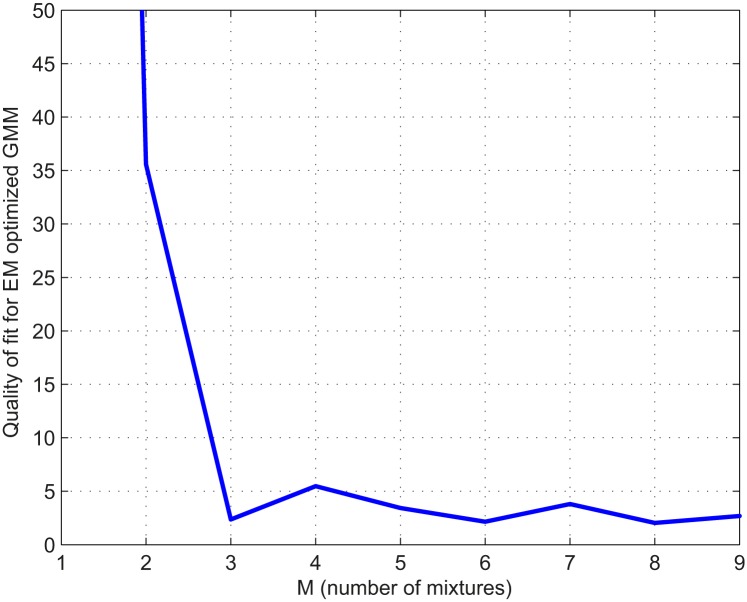
CPTs were clearly multi-modally distributed. Fitting a Gaussian Mixture Model (GMM) to the log-transformed threshold data revealed that the best fit is obtained when applying a three-model distribution pattern. The modes of the identified three Gaussian distributions, retransformed from the log domain to the mean stimulation temperatures at which the subjects had indicated pain thresholds, were obtained at 23.7 °C, 13.2 °C and 1.5 °C for Gaussian #1, #2 and #3, respectively.
The localization of the first and second Gaussians was interpreted as reflecting the contribution of two different cold sensors. From the calculated localization of the modes of the first two Gaussians, the hypothesis of an involvement of TRPM8, sensing temperatures from 25 - 24 °C, and TRPA1, sensing cold from 17 °C can be derived. In that case, subjects belonging to either Gaussian would possess a dominance of the one or the other receptor at the skin area where the cold stimuli had been applied. The findings therefore support a suitability of complex analytical approaches to detect mechanistically determined patterns from pain phenotype data.
假定不同的疼痛表型基于不同的分子发病机制。不同的离子通道似乎与冷痛觉相关,尤其是瞬时受体电位阳离子通道M8(TRPM8)和瞬时受体电位阳离子通道A1(TRPA1)此前已受到关注。本研究分析了冷痛阈值的分布,重点是基于它反映不同离子通道作用的假设来描述多模态情况。
冷痛阈值(CPT)数据来自之前研究中纳入的329名健康志愿者(年龄18 - 37岁;159名男性)。使用核密度估计(帕累托密度估计(PDE))描述汇总并经对数转换的阈值数据的分布,随后,使用期望最大化(EM)算法将对数数据建模为高斯分布的混合模型以优化拟合。
CPT呈明显的多模态分布。对经对数转换的阈值数据拟合高斯混合模型(GMM)表明,应用三模型分布模式时拟合效果最佳。从对数域重新转换为受试者表示疼痛阈值时的平均刺激温度后,所确定 的三个高斯分布的众数分别为高斯#1的23.7℃、高斯#2的13.2℃和高斯#3的1.5℃。
第一个和第二个高斯分布的定位被解释为反映了两种不同冷感受器的作用。根据前两个高斯分布众数的计算定位,可以得出瞬时受体电位阳离子通道M8(感知25 - 24℃温度)和瞬时受体电位阳离子通道A1(感知17℃寒冷)参与其中的假设。在这种情况下,属于任一高斯分布的受试者在施加冷刺激的皮肤区域会具有一种或另一种受体的优势。因此,这些发现支持了采用复杂分析方法从疼痛表型数据中检测机械决定模式的适用性。