Huttinger Alexandra, Dreibelbis Robert, Roha Kristin, Ngabo Fidel, Kayigamba Felix, Mfura Leodomir, Moe Christine
The Center for Global Safe Water, Sanitation and Hygiene at Emory University, 1518 Clifton Rd. NE, Atlanta, GA 30324, USA.
School of Civil Engineering and Environmental Science, The University of Oklahoma, 455 West Lindsey, Dale Hall Tower 521, Norman, OK 73019, USA.
Int J Environ Res Public Health. 2015 Oct 27;12(10):13602-23. doi: 10.3390/ijerph121013602.
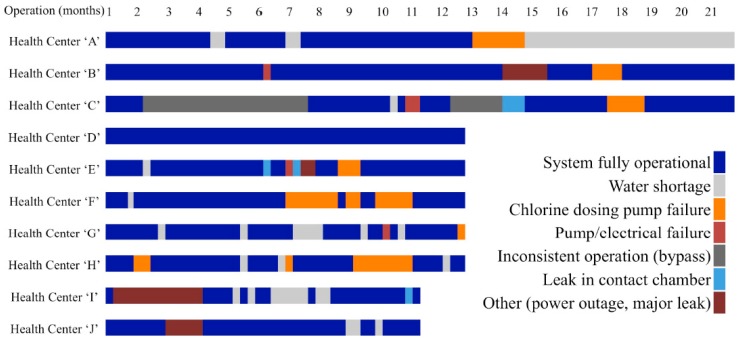
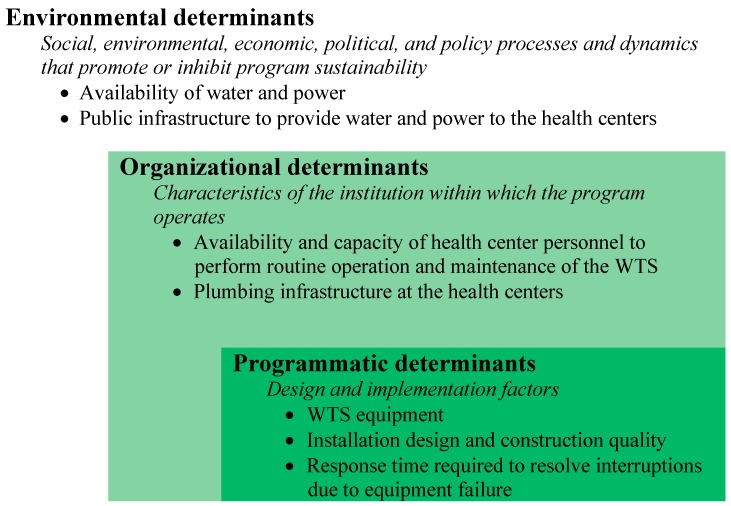
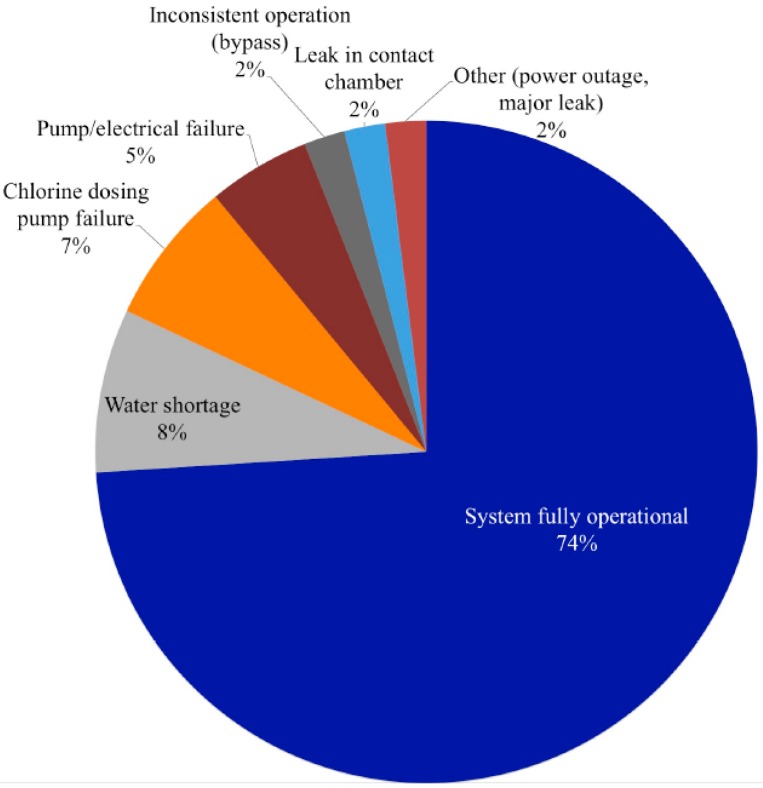
There is a critical need for safe water in healthcare facilities (HCF) in low-income countries. HCF rely on water supplies that may require additional on-site treatment, and need sustainable technologies that can deliver sufficient quantities of water. Water treatment systems (WTS) that utilize ultrafiltration membranes for water treatment can be a useful technology in low-income countries, but studies have not systematically examined the feasibility of this technology in low-income settings. We monitored 22 months of operation of 10 WTS, including pre-filtration, membrane ultrafiltration, and chlorine residual disinfection that were donated to and operated by rural HCF in Rwanda. The systems were fully operational for 74% of the observation period. The most frequent reasons for interruption were water shortage (8%) and failure of the chlorination mechanism (7%). When systems were operational, 98% of water samples collected from the HCF taps met World Health Organization (WHO) guidelines for microbiological water quality. Water quality deteriorated during treatment interruptions and when water was stored in containers. Sustained performance of the systems depended primarily on organizational factors: the ability of the HCF technician to perform routine servicing and repairs, and environmental factors: water and power availability and procurement of materials, including chlorine and replacement parts in Rwanda.
低收入国家的医疗保健机构(HCF)对安全用水有着迫切需求。HCF依赖的供水系统可能需要额外的现场处理,并且需要能够提供足够水量的可持续技术。利用超滤膜进行水处理的水处理系统(WTS)在低收入国家可能是一项有用的技术,但此前的研究尚未系统地考察该技术在低收入环境中的可行性。我们监测了10套WTS长达22个月的运行情况,这些系统包括预过滤、膜超滤和余氯消毒,由卢旺达农村的HCF接收并运行。在观察期内,这些系统有74%的时间能完全正常运行。最常见的中断原因是缺水(8%)和氯化机制故障(7%)。当系统正常运行时,从HCF水龙头采集的98%的水样符合世界卫生组织(WHO)的微生物水质指南。在处理中断期间以及水储存在容器中时,水质会恶化。系统的持续运行主要取决于组织因素,即HCF技术人员进行日常维护和修理的能力,以及环境因素,即卢旺达的水、电力供应情况以及包括氯和替换部件在内的材料采购情况。