Gärtner Nicola, Germann Laura, Wanyama Kennedy, Ouma Henry, Meierhofer Regula
Eawag, Swiss Federal Institute of Aquatic Science and Technology, Überlandstrasse 133, 8600, Dübendorf, Switzerland.
Africa Water Solutions, P.O Box 23699, Kampala, Uganda.
Water Res X. 2020 Dec 5;10:100079. doi: 10.1016/j.wroa.2020.100079. eCollection 2021 Jan 1.
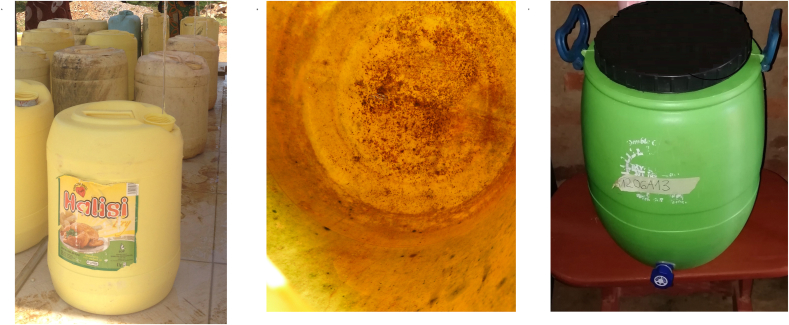
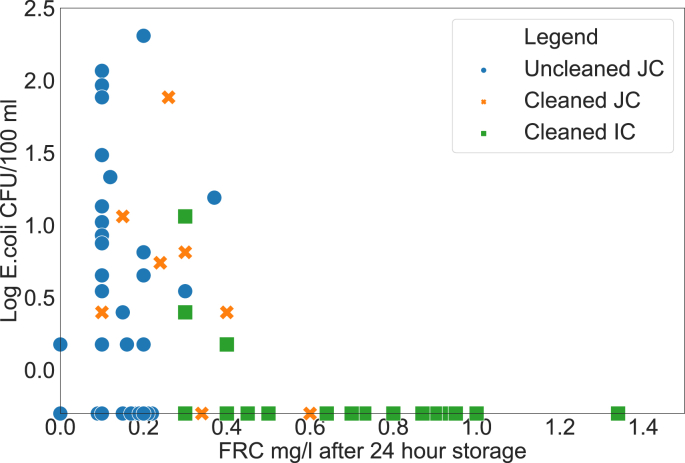
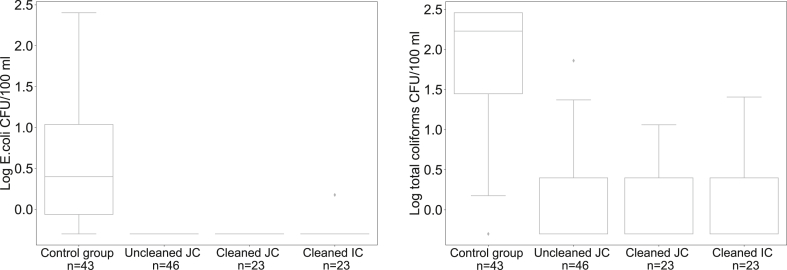
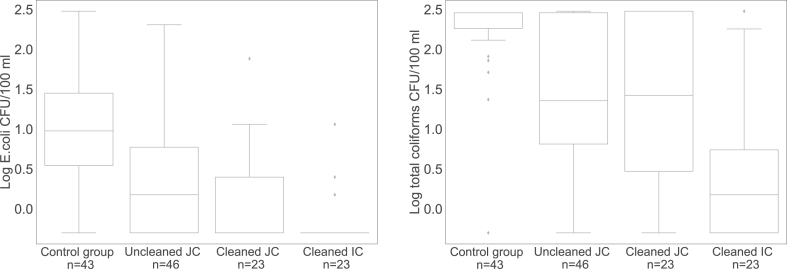
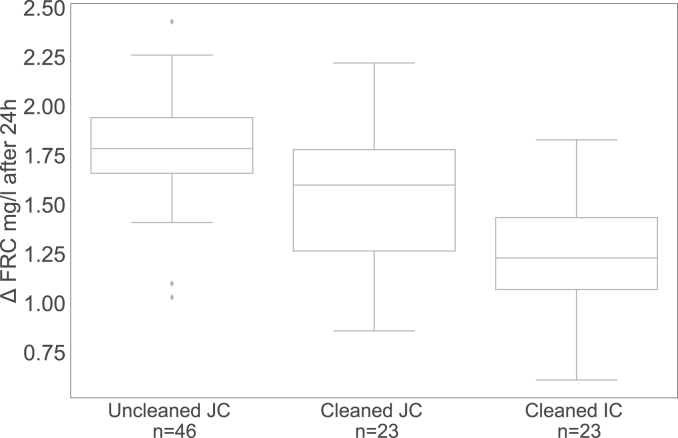
Drinking water is frequently recontaminated during transport and storage when water is poured into jerrycans. To address this issue, three strategies aiming at reducing these recontamination risks were implemented at water kiosks in Eastern Uganda. In all three strategies, water at the kiosks was chlorinated to a free residual chlorine (FRC) concentration of 2 mg/L at the tap of the kiosk. In addition, water was collected in different containers for drinking water transport: a) uncleaned jerrycans, b) cleaned jerrycans, and c) cleaned improved containers with a wide mouth and a spigot. Water quality in the containers was compared to that of a control group collecting unchlorinated water in uncleaned jerrycans. Water samples were collected at the tap of the kiosk, from the containers of 135 households after they were filled at the tap, and from the same containers in the households after 24 h of water storage. The samples were analysed for counts of , total coliforms, and FRC. Household interviews and structured observations were conducted to identify confounding variables and to assess the influence of water, sanitation, and hygiene infrastructure and practices on recontamination. All three intervention strategies contributed to significantly lower recontamination levels after 24 h than in the control group (Median (Mdn) = 9 CFU/100 mL, Interquartile Range (IQR) = 25). Median counts and mean FRC consumption were higher in uncleaned jerrycans (Median = 1 CFU/100 mL, IQR = 6, ΔFRC = 1.8 mg/L) than in cleaned jerrycans (Median = 0 CFU/100 mL IQR = 2, ΔFRC = 1.6 mg/L) and the lowest in cleaned improved containers (Median = 0 CFU/100 mL, IQR = 0, ΔFRC = 1.2 mg/L). The FRC concentration at the tap of 2 mg/L was too low to protect water from recontamination in uncleaned jerrycans over 24 h. Cleaning the jerrycans was inconvenient due to their small openings, therefore, sand was used. The cleaning with sand reduced recontamination with . but did not reduce the count of total coliforms. Improved containers with a larger opening allowed for cleaning with a brush and showed the lowest levels of recontamination for both and total coliforms. In addition to the intervention strategies, households receiving a higher number of WASH education visits within the previous year had lower recontamination levels of in stored water (OR = 0.54, = 0.003).
当水被倒入油桶时,饮用水在运输和储存过程中经常会再次受到污染。为了解决这个问题,乌干达东部的水站实施了三种旨在降低这些再污染风险的策略。在所有这三种策略中,水站的水在水站水龙头处被氯化至自由余氯(FRC)浓度为2毫克/升。此外,水被收集在不同的容器中用于饮用水运输:a)未清洗的油桶,b)清洗过的油桶,以及c)带有宽口和水龙头的清洗过的改良容器。将容器中的水质与在未清洗的油桶中收集未氯化水的对照组进行比较。在水站水龙头处、135户家庭在水龙头处装满水后从其容器中以及在家庭中储存24小时后的同一容器中采集水样。对水样进行了 计数、总大肠菌群和FRC分析。进行了家庭访谈和结构化观察,以确定混杂变量,并评估水、环境卫生和个人卫生基础设施及做法对再污染的影响。所有三种干预策略在24小时后导致的再污染水平均显著低于对照组(中位数(Mdn)=9 CFU/100毫升,四分位间距(IQR)=25)。未清洗的油桶中的 中位数计数和平均FRC消耗量(中位数=1 CFU/100毫升,IQR=6,ΔFRC=1.8毫克/升)高于清洗过的油桶(中位数=0 CFU/100毫升,IQR=2,ΔFRC=1.6毫克/升),而在清洗过的改良容器中最低(中位数=0 CFU/100毫升,IQR=0,ΔFRC=1.2毫克/升)。水龙头处2毫克/升的FRC浓度过低,无法在24小时内保护水免受未清洗油桶中的 再污染。由于油桶开口小,清洗不方便,因此使用了沙子。用沙子清洗减少了 的再污染,但没有减少总大肠菌群的计数。开口较大的改良容器允许用刷子清洗,并且对于 和总大肠菌群都显示出最低的再污染水平。除了干预策略外,上一年接受更多水、环境卫生和个人卫生教育访问的家庭,其储存水中的 再污染水平较低(比值比(OR)=0.54, =0.003)。