Ferrer Ana, Sebastián Rafael, Sánchez-Quintana Damián, Rodríguez José F, Godoy Eduardo J, Martínez Laura, Saiz Javier
Centro de Investigación e Innovación en Bioingeniería (Ci2B), Universitat Politècnica de València, Valencia, Spain.
Computational Multiscale Physiology Lab (CoMMLab), Department of Computer Science, Universitat de Valencia, Valencia, Spain.
PLoS One. 2015 Nov 2;10(11):e0141573. doi: 10.1371/journal.pone.0141573. eCollection 2015.
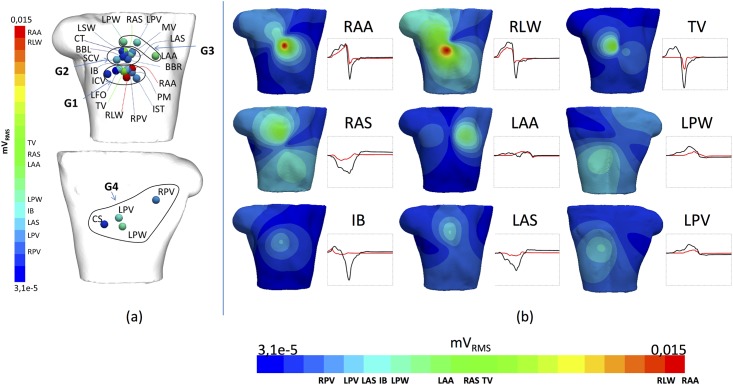
Atrial arrhythmias, and specifically atrial fibrillation (AF), induce rapid and irregular activation patterns that appear on the torso surface as abnormal P-waves in electrocardiograms and body surface potential maps (BSPM). In recent years both P-waves and the BSPM have been used to identify the mechanisms underlying AF, such as localizing ectopic foci or high-frequency rotors. However, the relationship between the activation of the different areas of the atria and the characteristics of the BSPM and P-wave signals are still far from being completely understood. In this work we developed a multi-scale framework, which combines a highly-detailed 3D atrial model and a torso model to study the relationship between atrial activation and surface signals in sinus rhythm. Using this multi scale model, it was revealed that the best places for recording P-waves are the frontal upper right and the frontal and rear left quadrants of the torso. Our results also suggest that only nine regions (of the twenty-one structures in which the atrial surface was divided) make a significant contribution to the BSPM and determine the main P-wave characteristics.
房性心律失常,尤其是心房颤动(AF),会引发快速且不规则的激活模式,这些模式在躯干表面表现为心电图和体表电位图(BSPM)中的异常P波。近年来,P波和BSPM都已被用于识别房颤背后的机制,比如定位异位灶或高频转子。然而,心房不同区域的激活与BSPM及P波信号特征之间的关系仍远未被完全理解。在这项工作中,我们开发了一个多尺度框架,它结合了一个高度详细的三维心房模型和一个躯干模型,以研究窦性心律下心房激活与表面信号之间的关系。使用这个多尺度模型发现,记录P波的最佳位置是躯干的右上前方以及左前和左后象限。我们的结果还表明,(在心房表面被划分成的21个结构中)只有9个区域对BSPM有显著贡献并决定了主要的P波特征。