Bilodeau Marie-Claude, Roosink Meyke, Mercier Catherine
Centre Interdisciplinaire de Recherche en Réadaptation et Intégration Sociale (CIRRIS), Quebec, QC, Canada.
Department of Rehabilitation, Faculty of Medicine, Laval University, Quebec, QC, Canada.
Exp Brain Res. 2016 Feb;234(2):475-82. doi: 10.1007/s00221-015-4478-3. Epub 2015 Nov 2.
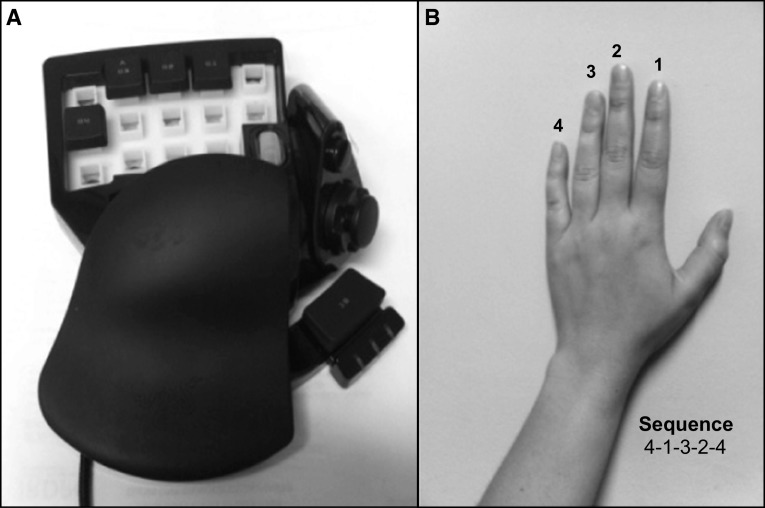
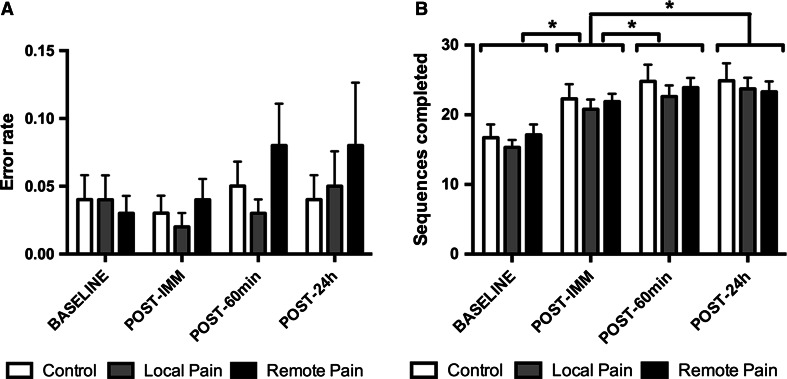
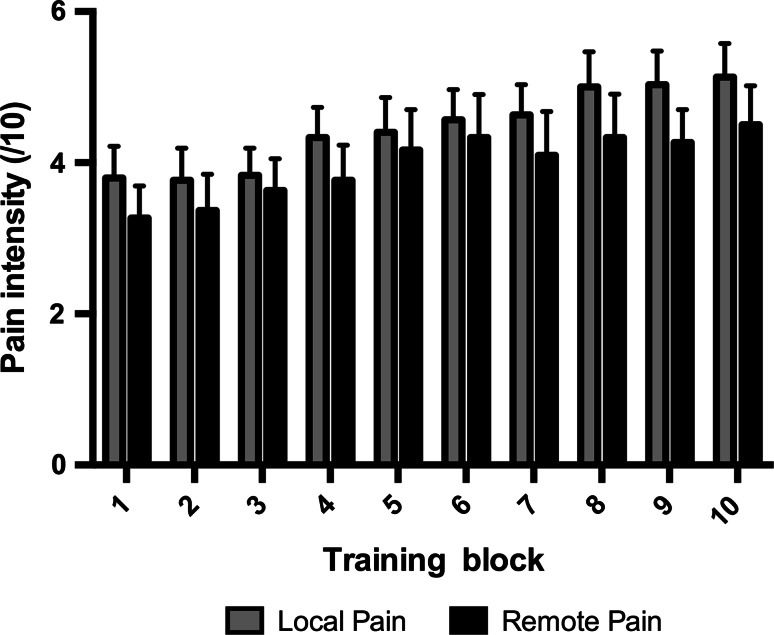
Although pain is present in a large proportion of patients receiving rehabilitation, its impact on motor learning is still unclear, especially in the case of neuropathic pain that is not tightly linked to specific movements. The aim of this study was to determine the effect of local and remote tonic cutaneous heat pain applied during training on motor learning of a finger-tapping sequence task. Forty-five healthy participants, randomized to the control, local pain or remote pain groups, were trained to perform an explicit finger motor sequence of five items as fast as possible. During the 10 training blocks (30 s each), local pain and remote pain groups received a heat pain stimulus on the wrist or leg, respectively. Performance was tested in the absence of pain in all groups before (baseline), immediately after (post-immediate), 60 min after (post-60 min) and 24 h after training (post-24 h) to assess both acquisition and next-day retention. Speed increased over time from baseline to post-24 h (p < 0.001), without any significant effect of group (p = 0.804) or time × group interaction (p = 0.385), indicating that the acquisition and retention were not affected by the presence of pain during training. No changes were observed on error rates, which were very low even at baseline. These results with experimental heat pain suggest that the ability to relearn finger sequence should not be affected by concomitant neuropathic pain in neurorehabilitation. However, these results need to be validated in the context of chronic pain, by including pain as a co-variable in motor rehabilitation trials.
尽管在接受康复治疗的患者中,很大一部分人存在疼痛,但疼痛对运动学习的影响仍不明确,尤其是在与特定运动没有紧密联系的神经性疼痛的情况下。本研究的目的是确定训练期间施加的局部和远程持续性皮肤热痛对手指敲击序列任务运动学习的影响。45名健康参与者被随机分为对照组、局部疼痛组或远程疼痛组,他们接受训练,尽可能快地执行一个由五个动作组成的明确手指运动序列。在10个训练时段(每个时段30秒)内,局部疼痛组和远程疼痛组分别在手腕或腿部接受热痛刺激。在训练前(基线)、训练后立即(即时后)、训练后60分钟(60分钟后)和训练后24小时(24小时后),所有组在无疼痛的情况下进行测试,以评估学习和次日的记忆情况。从基线到24小时后,速度随时间增加(p < 0.001),组间无显著影响(p = 0.804),时间×组间交互作用也无显著影响(p = 0.385),这表明学习和记忆不受训练期间疼痛的影响。错误率没有变化,即使在基线时错误率也很低。这些关于实验性热痛的结果表明,在神经康复中,重新学习手指序列的能力不应受到伴随的神经性疼痛的影响。然而,这些结果需要在慢性疼痛的背景下进行验证,即将疼痛作为运动康复试验中的一个协变量纳入研究。