Kondej Dorota, Sosnowski Tomasz R
Central Institute for Labour Protection-National Research Institute, Czerniakowska 16, 00-701, Warsaw, Poland.
Faculty of Chemical and Process Engineering, Warsaw University of Technology, Warynskiego 1, 00-645, Warsaw, Poland.
Environ Sci Pollut Res Int. 2016 Mar;23(5):4660-9. doi: 10.1007/s11356-015-5610-4. Epub 2015 Nov 3.
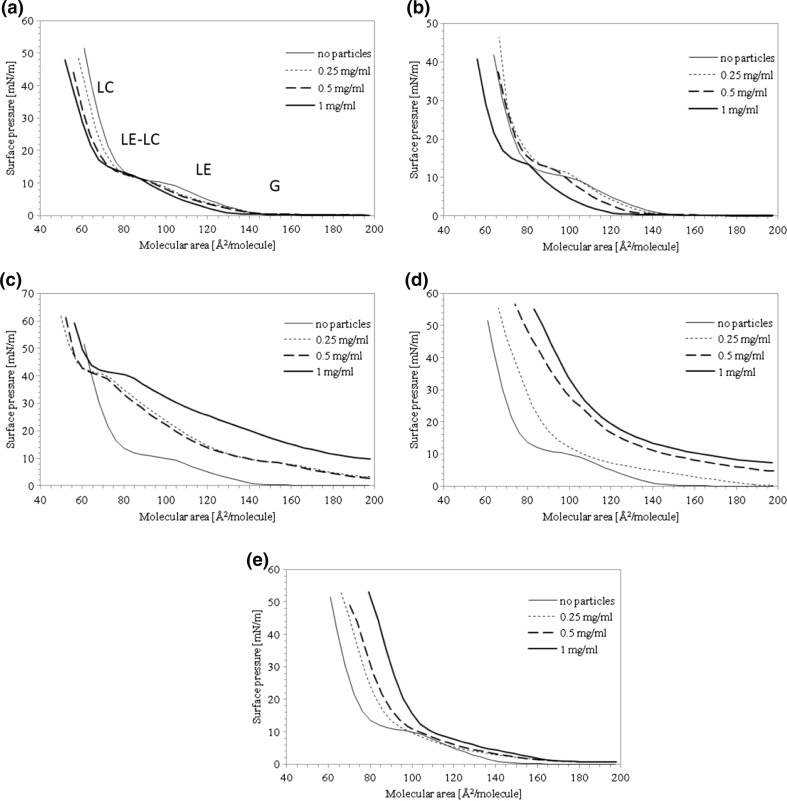
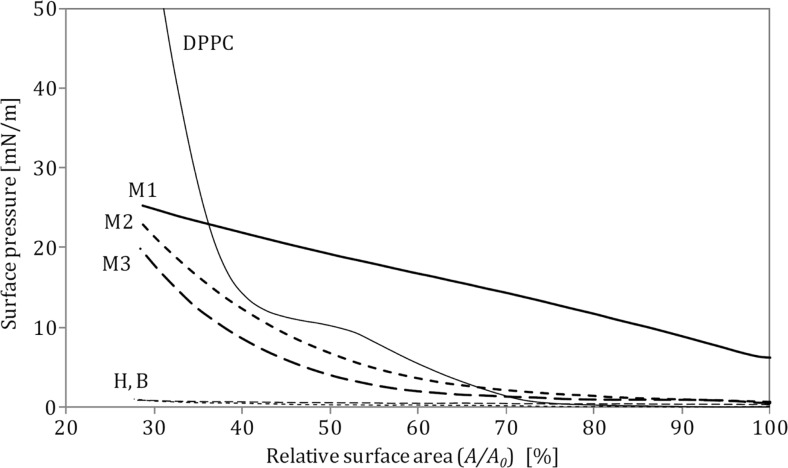
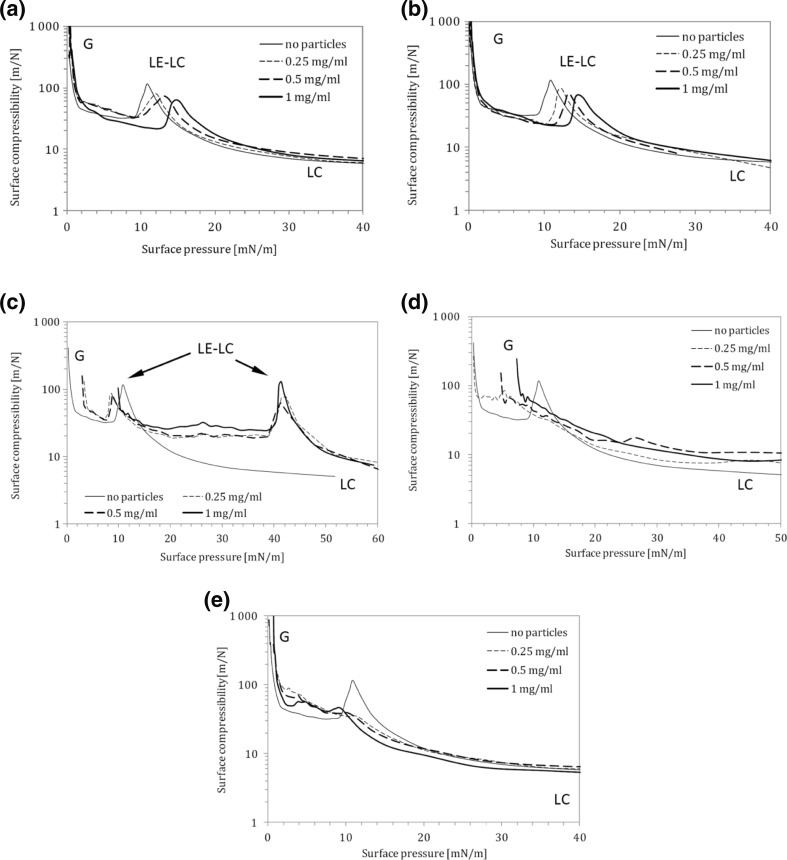
This work investigates influence of different aluminosillicate nanoparticles (NPs) which are found in air in selected workplaces on the properties of the phospholipid (DPPC) monolayer at air-saline interface considered as ex vivo model of the lung surfactant (LS). The measurements were done under physiological-like conditions (deformable liquid interface at 37 °C) for NP concentrations matching the calculated lung doses after exposure in the working environment. Measured surface pressure-area (π-A) isotherms and compressibility curves demonstrated NP-induced changes in the structure and mechanical properties of the lipid monolayer. It was shown that hydrophilic nanomaterials (halloysite and bentonite) induced concentration-dependent impairment of DPPC's ability of attaining high surface pressures on interfacial compression, suggesting a possibility of reduction of physiological function of natural LS. Hydrophobic montmorillonites affected DPPC monolayer in the opposite way; however, they significantly changed the mechanical properties of the air-liquid interface during compression. The results support the hypothesis of possible reduction or even degradation of the natural function of the lung surfactant induced by particle-phospholipid interactions after inhalation of nanoclays. Presented data do not only supplement the earlier results obtained with another LS model (animal-derived surfactant in oscillating bubble experiments) but also offer an explanation of physicochemical mechanisms responsible for detrimental effects which arise after deposition of inhaled nanomaterials on the surface of the respiratory system.
本研究调查了特定工作场所空气中存在的不同铝硅酸盐纳米颗粒(NPs)对磷脂(DPPC)单分子层在气-盐界面处性质的影响,该界面被视为肺表面活性剂(LS)的体外模型。测量是在类似生理条件下(37°C的可变形液体界面)进行的,NP浓度与工作环境暴露后计算出的肺部剂量相匹配。测得的表面压力-面积(π-A)等温线和压缩性曲线表明NP引起了脂质单分子层结构和力学性能的变化。结果表明,亲水性纳米材料(埃洛石和膨润土)在界面压缩时会导致DPPC达到高表面压力的能力出现浓度依赖性损伤,这表明天然LS的生理功能可能会降低。疏水性蒙脱石对DPPC单分子层的影响则相反;然而,它们在压缩过程中显著改变了气液界面的力学性能。这些结果支持了吸入纳米粘土后颗粒-磷脂相互作用可能导致肺表面活性剂天然功能降低甚至退化的假设。所呈现的数据不仅补充了早期使用另一种LS模型(振荡气泡实验中动物来源的表面活性剂)获得的结果,还解释了吸入纳米材料沉积在呼吸系统表面后产生有害影响的物理化学机制。