• 文献检索
  • 文档翻译
  • 深度研究
  • 学术资讯
  • Suppr Zotero 插件Zotero 插件
  • 邀请有礼
  • 套餐&价格
  • 历史记录
应用&插件
Suppr Zotero 插件Zotero 插件浏览器插件Mac 客户端Windows 客户端微信小程序
定价
高级版会员购买积分包购买API积分包
服务
文献检索文档翻译深度研究API 文档MCP 服务
关于我们
关于 Suppr公司介绍联系我们用户协议隐私条款
关注我们

Suppr 超能文献

核心技术专利:CN118964589B侵权必究
粤ICP备2023148730 号-1Suppr @ 2026

文献检索

告别复杂PubMed语法,用中文像聊天一样搜索,搜遍4000万医学文献。AI智能推荐,让科研检索更轻松。

立即免费搜索

文件翻译

保留排版,准确专业,支持PDF/Word/PPT等文件格式,支持 12+语言互译。

免费翻译文档

深度研究

AI帮你快速写综述,25分钟生成高质量综述,智能提取关键信息,辅助科研写作。

立即免费体验

印度儿童社区获得性肺炎的病因:前瞻性队列研究。

Etiology of community acquired pneumonia among children in India: prospective, cohort study.

作者信息

Mathew Joseph L, Singhi Sunit, Ray Pallab, Hagel Eva, Saghafian-Hedengren Shanie, Bansal Arun, Ygberg Sofia, Sodhi Kushaljit Singh, Kumar B V Ravi, Nilsson Anna

机构信息

Department of Pediatrics, PGIMER, Chandigarh, India.

Department of Medical Microbiology, PGIMER, Chandigarh, India.

出版信息

J Glob Health. 2015 Dec;5(2):050418. doi: 10.7189/jogh.05.020418.

DOI:10.7189/jogh.05.020418
PMID:26528392
原文链接:https://pmc.ncbi.nlm.nih.gov/articles/PMC4623579/
Abstract

BACKGROUND

Childhood community acquired pneumonia (CAP) is a significant problem in developing countries, and confirmation of microbial etiology is important for individual, as well as public health. However, there is paucity of data from a large cohort, examining multiple biological specimens for diverse pathogens (bacteria and viruses). The Community Acquired Pneumonia Etiology Study (CAPES) was designed to address this knowledge gap.

METHODS

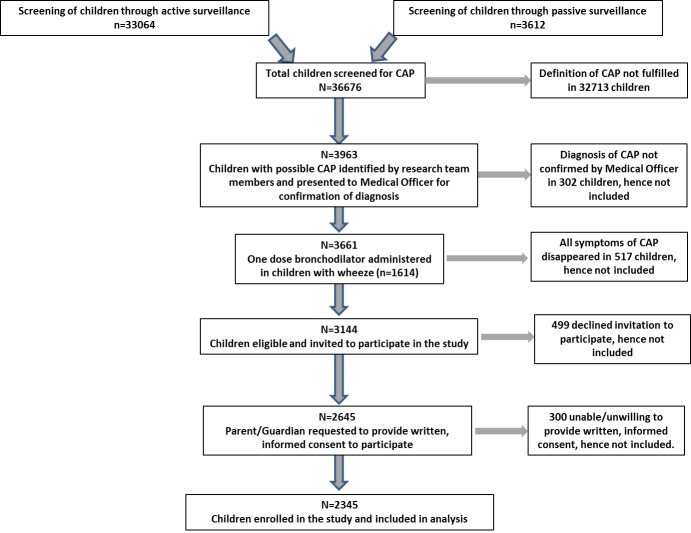
We enrolled children with CAP (based on WHO IMCI criteria of tachypnea with cough or breathing difficulty) over 24 consecutive months, and recorded presenting symptoms, risk factors, clinical signs, and chest radiography. We performed blood and nasopharyngeal aspirate (NPA) bacterial cultures, and serology (Mycoplasma pneumoniae, Chlamydophila pneumoniae). We also performed multiplex PCR for 25 bacterial/viral species in a subgroup representing 20% of the cohort. Children requiring endotracheal intubation underwent culture and PCR of bronchoalveolar lavage (BAL) specimens.

FINDINGS

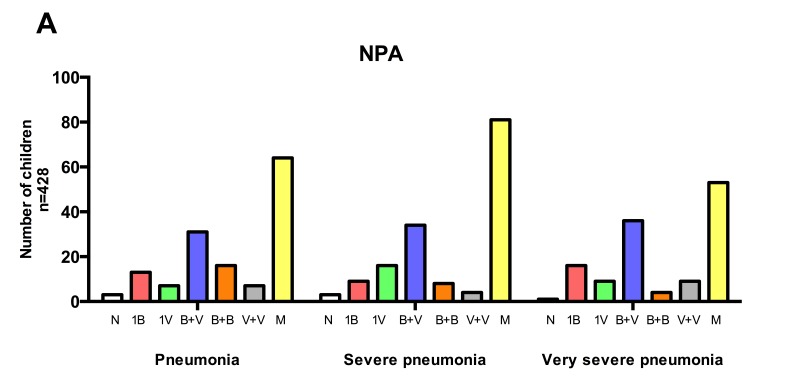
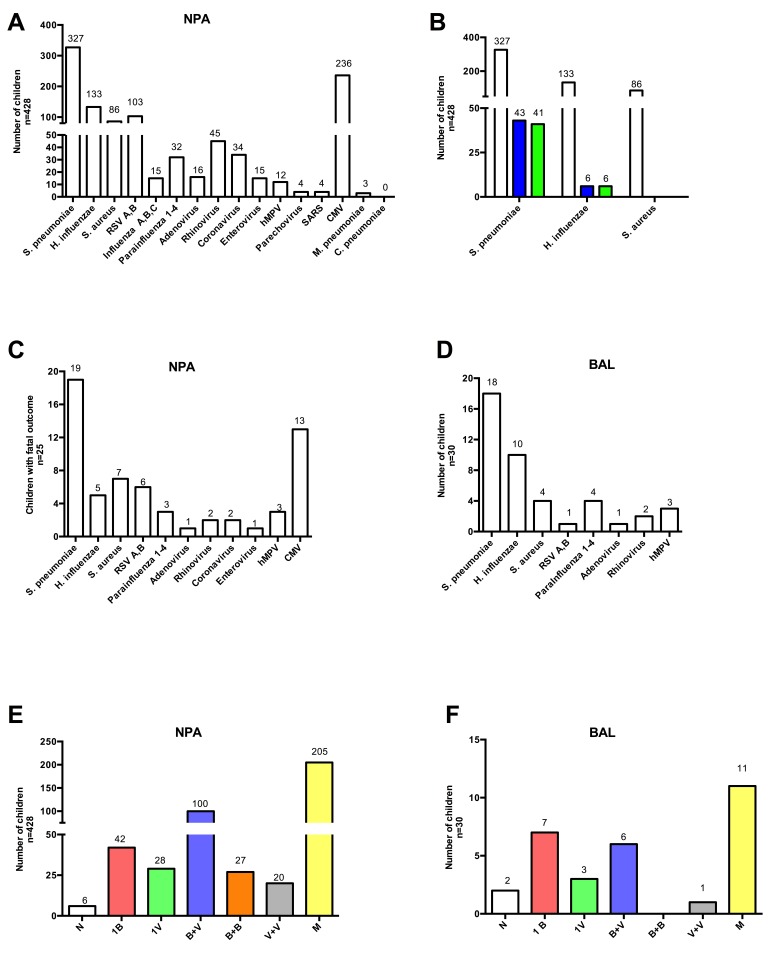
We enrolled 2345 children. NPA and blood cultures yielded bacteria in only 322 (13.7%) and 49 (2.1%) children respectively. In NPA, Streptococcus pneumoniae (79.1%) predominated, followed by Haemophilus influenzae (9.6%) and Staphylococcus aureus (6.8%). In blood, S. aureus (30.6%) dominated, followed by S. pneumoniae (20.4%) and Klebsiella pneumoniae (12.2%). M. pneumoniae and C. pneumoniae serology were positive in 4.3% and 1.1% respectively. Multiplex PCR in 428 NPA specimens identified organisms in 422 (98.6%); of these 352 (82.2%) had multiple organisms and only 70 (16.4%) had a single organism viz. S. pneumoniae: 35 (50%), Cytomegalovirus (CMV): 13 (18.6%), Respiratory Syncytial Virus (RSV): 9 (12.9%), other viruses: 6 (8.7%), S. aureus: 5 (7.1%), and H. influenzae: 2 (2.9%). BAL PCR (n = 30) identified single pathogens in 10 (S. pneumoniae-3, CMV-3, S. aureus-2, H. influenzae-2) and multiple pathogens in 18 children. There were 108 (4.6%) deaths. The pattern of pathogens identified did not correlate with pneumonia severity or mortality.

CONCLUSIONS

The majority of children with CAP have multiple pathogens (bacteria and viruses). S. pneumoniae and S. aureus predominate in NPA and blood respectively. CMV and RSV were the dominant respiratory viruses in NPA and BAL. The presence of multiple pathogens, especially organisms associated with nasopharyngeal carriage, precludes confirmation of a causal relationship in most cases.

摘要

背景

儿童社区获得性肺炎(CAP)在发展中国家是一个重大问题,微生物病因的确诊对个体健康以及公共卫生都很重要。然而,来自大型队列研究、针对多种病原体(细菌和病毒)检测多个生物标本的数据匮乏。社区获得性肺炎病因学研究(CAPES)旨在填补这一知识空白。

方法

我们连续24个月纳入符合CAP标准(基于世界卫生组织IMCI标准,即呼吸急促伴咳嗽或呼吸困难)的儿童,记录其就诊症状、危险因素、临床体征及胸部X线检查结果。我们进行了血液和鼻咽抽吸物(NPA)细菌培养以及血清学检测(肺炎支原体、肺炎衣原体)。我们还对占队列20%的一个亚组中的25种细菌/病毒进行了多重PCR检测。需要气管插管的儿童接受支气管肺泡灌洗(BAL)标本培养和PCR检测。

结果

我们共纳入2345名儿童。NPA和血液培养分别仅在322名(13.7%)和49名(2.1%)儿童中培养出细菌。在NPA中,肺炎链球菌(79.1%)占主导,其次是流感嗜血杆菌(9.6%)和金黄色葡萄球菌(6.8%)。在血液中,金黄色葡萄球菌(30.6%)占主导,其次是肺炎链球菌(20.4%)和肺炎克雷伯菌(12.2%)。肺炎支原体和肺炎衣原体血清学检测阳性率分别为4.3%和1.1%。对428份NPA标本进行的多重PCR检测在422份(98.6%)标本中鉴定出病原体;其中352份(82.2%)有多种病原体,仅70份(16.4%)有单一病原体,即肺炎链球菌:35份(50%)、巨细胞病毒(CMV):13份(18.6%)、呼吸道合胞病毒(RSV):9份(12.9%)、其他病毒:6份(8.7%)、金黄色葡萄球菌:5份(7.1%)、流感嗜血杆菌:2份(2.9%)。BAL PCR(n = 30)在10名儿童中鉴定出单一病原体(肺炎链球菌 - 3例、CMV - 3例、金黄色葡萄球菌 - 2例、流感嗜血杆菌 - 2例),在18名儿童中鉴定出多种病原体。共有108例(4.6%)死亡。所鉴定的病原体模式与肺炎严重程度或死亡率无关。

结论

大多数CAP儿童有多种病原体(细菌和病毒)。肺炎链球菌和金黄色葡萄球菌分别在NPA和血液中占主导。CMV和RSV是NPA和BAL中主要的呼吸道病毒。多种病原体的存在,尤其是与鼻咽部携带相关的病原体,使得在大多数情况下难以确定因果关系。
https://cdn.ncbi.nlm.nih.gov/pmc/blobs/28ea/4623579/3e3394e695ae/jogh-05-020418-F3.jpg
https://cdn.ncbi.nlm.nih.gov/pmc/blobs/28ea/4623579/290be24cd3c7/jogh-05-020418-F1.jpg
https://cdn.ncbi.nlm.nih.gov/pmc/blobs/28ea/4623579/7e376a4faa92/jogh-05-020418-F2.jpg
https://cdn.ncbi.nlm.nih.gov/pmc/blobs/28ea/4623579/3e3394e695ae/jogh-05-020418-F3.jpg
https://cdn.ncbi.nlm.nih.gov/pmc/blobs/28ea/4623579/290be24cd3c7/jogh-05-020418-F1.jpg
https://cdn.ncbi.nlm.nih.gov/pmc/blobs/28ea/4623579/7e376a4faa92/jogh-05-020418-F2.jpg
https://cdn.ncbi.nlm.nih.gov/pmc/blobs/28ea/4623579/3e3394e695ae/jogh-05-020418-F3.jpg

相似文献

1
Etiology of community acquired pneumonia among children in India: prospective, cohort study.印度儿童社区获得性肺炎的病因:前瞻性队列研究。
J Glob Health. 2015 Dec;5(2):050418. doi: 10.7189/jogh.05.020418.
2
Aetiology of pneumonia in hospitalized children.住院儿童肺炎的病因
J Trop Pediatr. 1996 Feb;42(1):15-20. doi: 10.1093/tropej/42.1.15.
3
[Investigation of bacterial etiology with conventional and multiplex PCR methods in adult patients with community-acquired pneumonia].[采用传统及多重PCR方法对成人社区获得性肺炎患者进行细菌病因学调查]
Mikrobiyol Bul. 2012 Oct;46(4):523-31.
4
A multiplex PCR-based reverse line blot hybridization (mPCR/RLB) assay for detection of bacterial respiratory pathogens in children with pneumonia.一种基于多重聚合酶链反应的反向线印迹杂交(mPCR/RLB)检测方法用于检测肺炎患儿的细菌性呼吸道病原体。
Pediatr Pulmonol. 2008 Feb;43(2):150-9. doi: 10.1002/ppul.20749.
5
Identification of priority pathogens for aetiological diagnosis in adults with community-acquired pneumonia in China: a multicentre prospective study.中国成人社区获得性肺炎病因学诊断的重点病原体识别:一项多中心前瞻性研究。
BMC Infect Dis. 2023 Apr 14;23(1):231. doi: 10.1186/s12879-023-08166-3.
6
Causes of severe pneumonia requiring hospital admission in children without HIV infection from Africa and Asia: the PERCH multi-country case-control study.无 HIV 感染的非洲和亚洲儿童需住院治疗的严重肺炎的病因:PERCH 多国家病例对照研究。
Lancet. 2019 Aug 31;394(10200):757-779. doi: 10.1016/S0140-6736(19)30721-4. Epub 2019 Jun 27.
7
The etiology of community-acquired pneumonia among children under 5 years of age in mainland China, 2001-2015: A systematic review.中国大陆 5 岁以下儿童社区获得性肺炎的病因:系统综述。
Hum Vaccin Immunother. 2017 Nov 2;13(11):2742-2750. doi: 10.1080/21645515.2017.1371381. Epub 2017 Sep 18.
8
The use of multiplex real-time PCR improves the detection of the bacterial etiology of community acquired pneumonia.多重实时聚合酶链反应的应用提高了社区获得性肺炎细菌病因的检测率。
Trop Biomed. 2011 Dec;28(3):531-44.
9
The incidence and etiology of community-acquired pneumonia in fever outpatients.发热门诊社区获得性肺炎的发病及病因。
Exp Biol Med (Maywood). 2012 Nov;237(11):1256-61. doi: 10.1258/ebm.2012.012014.
10
Epidemiology, clinical characteristics and antimicrobial resistance patterns of community-acquired pneumonia in 1702 hospitalized children in Singapore.新加坡1702名住院儿童社区获得性肺炎的流行病学、临床特征及抗菌药物耐药模式
Respirology. 2007 Mar;12(2):254-61. doi: 10.1111/j.1440-1843.2006.01036.x.

引用本文的文献

1
Should Amoxicillin-Clavulanate and Not Amoxicillin be the Choice of Antibiotic for Uncomplicated Community Acquired Pneumonia? Yes.对于非复杂性社区获得性肺炎,抗生素的选择应该是阿莫西林 - 克拉维酸而非阿莫西林吗?答案是肯定的。
Indian Pediatr. 2025 Aug 12. doi: 10.1007/s13312-025-00170-x.
2
Adenoviral Infections in Immunocompetent Children.免疫功能正常儿童的腺病毒感染
Indian J Pediatr. 2025 Apr 10. doi: 10.1007/s12098-025-05483-0.
3
Microbiological aetiology of paediatric respiratory tract infections in Kyrgyzstan.吉尔吉斯斯坦小儿呼吸道感染的微生物病因学

本文引用的文献

1
Etiology of bacteremia in young infants in six countries.六个国家中幼儿菌血症的病因
Pediatr Infect Dis J. 2015 Jan;34(1):e1-8. doi: 10.1097/INF.0000000000000549.
2
Nasopharyngeal carriage, antibiogram & serotype distribution of Streptococcus pneumoniae among healthy under five children.五岁以下健康儿童肺炎链球菌的鼻咽部携带情况、抗菌谱及血清型分布
Indian J Med Res. 2014 Aug;140(2):216-20.
3
Global, regional, and national causes of child mortality in 2000-13, with projections to inform post-2015 priorities: an updated systematic analysis.
BMC Infect Dis. 2025 Feb 26;25(1):280. doi: 10.1186/s12879-025-10668-1.
4
Clinical characteristics of pediatric patients hospitalized with community-acquired pneumonia and cytomegalovirus DNA detected in bronchoalveolar lavage fluid.因社区获得性肺炎住院且支气管肺泡灌洗液中检测出巨细胞病毒DNA的儿科患者的临床特征
Front Pediatr. 2024 Jul 24;12:1407174. doi: 10.3389/fped.2024.1407174. eCollection 2024.
5
Paediatric pulmonary disease-are we diagnosing it right?小儿肺部疾病——我们的诊断正确吗?
Front Pediatr. 2024 Apr 10;12:1370687. doi: 10.3389/fped.2024.1370687. eCollection 2024.
6
Clinical algorithm reduces antibiotic use among children presenting with respiratory symptoms to hospital in central Vietnam.临床算法减少了越南中部因呼吸道症状住院儿童的抗生素使用量。
Pneumonia (Nathan). 2023 Jul 25;15(1):11. doi: 10.1186/s41479-023-00113-9.
7
Childhood Pneumonia: What's Unchanged, and What's New?儿童肺炎:不变与新变
Indian J Pediatr. 2023 Jul;90(7):693-699. doi: 10.1007/s12098-023-04628-3. Epub 2023 May 19.
8
Utility of multiplex real-time PCR for diagnosing paediatric acute respiratory tract infection in a tertiary care hospital.多重实时聚合酶链反应在三级医院诊断儿童急性呼吸道感染中的应用价值
Med J Armed Forces India. 2023 May-Jun;79(3):286-291. doi: 10.1016/j.mjafi.2021.05.007. Epub 2021 Jul 31.
9
Reclassification of respiratory syncytial virus genotypes in India.印度呼吸道合胞病毒基因型的重新分类
Virusdisease. 2023 Mar;34(1):1-14. doi: 10.1007/s13337-022-00802-x. Epub 2022 Nov 27.
10
What are the risk factors for death among children with pneumonia in low- and middle-income countries? A systematic review.中低收入国家儿童肺炎死亡的危险因素有哪些?系统评价。
J Glob Health. 2023 Feb 24;13:05003. doi: 10.7189/jogh.13.05003.
2000-13 年全球、区域和国家儿童死亡原因及其对 2015 年后重点的影响:更新系统分析。
Lancet. 2015 Jan 31;385(9966):430-40. doi: 10.1016/S0140-6736(14)61698-6. Epub 2014 Sep 30.
4
Epidemiology of nasopharyngeal colonization by S. pneumoniae in Indian infants in the first 2 years of life.印度2岁以下婴儿肺炎链球菌鼻咽定植的流行病学研究。
Int J Pediatr Otorhinolaryngol. 2014 Oct;78(10):1701-6. doi: 10.1016/j.ijporl.2014.07.024. Epub 2014 Jul 25.
5
Empyema thoracis in children: Still a challenge in developing countries.儿童脓胸:在发展中国家仍是一项挑战。
Afr J Paediatr Surg. 2014 Jul-Sep;11(3):206-10. doi: 10.4103/0189-6725.137326.
6
Burden of invasive pneumococcal disease in children aged 1 month to 12 years living in South Asia: a systematic review.南亚1个月至12岁儿童侵袭性肺炎球菌疾病负担:一项系统评价。
PLoS One. 2014 May 5;9(5):e96282. doi: 10.1371/journal.pone.0096282. eCollection 2014.
7
Clinical utility of PCR for common viruses in acute respiratory illness.PCR 在急性呼吸道疾病常见病毒中的临床应用。
Pediatrics. 2014 Mar;133(3):e538-45. doi: 10.1542/peds.2013-3042. Epub 2014 Feb 24.
8
Prevalence of herpes and respiratory viruses in induced sputum among hospitalized children with non typical bacterial community-acquired pneumonia.住院的非典型细菌性社区获得性肺炎患儿诱导痰中疱疹病毒和呼吸道病毒的流行情况。
PLoS One. 2013 Nov 18;8(11):e79477. doi: 10.1371/journal.pone.0079477. eCollection 2013.
9
Epidemiology and etiology of childhood pneumonia in 2010: estimates of incidence, severe morbidity, mortality, underlying risk factors and causative pathogens for 192 countries.2010 年儿童肺炎的流行病学和病因学:192 个国家的发病率、严重发病、死亡率、潜在危险因素和病原体的估计。
J Glob Health. 2013 Jun;3(1):010401. doi: 10.7189/jogh.03.010401.
10
Empyema thoracis in children: a short term outcome study.小儿脓胸:短期预后研究。
Indian Pediatr. 2013 Sep;50(9):879-82. doi: 10.1007/s13312-013-0232-8. Epub 2013 Apr 5.