Wu Chia-Jung, Lin Hung-Jung, Weng Shih-Feng, Hsu Chien-Chin, Wang Jhi-Joung, Su Shih-Bin, Huang Chien-Cheng, Guo How-Ran
Department of Emergency Medicine, Chi-Mei Medical Center, Tainan, Taiwan.
Department of Emergency Medicine, Chi-Mei Medical Center, Tainan, Taiwan; Department of Emergency Medicine, Taipei Medical University, Taipei, Taiwan; Department of Biotechnology, Southern Taiwan University of Science and Technology, Tainan, Taiwan.
PLoS One. 2015 Nov 3;10(11):e0142000. doi: 10.1371/journal.pone.0142000. eCollection 2015.
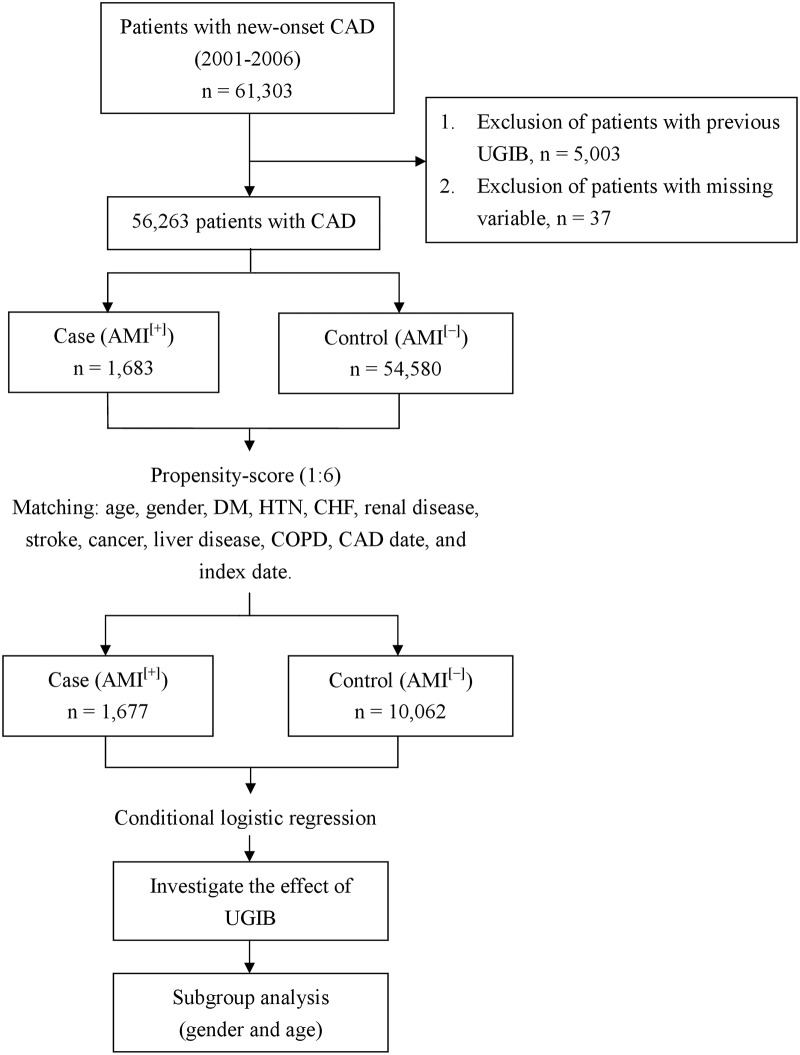
Prior studies of upper gastrointestinal bleeding (UGIB) and acute myocardial infarction (AMI) are small, and long-term effects of UGIB on AMI have not been delineated. We investigated whether UGIB in patients diagnosed with coronary artery disease (CAD) increased their risk of subsequent AMI. This was a population-based, nested case-control study using Taiwan's National Health Insurance Research Database. After propensity-score matching for age, gender, comorbidities, CAD date, and follow-up duration, we identified 1,677 new-onset CAD patients with AMI (AMI[+]) between 2001 and 2006 as the case group and 10,062 new-onset CAD patients without (AMI[-]) as the control group. Conditional logistic regression was used to examine the association between UGIB and AMI. Compared with UGIB[-] patients, UGIB[+] patients had twice the risk for subsequent AMI (adjusted odds ratio [AOR] = 2.08; 95% confidence interval [CI], 1.72-2.50). In the subgroup analysis for gender and age, UGIB[+] women (AOR = 2.70; 95% CI, 2.03-3.57) and patients < 65 years old (AOR = 2.23; 95% CI, 1.56-3.18) had higher odds of an AMI. UGIB[+] AMI[+] patients used nonsignificantly less aspirin than did UGIB[-] AMI[+] patients (27.69% vs. 35.61%, respectively). UGIB increased the risk of subsequent AMI in CAD patients, especially in women and patients < 65. This suggests that physicians need to use earlier and more aggressive intervention to detect UGIB and prevent AMI in CAD patients.
先前关于上消化道出血(UGIB)和急性心肌梗死(AMI)的研究规模较小,且UGIB对AMI的长期影响尚未明确。我们调查了被诊断为冠心病(CAD)的患者发生UGIB是否会增加其随后发生AMI的风险。这是一项基于人群的巢式病例对照研究,使用了台湾地区的全民健康保险研究数据库。在对年龄、性别、合并症、CAD确诊日期和随访时长进行倾向得分匹配后,我们将2001年至2006年间1677例新发生CAD且伴有AMI(AMI[+])的患者确定为病例组,将10062例新发生CAD且无AMI(AMI[-])的患者作为对照组。采用条件逻辑回归分析来检验UGIB与AMI之间的关联。与UGIB[-]患者相比,UGIB[+]患者随后发生AMI的风险是前者的两倍(校正比值比[AOR]=2.08;95%置信区间[CI],1.72 - 2.50)。在按性别和年龄进行的亚组分析中,UGIB[+]女性(AOR = 2.70;95%CI,2.03 - 3.57)和年龄<65岁的患者(AOR = 2.23;95%CI,1.56 - 3.18)发生AMI的几率更高。UGIB[+] AMI[+]患者使用阿司匹林的比例略低于UGIB[-] AMI[+]患者(分别为27.69%和35.61%),但差异无统计学意义。UGIB增加了CAD患者随后发生AMI的风险,尤其是女性和年龄<65岁的患者。这表明医生需要更早且更积极地进行干预,以检测CAD患者的UGIB并预防AMI。