Rábago Christopher A, Dingwell Jonathan B, Wilken Jason M
Center for the Intrepid, Department of Orthopaedics and Rehabilitation, Brooke Army Medical Center, JBSA Fort Sam Houston, Texas, United States of America.
Department of Defense and Veterans Affairs Extremity Trauma and Amputation Center of Excellence, JBSA Fort Sam Houston, Texas, United States of America.
PLoS One. 2015 Nov 4;10(11):e0142083. doi: 10.1371/journal.pone.0142083. eCollection 2015.
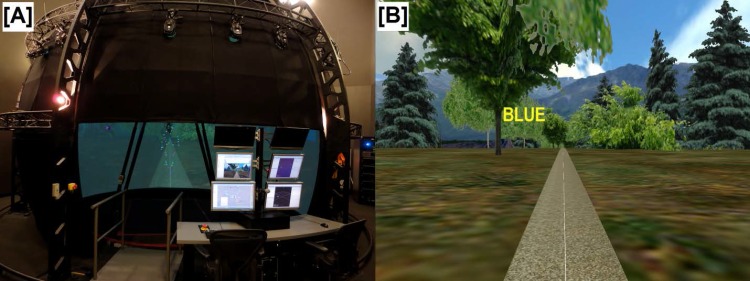
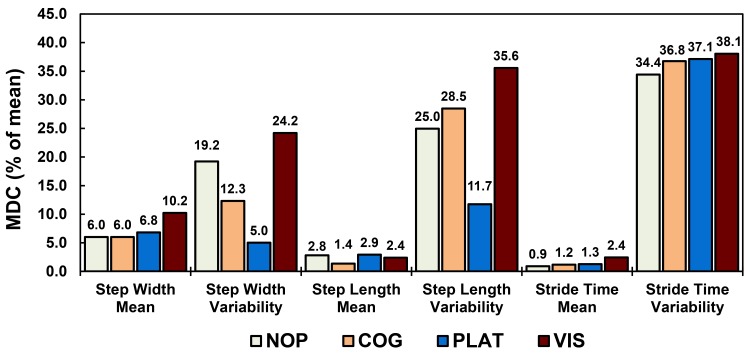
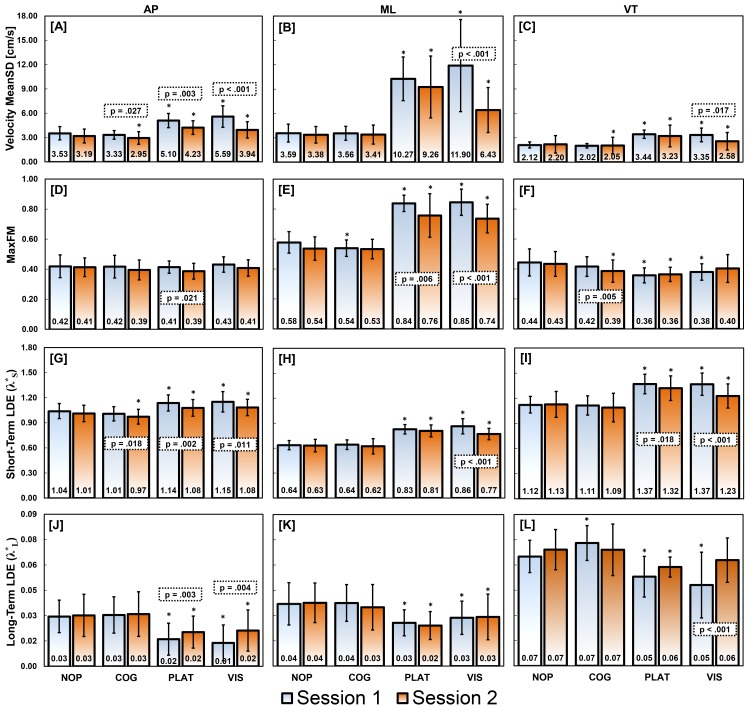
Temporal-spatial, kinematic variability, and dynamic stability measures collected during perturbation-based assessment paradigms are often used to identify dysfunction associated with gait instability. However, it remains unclear which measures are most reliable for detecting and tracking responses to perturbations. This study systematically determined the between-session reliability and minimum detectable change values of temporal-spatial, kinematic variability, and dynamic stability measures during three types of perturbed gait. Twenty young healthy adults completed two identical testing sessions two weeks apart, comprised of an unperturbed and three perturbed (cognitive, physical, and visual) walking conditions in a virtual reality environment. Within each session, perturbation responses were compared to unperturbed walking using paired t-tests. Between-session reliability and minimum detectable change values were also calculated for each measure and condition. All temporal-spatial, kinematic variability and dynamic stability measures demonstrated fair to excellent between-session reliability. Minimal detectable change values, normalized to mean values ranged from 1-50%. Step width mean and variability measures demonstrated the greatest response to perturbations with excellent between-session reliability and low minimum detectable change values. Orbital stability measures demonstrated specificity to perturbation direction and sensitivity with excellent between-session reliability and low minimum detectable change values. We observed substantially greater between-session reliability and lower minimum detectable change values for local stability measures than previously described which may be the result of averaging across trials within a session and using velocity versus acceleration data for reconstruction of state spaces. Across all perturbation types, temporal-spatial, orbital and local measures were the most reliable measures with the lowest minimum detectable change values, supporting their use for tracking changes over multiple testing sessions. The between-session reliability and minimum detectable change values reported here provide an objective means for interpreting changes in temporal-spatial, kinematic variability, and dynamic stability measures during perturbed walking which may assist in identifying instability.
在基于扰动的评估范式中收集的时空、运动学变异性和动态稳定性测量指标,常用于识别与步态不稳相关的功能障碍。然而,目前尚不清楚哪些测量指标对于检测和跟踪对扰动的反应最为可靠。本研究系统地确定了三种类型的扰动步态期间,时空、运动学变异性和动态稳定性测量指标的组间可靠性和最小可检测变化值。20名年轻健康成年人在相隔两周的时间内完成了两次相同的测试,测试包括虚拟现实环境中的无扰动步行以及三种扰动(认知、身体和视觉)步行条件。在每次测试中,使用配对t检验将扰动反应与无扰动步行进行比较。还计算了每种测量指标和条件下的组间可靠性和最小可检测变化值。所有时空、运动学变异性和动态稳定性测量指标均表现出良好至优秀的组间可靠性。最小可检测变化值(以平均值标准化)范围为1%-50%。步宽均值和变异性测量指标对扰动的反应最大,具有优秀的组间可靠性和较低的最小可检测变化值。轨道稳定性测量指标表现出对扰动方向的特异性和敏感性,具有优秀的组间可靠性和较低的最小可检测变化值。我们观察到,与之前描述的相比,局部稳定性测量指标的组间可靠性显著更高,最小可检测变化值更低,这可能是由于在一次测试中对多次试验进行平均,并使用速度与加速度数据来重建状态空间的结果。在所有扰动类型中,时空、轨道和局部测量指标是最可靠的指标,最小可检测变化值最低,支持它们用于跟踪多次测试期间的变化。这里报告的组间可靠性和最小可检测变化值为解释扰动步行期间时空、运动学变异性和动态稳定性测量指标的变化提供了一种客观方法,这可能有助于识别不稳定性。