Ekizos Antonis, Santuz Alessandro, Schroll Arno, Arampatzis Adamantios
Department of Training and Movement Sciences, Humboldt-Universität zu Berlin, Berlin, Germany.
Berlin School of Movement Science, Humboldt-Universität zu Berlin, Berlin, Germany.
Front Physiol. 2018 Aug 24;9:1101. doi: 10.3389/fphys.2018.01101. eCollection 2018.
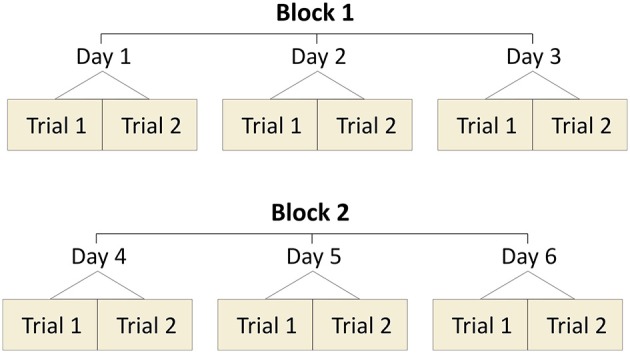
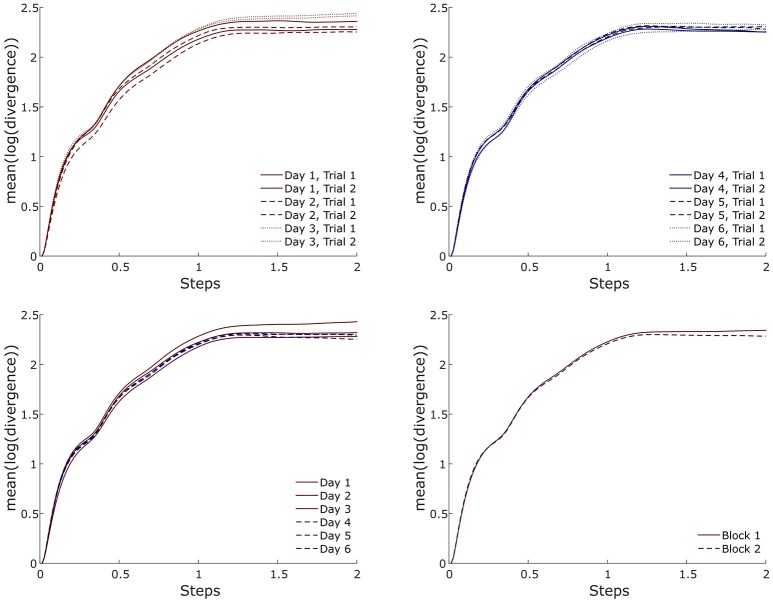
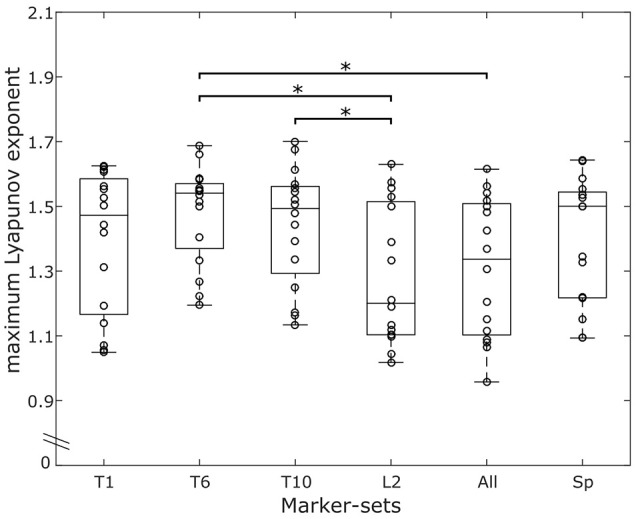
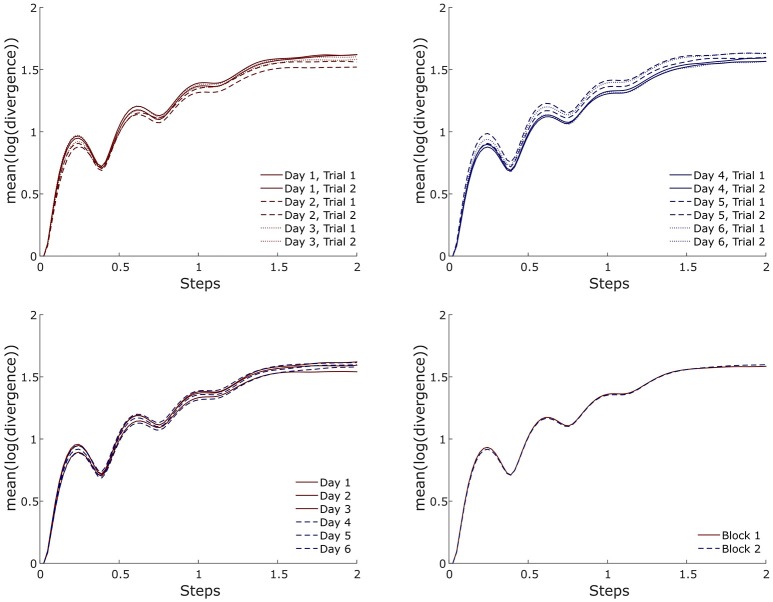
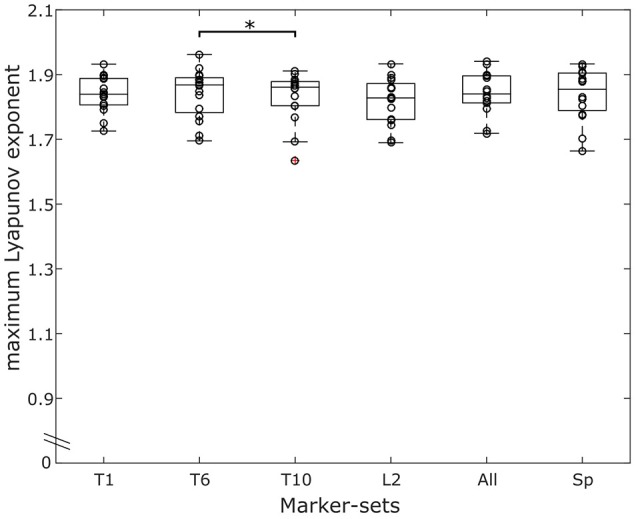
The maximum Lyapunov exponent (MLE) has often been suggested as the prominent measure for evaluation of dynamic stability of locomotion in pathological and healthy population. Although the popularity of the MLE has increased in the last years, there is scarce information on the reliability of the method, especially during running. The purpose of the current study was, thus, to examine the reliability of the MLE during both walking and running. Sixteen participants walked and ran on a treadmill completing two measurement blocks (i.e., two trials per day for three consecutive days per block) separated by 2 months on average. Six different marker-sets on the trunk were analyzed. Intraday, interday and between blocks reliability was assessed using the intraclass correlation coefficient (ICC) and the root mean square difference (RMSD). The MLE was on average significantly higher ( < 0.001) in running (1.836 ± 0.080) compared to walking (1.386 ± 0.207). All marker-sets showed excellent ICCs (>0.90) during walking and mostly good ICCs (>0.75) during running. The RMSD ranged from 0.023 to 0.047 for walking and from 0.018 to 0.050 for running. The reliability was better when comparing MLE values between blocks (ICCs: 0.965-0.991 and 0.768-0.961; RMSD: 0.023-0.034 and 0.018-0.027 for walking and running respectively), and worse when considering trials of the same day (ICCs: 0.946-0.980 and 0.739-0.844; RMSD: 0.042-0.047 and 0.045-0.050 for walking and running respectively). Further, different marker-sets affect the reliability of the MLE in both walking and running. Our findings provide evidence that the assessment of dynamic stability using the MLE is reliable in both walking and running. More trials spread over more than 1 day should be considered in study designs with increased demands of accuracy independent of the locomotion condition.
最大Lyapunov指数(MLE)常被视为评估病理人群和健康人群运动动态稳定性的重要指标。尽管近年来MLE的应用越来越广泛,但关于该方法可靠性的信息却很少,尤其是在跑步过程中。因此,本研究的目的是检验步行和跑步过程中MLE的可靠性。16名参与者在跑步机上行走和跑步,完成两个测量块(即每个块连续三天每天进行两次试验),平均间隔2个月。分析了躯干上的六种不同标记集。使用组内相关系数(ICC)和均方根差(RMSD)评估日内、日间和块间可靠性。与步行(1.386±0.207)相比,跑步时的MLE平均显著更高(<0.001)(1.836±0.080)。所有标记集在步行时均显示出优异的ICC(>0.90),在跑步时大多显示出良好的ICC(>0.75)。步行时RMSD范围为0.023至0.047,跑步时为0.018至0.050。比较块间的MLE值时可靠性更好(ICC:步行和跑步分别为0.965 - 0.991和0.768 - 0.961;RMSD:步行和跑步分别为0.023 - 0.034和0.018 - 0.027),而考虑同一天的试验时可靠性更差(ICC:步行和跑步分别为0.946 - 0.980和0.739 - 0.844;RMSD:步行和跑步分别为0.042 - 0.047和0.045 - 0.050)。此外,不同的标记集会影响步行和跑步时MLE的可靠性。我们的研究结果表明,使用MLE评估动态稳定性在步行和跑步中都是可靠的。在对准确性要求较高的研究设计中,无论运动条件如何,都应考虑在超过一天的时间内进行更多试验。