Liu Lin L, Li Fei, Pao William, Michor Franziska
Department of Biostatistics, Harvard T. H. Chan School of Public Health, Boston, MA 02115, United States of America.
Department of Biostatistics and Computational Biology, Dana-Farber Cancer Institute, Boston, MA 02215, United States of America.
PLoS One. 2015 Nov 4;10(11):e0141665. doi: 10.1371/journal.pone.0141665. eCollection 2015.
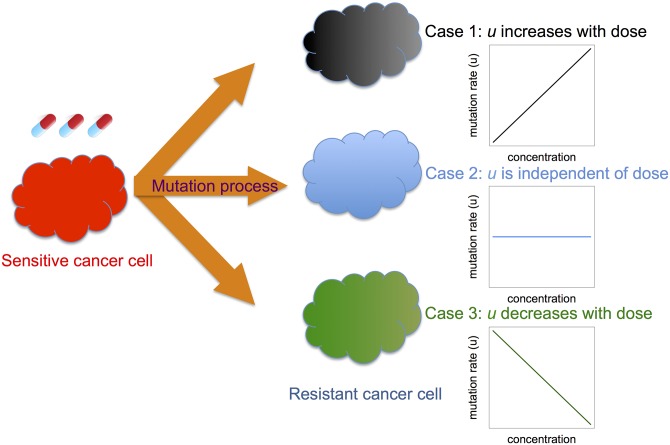
The advent of targeted therapy for cancer treatment has brought about a paradigm shift in the clinical management of human malignancies. Agents such as erlotinib used for EGFR-mutant non-small cell lung cancer or imatinib for chronic myeloid leukemia, for instance, lead to rapid tumor responses. Unfortunately, however, resistance often emerges and renders these agents ineffective after a variable amount of time. The FDA-approved dosing schedules for these drugs were not designed to optimally prevent the emergence of resistance. To this end, we have previously utilized evolutionary mathematical modeling of treatment responses to elucidate the dosing schedules best able to prevent or delay the onset of resistance. Here we expand on our approaches by taking into account dose-dependent mutation rates at which resistant cells emerge. The relationship between the serum drug concentration and the rate at which resistance mutations arise can lead to non-intuitive results about the best dose administration strategies to prevent or delay the emergence of resistance.
We used mathematical modeling, available clinical trial data, and different considerations of the relationship between mutation rate and drug concentration to predict the effectiveness of different dosing strategies.
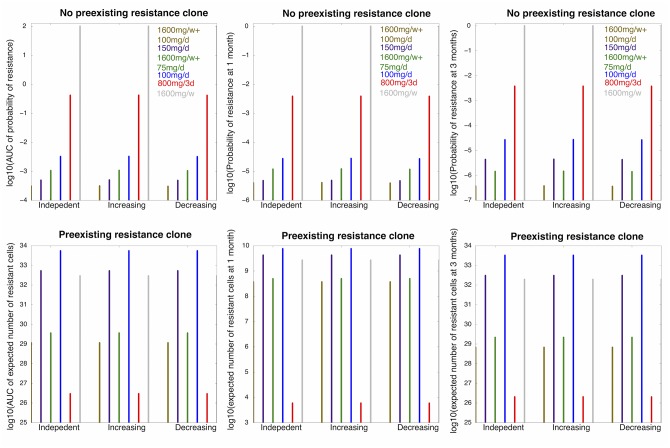
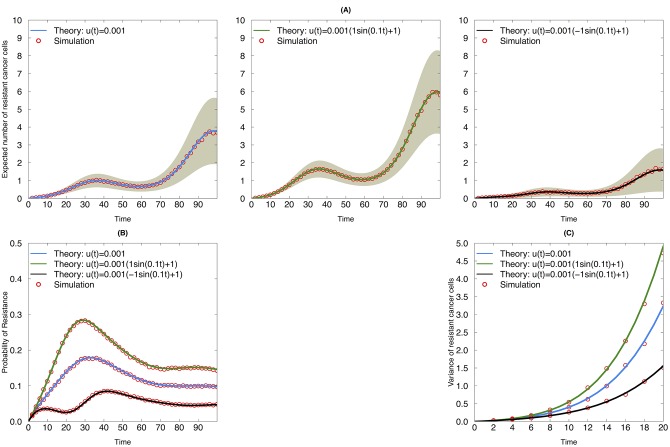
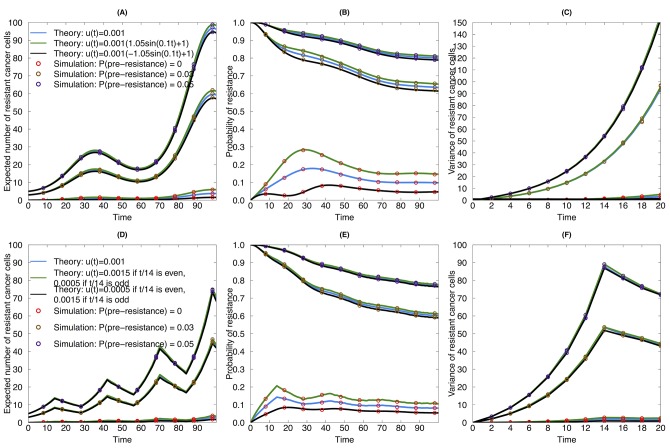
We designed several distinct measures to interrogate the effects of different treatment dosing strategies and found that a low-dose continuous strategy coupled with high-dose pulses leads to the maximal delay until clinically observable resistance. Furthermore, the response to treatment is robust against different assumptions of the mutation rate as a function of drug concentration.
For new and existing targeted drugs, our methodology can be employed to compare the effectiveness of different dose administration schedules and investigate the influence of changing mutation rates on outcomes.
癌症治疗中靶向治疗的出现给人类恶性肿瘤的临床管理带来了范式转变。例如,用于表皮生长因子受体(EGFR)突变的非小细胞肺癌的厄洛替尼或用于慢性粒细胞白血病的伊马替尼等药物,可使肿瘤迅速产生反应。然而,不幸的是,耐药性常常出现,且在不同时间后会使这些药物失效。这些药物经美国食品药品监督管理局(FDA)批准的给药方案并非旨在最佳地预防耐药性的出现。为此,我们此前利用治疗反应的进化数学模型来阐明最能预防或延缓耐药性出现的给药方案。在此,我们通过考虑耐药细胞出现时的剂量依赖性突变率来扩展我们的方法。血清药物浓度与耐药性突变出现速率之间的关系可能会导致关于预防或延缓耐药性出现的最佳给药策略的非直观结果。
我们使用数学建模、可用的临床试验数据以及对突变率与药物浓度之间关系的不同考量来预测不同给药策略的有效性。
我们设计了几种不同的方法来探究不同治疗给药策略的效果,发现低剂量持续策略与高剂量脉冲相结合可导致临床上可观察到耐药性出现的最大延迟。此外,对于作为药物浓度函数的突变率的不同假设,治疗反应具有稳健性。
对于新的和现有的靶向药物,我们的方法可用于比较不同给药方案的有效性,并研究突变率变化对结果的影响。