Sultana Farhana, Mullins Robyn, English Dallas R, Simpson Julie A, Drennan Kelly T, Heley Stella, Wrede C David, Brotherton Julia M L, Saville Marion, Gertig Dorota M
Centre for Epidemiology and Biostatistics, Melbourne School of Population and Global Health, University of Melbourne, Melbourne, Australia.
Cancer Council Victoria, 615 St Kilda Rd, Melbourne, Vic, 3004, Australia.
BMC Cancer. 2015 Nov 4;15:849. doi: 10.1186/s12885-015-1804-x.
Increasing cervical screening coverage by reaching inadequately screened groups is essential for improving the effectiveness of cervical screening programs. Offering HPV self-sampling to women who are never or under-screened can improve screening participation, however participation varies widely between settings. Information on women's experience with self-sampling and preferences for future self-sampling screening is essential for programs to optimize participation.
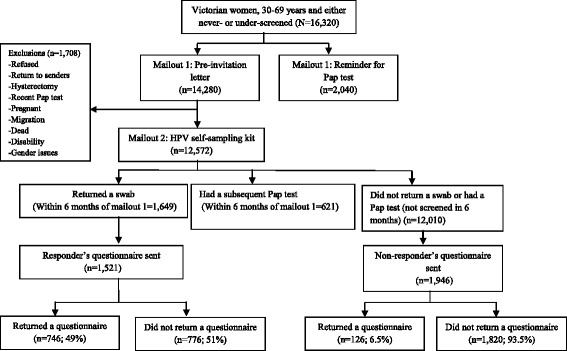
The survey was conducted as part of a larger trial ("iPap") investigating the effect of HPV self-sampling on participation of never and under-screened women in Victoria, Australia. Questionnaires were mailed to a) most women who participated in the self-sampling to document their experience with and preference for self-sampling in future, and b) a sample of the women who did not participate asking reasons for non-participation and suggestions for enabling participation. Reasons for not having a previous Pap test were also explored.
About half the women who collected a self sample for the iPap trial returned the subsequent questionnaire (746/1521). Common reasons for not having cervical screening were that having Pap test performed by a doctor was embarrassing (18 %), not having the time (14 %), or that a Pap test was painful and uncomfortable (11 %). Most (94 %) found the home-based self-sampling less embarrassing, less uncomfortable (90 %) and more convenient (98%) compared with their last Pap test experience (if they had one); however, many were unsure about the test accuracy (57 %). Women who self-sampled thought the instructions were clear (98 %), it was easy to use the swab (95 %), and were generally confident that they did the test correctly (81 %). Most preferred to take the self-sample at home in the future (88 %) because it was simple and did not require a doctor's appointment. Few women (126/1946, 7 %) who did not return a self-sample in the iPap trial returned the questionnaire. Their main reason for not screening was having had a hysterectomy.
Home-based self-sampling can overcome emotional and practical barriers to Pap test and increase participation in cervical screening despite some women's concerns about test accuracy. Mailing to eligible women and assuring women about test accuracy could further optimize participation in screening.
通过覆盖筛查不足的人群来提高宫颈癌筛查覆盖率,对于提高宫颈癌筛查项目的有效性至关重要。向从未接受过筛查或筛查不足的女性提供人乳头瘤病毒(HPV)自我采样,可以提高筛查参与率,然而不同地区的参与率差异很大。了解女性自我采样的经历以及对未来自我采样筛查的偏好,对于优化项目参与率至关重要。
该调查是一项更大规模试验(“iPap”)的一部分,该试验旨在研究HPV自我采样对澳大利亚维多利亚州从未接受过筛查和筛查不足的女性参与筛查的影响。问卷被邮寄给:a)大多数参与自我采样的女性,以记录她们的经历以及对未来自我采样的偏好;b)未参与的女性样本,询问其未参与的原因以及促进参与的建议。同时也探讨了未进行过巴氏试验的原因。
约一半在iPap试验中采集了自我样本的女性返回了后续问卷(746/1521)。未进行宫颈癌筛查的常见原因包括让医生进行巴氏试验令人尴尬(18%)、没有时间(14%),或者巴氏试验疼痛且不舒服(11%)。与上次巴氏试验经历(如果她们有过的话)相比,大多数(94%)女性发现在家中进行自我采样不那么尴尬、不那么不舒服(90%)且更方便(98%);然而,许多人不确定检测准确性(57%)。进行自我采样的女性认为说明很清楚(98%),使用拭子很容易(95%),并且总体上相信自己正确完成了检测(81%)。大多数人未来更愿意在家中采集自我样本(88%),因为这很简单,而且无需预约医生。在iPap试验中未返回自我样本的女性中,很少有人(126/1946,7%)返回了问卷。她们未进行筛查的主要原因是做了子宫切除术。
尽管一些女性担心检测准确性,但在家中进行自我采样可以克服巴氏试验的情感和实际障碍,并提高宫颈癌筛查的参与率。向符合条件的女性邮寄问卷并向她们保证检测准确性,可以进一步优化筛查参与率。