Cecilio Lucila Arantes, Bonatto Mauro W
School of Medicine, Faculdade Assis Gurgacz, Cascavel, PR, Brazil.
aff1, Brazil.
Arq Bras Cir Dig. 2015 Jul-Sep;28(3):183-5. doi: 10.1590/S0102-67202015000300009.
Celiac disease is an enteropathy characterized by gluten sensitivity and broad clinical aspect. Has a multifactorial cause and depends on genetic, immunological and environmental factors for its development. The genetic influence is given mostly by the human leukocyte antigens HLA DQ2 and DQ8.
To evaluate the prevalence of human leukocyte antigens DQ2 and DQ8 in three different groups: patients with celiac disease, first-degree relatives and the general population.
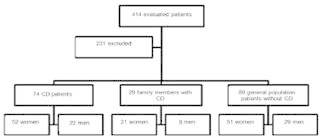
Retrospective analysis that evaluated serologic and endoscopic data of 74 patients with celiac disease and 109 non-celiac, which were subdivided into two subgroups: non-celiac who had first-degree relatives with celiac and non-celiac who did not. All patients underwent laboratory examination for screening genetic sensitivity given by HLA DQ2 and HLA DQ8 by.
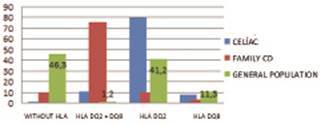
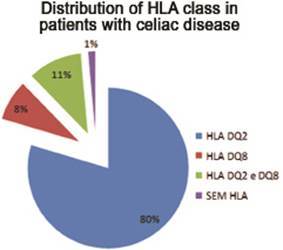
The presence of HLA DQ2 and DQ8 was identified in 98,4% of 74 celiac patients, of which 79,7% had only HLA DQ2; 8,1% had only HLA DQ8 and 10,8% had both antigens histocompatibility. In the group of relatives of celiac patients, were included 29 patients; among them, 89,6% had HLA DQ2 and/or DQ8; 76% only the HLA DQ2, 10,3% only HLA DQ8 and 3,4% presented both human leukocyte antigens (HLA).
HLA DQ2/DQ8 was present in 98,4% of celiac patients; 89,6% relatives of celiac family and in 55,4% of people from the general population without family celiac.
乳糜泻是一种以麸质敏感性和广泛临床症状为特征的肠病。其病因是多因素的,发展取决于遗传、免疫和环境因素。遗传影响主要由人类白细胞抗原HLA DQ2和DQ8决定。
评估人类白细胞抗原DQ2和DQ8在三个不同组中的患病率:乳糜泻患者、一级亲属和普通人群。
回顾性分析,评估74例乳糜泻患者和109例非乳糜泻患者的血清学和内镜数据,后者被细分为两个亚组:有乳糜泻一级亲属的非乳糜泻患者和没有此类亲属的非乳糜泻患者。所有患者均接受实验室检查,以筛查由HLA DQ2和HLA DQ8引起的遗传敏感性。
在74例乳糜泻患者中,98.4%检测到HLA DQ2和DQ8,其中79.7%仅具有HLA DQ2;8.1%仅具有HLA DQ8,10.8%同时具有两种组织相容性抗原。在乳糜泻患者的亲属组中,有29例患者;其中,89.6%具有HLA DQ2和/或DQ8;76%仅具有HLA DQ2,10.3%仅具有HLA DQ8,3.4%同时具有两种人类白细胞抗原(HLA)。
HLA DQ2/DQ8在98.4%的乳糜泻患者中存在;在乳糜泻家族的亲属中为89.6%,在无乳糜泻家族史的普通人群中为55.4%。