Kim Byung-Hak, Choi Mi Sun, Lee Hyun Gyu, Lee Song-Hee, Noh Kum Hee, Kwon Sunho, Jeong Ae Jin, Lee Haeri, Yi Eun Hee, Park Jung Youl, Lee Jintae, Joo Eun Young, Ye Sang-Kyu
Department of Pharmacology, Seoul National University College of Medicine, Seoul 110-799, Korea.
Biomedical Science Project (BK21 PLUS), Seoul National University College of Medicine, Seoul 110-799, Korea.
Mol Cells. 2015 Nov;38(11):982-90. doi: 10.14348/molcells.2015.0169. Epub 2015 Nov 4.
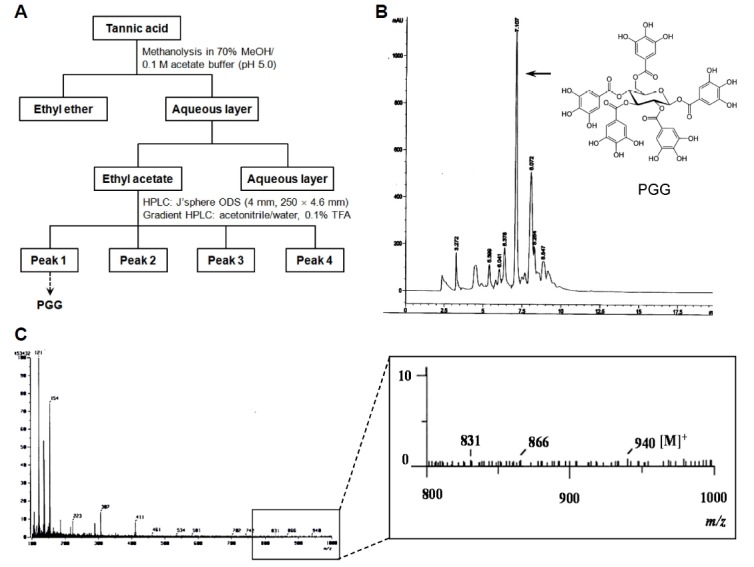
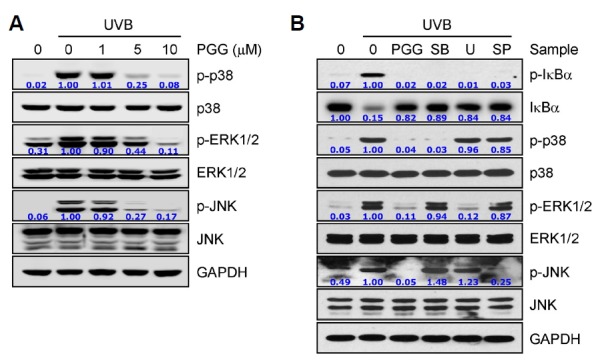
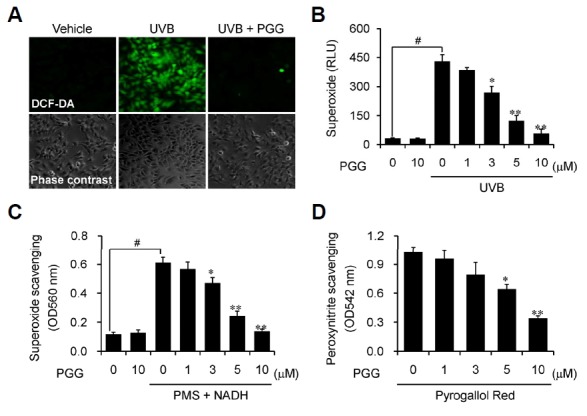
Exposure of the skin to ultraviolet radiation can cause skin damage with various pathological changes including inflammation. In the present study, we identified the skin-protective activity of 1,2,3,4,6-penta-O-galloyl-β-D-glucose (pentagalloyl glucose, PGG) in ultraviolet B (UVB) radiation-induced human dermal fibroblasts and mouse skin. PGG exhibited antioxidant activity with regard to intracellular reactive oxygen species (ROS) generation as well as ROS and reactive nitrogen species (RNS) scavenging. Furthermore, PGG exhibited anti-inflammatory activity, inhibiting the activation of nuclear factor-kappaB (NF-κB) and mitogen-activated protein kinase (MAPK) signaling, resulting in inhibition of the expression of pro-inflammatory mediators. Topical application of PGG followed by chronic exposure to UVB radiation in the dorsal skin of hairless mice resulted in a significant decrease in the progression of inflammatory skin damages, leading to inhibited activation of NF-κB signaling and expression of pro-inflammatory mediators. The present study demonstrated that PGG protected from skin damage induced by UVB radiation, and thus, may be a potential candidate for the prevention of environmental stimuli-induced inflammatory skin damage.
皮肤暴露于紫外线辐射会导致皮肤损伤,并伴有包括炎症在内的各种病理变化。在本研究中,我们确定了1,2,3,4,6 - 五 - O - 没食子酰基 - β - D - 葡萄糖(五没食子酰葡萄糖,PGG)在紫外线B(UVB)辐射诱导的人皮肤成纤维细胞和小鼠皮肤中的皮肤保护活性。PGG在细胞内活性氧(ROS)生成以及ROS和活性氮(RNS)清除方面表现出抗氧化活性。此外,PGG表现出抗炎活性,抑制核因子 - κB(NF - κB)和丝裂原活化蛋白激酶(MAPK)信号通路的激活,从而抑制促炎介质的表达。在无毛小鼠背部皮肤局部应用PGG后,长期暴露于UVB辐射,导致炎症性皮肤损伤的进展显著减少,NF - κB信号通路的激活和促炎介质的表达受到抑制。本研究表明,PGG可保护皮肤免受UVB辐射诱导的损伤,因此,可能是预防环境刺激诱导的炎症性皮肤损伤的潜在候选物。