Genty Emilie, Neumann Christof, Zuberbühler Klaus
Department of Comparative Cognition, Institute of Biology, University of Neuchâtel, rue Emile Argand 11, 2000 Neuchâtel, Switzerland.
School of Psychology and Neuroscience, University of St Andrews, St Andrews, KY16 9JP, Scotland (UK).
Sci Rep. 2015 Nov 5;5:16135. doi: 10.1038/srep16135.
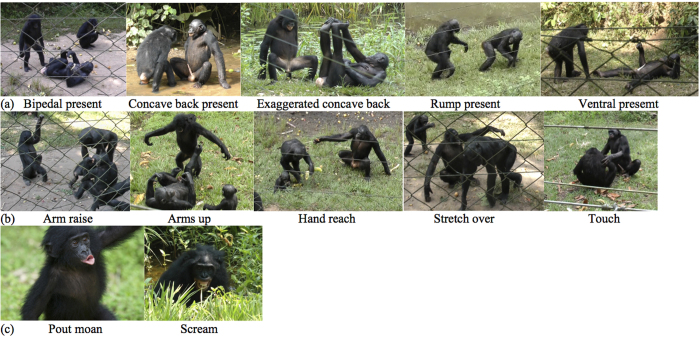
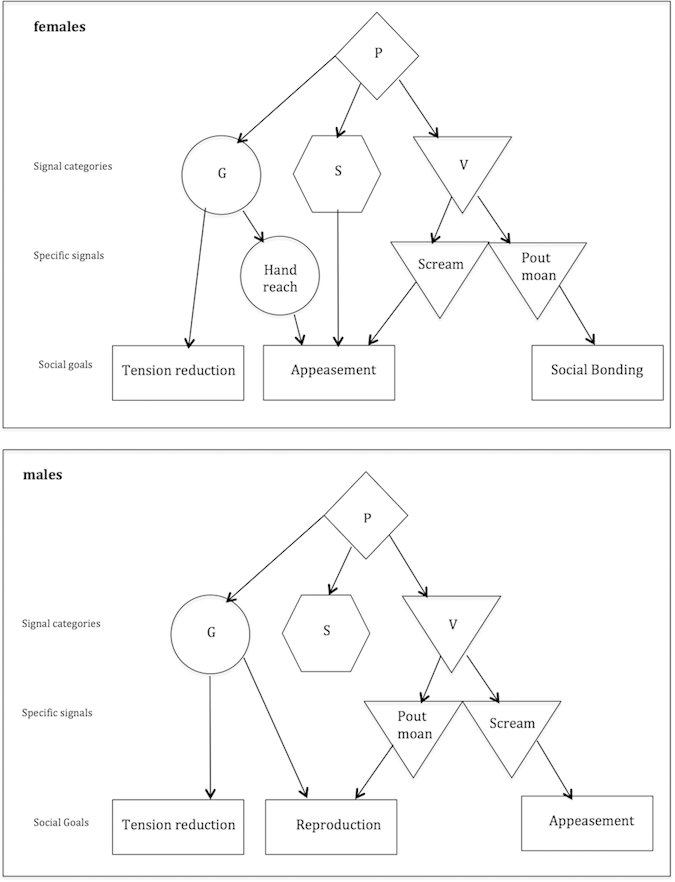
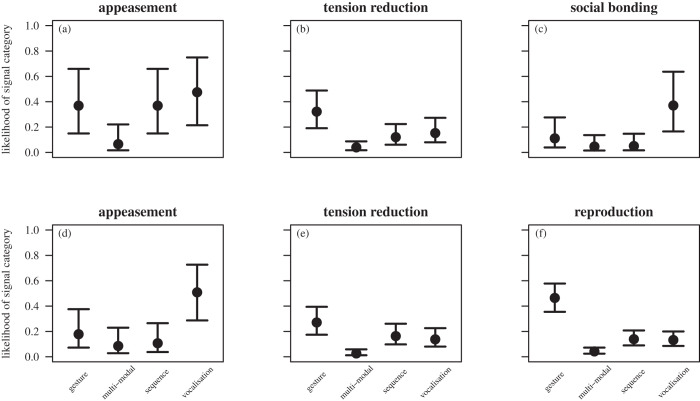
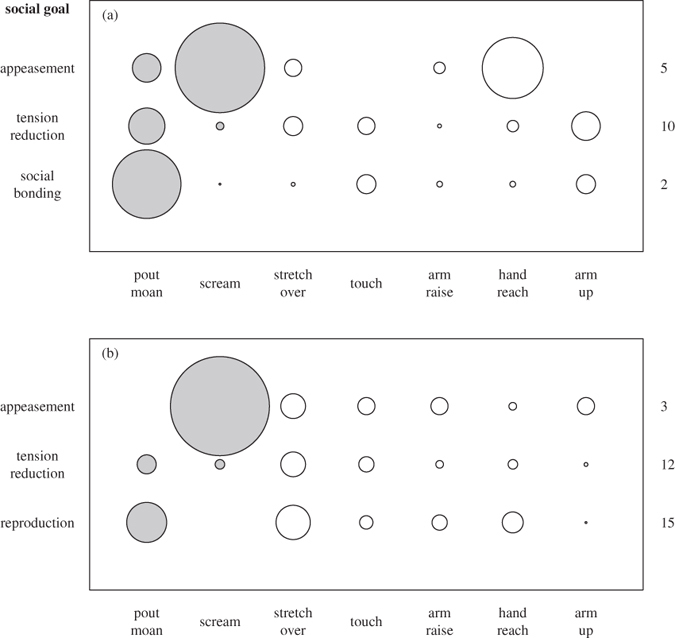
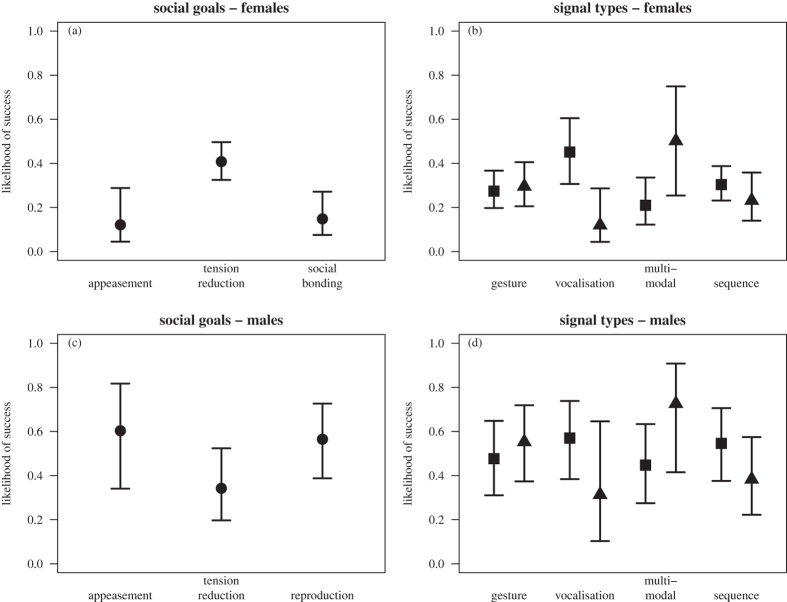
Sexual behaviour in bonobos (Pan paniscus) functions beyond mere reproduction to mediate social interactions and relationships. In this study, we assessed the signalling behaviour in relation to four social goals of sex in this species: appeasement after conflict, tension reduction, social bonding and reproduction. Overall, sexual behaviour was strongly decoupled from its ancestral reproductive function with habitual use in the social domain, which was accompanied by a corresponding complexity in communication behaviour. We found that signalling behaviour varied systematically depending on the initiator's goals and gender. Although all gestures and vocalisations were part of the species-typical communication repertoire, they were often combined and produced flexibly. Generally, gestures and multi-modal combinations were more flexibly used to communicate a goal than vocalisations. There was no clear relation between signalling behaviour and success of sexual initiations, suggesting that communication was primarily used to indicate the signaller's intention, and not to influence a recipient's willingness to interact sexually. We discuss these findings in light of the larger question of what may have caused, in humans, the evolutionary transition from primate-like communication to language.
倭黑猩猩(Pan paniscus)的性行为不仅具有繁殖功能,还能调节社会互动和关系。在本研究中,我们评估了与该物种性行为的四个社会目标相关的信号行为:冲突后的安抚、紧张缓解、社会联结和繁殖。总体而言,性行为与其祖传的生殖功能在社会领域的习惯性使用中严重脱钩,这伴随着相应的交流行为复杂性。我们发现,信号行为根据发起者的目标和性别系统地变化。尽管所有的手势和发声都是该物种典型交流方式的一部分,但它们经常被灵活地组合和产生。一般来说,手势和多模态组合比发声更灵活地用于传达目标。信号行为与性发起的成功之间没有明显关系,这表明交流主要用于表明信号者的意图,而不是影响接受者进行性互动的意愿。我们根据一个更大的问题来讨论这些发现,即人类从类灵长类交流向语言的进化转变可能是由什么引起的。