Jakicic John M, King Wendy C, Marcus Marsha D, Davis Kelliann K, Helsel Diane, Rickman Amy D, Gibbs Bethany Barone, Rogers Renee J, Wahed Abdus, Belle Steven H
Department of Health and Physical Activity, Physical Activity and Weight Management Research Center, University of Pittsburgh, Pennsylvania, USA.
Department of Epidemiology, Graduate School of Public Health, University of Pittsburgh, Pennsylvania, USA.
Obesity (Silver Spring). 2015 Dec;23(12):2385-97. doi: 10.1002/oby.21241. Epub 2015 Nov 5.
This study examined the effect of a behavioral weight loss intervention (BWLI) on young adults (age = 18-35 years).
Participants (N = 470) enrolled in a 6-month BWLI that included weekly group sessions, a prescribed energy-restricted diet, and moderate to vigorous physical activity (MVPA). Assessments included weight, body composition, fitness, lipids, glucose, insulin, resting blood pressure and heart rate, physical activity, and dietary intake. Data are presented as median [25th, 75th percentiles].
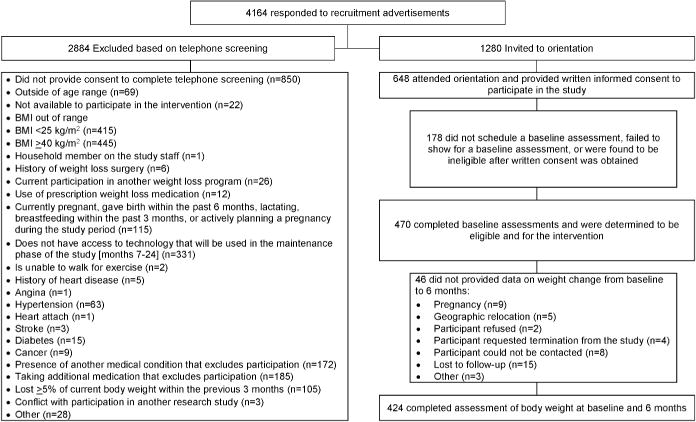
Retention was 90% (N = 424; age: 30.9 [27.8, 33.7] years; BMI: 31.2 [28.4, 34.3] kg m(-2) ). Participants completed 87.5% [76.1%, 95.5%] of scheduled intervention contacts. Weight and body fat decreased while fitness increased (P < 0.0001). MVPA in bouts ≥10 min increased (P < 0.0001), though total MVPA did not change significantly. Sedentary time decreased (P = 0.03). Energy and percent fat intake decreased, while percent carbohydrate and protein intake increased (P < 0.0001). Systolic and diastolic blood pressure, total cholesterol, LDL cholesterol, triglycerides, glucose, and insulin decreased (P < 0.0001).
A 6-month BWLI produced favorable changes in dietary intake and physical activity and elicited favorable changes in weight and other health outcomes in young adults. MVPA performed in bouts of ≥10 min was associated with greater weight loss, but sedentary behavior was not.
本研究探讨行为减重干预(BWLI)对年轻成年人(年龄 = 18 - 35岁)的影响。
470名参与者参加了为期6个月的BWLI,其中包括每周的小组会议、规定的能量限制饮食以及中等至剧烈的体育活动(MVPA)。评估内容包括体重、身体成分、体能、血脂、血糖、胰岛素、静息血压和心率、身体活动以及饮食摄入。数据以中位数[第25、75百分位数]表示。
保留率为90%(N = 424;年龄:30.9[27.8,33.7]岁;BMI:31.2[28.4,34.3]kg m⁻²)。参与者完成了计划干预接触的87.5%[76.1%,95.5%]。体重和体脂减少,而体能增加(P < 0.0001)。持续时间≥10分钟的MVPA增加(P < 0.0001),尽管总MVPA没有显著变化。久坐时间减少(P = 0.03)。能量和脂肪摄入量百分比下降,而碳水化合物和蛋白质摄入量百分比增加(P < 0.0001)。收缩压和舒张压、总胆固醇、低密度脂蛋白胆固醇、甘油三酯、血糖和胰岛素下降(P < 0.0001)。
为期6个月的BWLI在年轻成年人的饮食摄入和身体活动方面产生了有利变化,并在体重和其他健康结果方面引发了有利变化。持续时间≥10分钟的MVPA与更大程度的体重减轻相关,但久坐行为并非如此。