• 文献检索
  • 文档翻译
  • 深度研究
  • 学术资讯
  • Suppr Zotero 插件Zotero 插件
  • 邀请有礼
  • 套餐&价格
  • 历史记录
应用&插件
Suppr Zotero 插件Zotero 插件浏览器插件Mac 客户端Windows 客户端微信小程序
定价
高级版会员购买积分包购买API积分包
服务
文献检索文档翻译深度研究API 文档MCP 服务
关于我们
关于 Suppr公司介绍联系我们用户协议隐私条款
关注我们

Suppr 超能文献

核心技术专利:CN118964589B侵权必究
粤ICP备2023148730 号-1Suppr @ 2026

文献检索

告别复杂PubMed语法,用中文像聊天一样搜索,搜遍4000万医学文献。AI智能推荐,让科研检索更轻松。

立即免费搜索

文件翻译

保留排版,准确专业,支持PDF/Word/PPT等文件格式,支持 12+语言互译。

免费翻译文档

深度研究

AI帮你快速写综述,25分钟生成高质量综述,智能提取关键信息,辅助科研写作。

立即免费体验

埃迪卡拉纪具骨骼的后生动物,被解释为触手冠动物。

Ediacaran skeletal metazoan interpreted as a lophophorate.

作者信息

Zhuravlev A Yu, Wood R A, Penny A M

机构信息

Department of Biological Evolution, Faculty of Biology, Lomonosov Moscow State University, Leninskie Gory, Moscow 119991, Russia.

School of GeoSciences, University of Edinburgh, West Mains Road, Edinburgh EH9 3FE, UK

出版信息

Proc Biol Sci. 2015 Nov 7;282(1818):20151860. doi: 10.1098/rspb.2015.1860.

DOI:10.1098/rspb.2015.1860
PMID:26538593
原文链接:https://pmc.ncbi.nlm.nih.gov/articles/PMC4650157/
Abstract

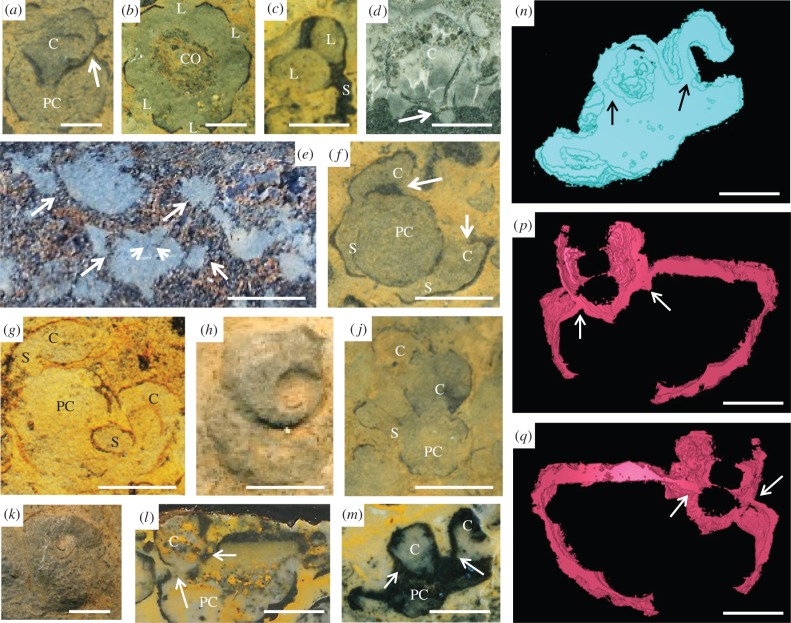
While many skeletal biomineralized genera are described from Ediacaran (635-541 million years ago, Ma) strata, none have been suggested to have an affinity above the Porifera-Cnidaria metazoan grade. Here, we reinterpret the widespread terminal Ediacaran (approx. 550-541 Ma) sessile goblet-shaped Namacalathus as a triploblastic eumetazoan. Namacalathus has a stalked cup with radially symmetrical cross section, multiple lateral lumens and a central opening. We show that the skeleton of Namacalathus is composed of a calcareous foliated ultrastructure displaying regular concordant columnar inflections, with a possible inner organic-rich layer. These features point to an accretionary growth style of the skeleton and an affinity with the Lophotrochozoa, more specifically within the Lophophorata (Brachiopoda and Bryozoa). Additionally, we present evidence for asexual reproduction as expressed by regular budding in a bilateral pattern. The interpretation of Namacalathus as an Ediacaran total group lophophorate is consistent with an early radiation of the Lophophorata, as known early Cambrian representatives were sessile, mostly stalked forms, and in addition, the oldest known calcareous Brachiopoda (early Cambrian Obolellida) and Bryozoa (Ordovician Stenolaemata) possessed foliated ultrastructures.

摘要

虽然在埃迪卡拉纪(6.35亿至5.41亿年前,Ma)地层中描述了许多骨骼生物矿化类群,但没有一个被认为亲缘关系高于多孔动物-刺胞动物后生动物等级。在这里,我们将广泛分布的埃迪卡拉纪末期(约5.50亿至5.41亿年前)固着的杯状纳马卡剌斯重新解释为三胚层真后生动物。纳马卡剌斯有一个带柄的杯状体,横截面呈放射状对称,有多个侧向腔和一个中央开口。我们表明,纳马卡剌斯的骨骼由钙质叶状超微结构组成,显示出规则一致的柱状弯曲,可能有一个内部富含有机物的层。这些特征表明骨骼具有增生生长方式,并且与冠轮动物有亲缘关系,更具体地说,属于触手冠动物(腕足动物和苔藓虫)。此外,我们还提供了以双侧模式规则出芽所表现的无性繁殖的证据。将纳马卡剌斯解释为埃迪卡拉纪全群触手冠动物与触手冠动物的早期辐射是一致的,因为已知的寒武纪早期代表是固着的,大多是有柄的形式,此外,已知最古老的钙质腕足动物(寒武纪早期的小嘴贝目)和苔藓虫(奥陶纪窄唇苔藓虫纲)具有叶状超微结构。
https://cdn.ncbi.nlm.nih.gov/pmc/blobs/5167/4650157/0ba1e00c9eea/rspb20151860-g4.jpg
https://cdn.ncbi.nlm.nih.gov/pmc/blobs/5167/4650157/300e04519de3/rspb20151860-g1.jpg
https://cdn.ncbi.nlm.nih.gov/pmc/blobs/5167/4650157/5846ee00ecc2/rspb20151860-g2.jpg
https://cdn.ncbi.nlm.nih.gov/pmc/blobs/5167/4650157/40bb74ad3be5/rspb20151860-g3.jpg
https://cdn.ncbi.nlm.nih.gov/pmc/blobs/5167/4650157/0ba1e00c9eea/rspb20151860-g4.jpg
https://cdn.ncbi.nlm.nih.gov/pmc/blobs/5167/4650157/300e04519de3/rspb20151860-g1.jpg
https://cdn.ncbi.nlm.nih.gov/pmc/blobs/5167/4650157/5846ee00ecc2/rspb20151860-g2.jpg
https://cdn.ncbi.nlm.nih.gov/pmc/blobs/5167/4650157/40bb74ad3be5/rspb20151860-g3.jpg
https://cdn.ncbi.nlm.nih.gov/pmc/blobs/5167/4650157/0ba1e00c9eea/rspb20151860-g4.jpg

相似文献

1
Ediacaran skeletal metazoan interpreted as a lophophorate.埃迪卡拉纪具骨骼的后生动物,被解释为触手冠动物。
Proc Biol Sci. 2015 Nov 7;282(1818):20151860. doi: 10.1098/rspb.2015.1860.
2
Ediacaran metazoan reveals lophotrochozoan affinity and deepens root of Cambrian Explosion.埃迪卡拉纪后生动物揭示了冠轮动物亲缘关系并加深了寒武纪大爆发的根源。
Sci Adv. 2021 Jan 1;7(1). doi: 10.1126/sciadv.abf2933. Print 2021 Jan.
3
Intraspecific variation in an Ediacaran skeletal metazoan: Namacalathus from the Nama Group, Namibia.一种埃迪卡拉纪具骨骼后生动物的种内变异:来自纳米比亚纳马群的纳马卡拉虫。
Geobiology. 2017 Jan;15(1):81-93. doi: 10.1111/gbi.12205. Epub 2016 Sep 28.
4
Fossil evidence unveils an early Cambrian origin for Bryozoa.化石证据揭示了苔藓动物门的早期寒武纪起源。
Nature. 2021 Nov;599(7884):251-255. doi: 10.1038/s41586-021-04033-w. Epub 2021 Oct 27.
5
The two phases of the Cambrian Explosion.寒武纪生命大爆发的两个阶段。
Sci Rep. 2018 Nov 9;8(1):16656. doi: 10.1038/s41598-018-34962-y.
6
A Cambrian tommotiid preserving soft tissues reveals the metameric ancestry of lophophorates.保存软组织的寒武纪托莫特虫揭示了担轮动物门的分节祖先。
Curr Biol. 2022 Nov 7;32(21):4769-4778.e2. doi: 10.1016/j.cub.2022.09.011. Epub 2022 Sep 27.
7
The scleritome of Paterimitra: an Early Cambrian stem group brachiopod from South Australia.帕特米特拉的骨片:一种来自南澳大利亚的早寒武世干群腕足动物。
Proc Biol Sci. 2009 May 7;276(1662):1651-6. doi: 10.1098/rspb.2008.1655. Epub 2009 Jan 20.
8
Quantitative study of developmental biology confirms as a metazoan.发育生物学的定量研究证实其为后生动物。
Proc Biol Sci. 2017 Sep 13;284(1862). doi: 10.1098/rspb.2017.1348.
9
Haootia quadriformis n. gen., n. sp., interpreted as a muscular cnidarian impression from the Late Ediacaran period (approx. 560 Ma).四形哈欧提亚虫,新属,新种,被解释为来自晚埃迪卡拉纪时期(约5.6亿年前)的一种肌肉型刺胞动物印记。
Proc Biol Sci. 2014 Oct 22;281(1793). doi: 10.1098/rspb.2014.1202.
10
Extensive metazoan reefs from the Ediacaran Nama Group, Namibia: the rise of benthic suspension feeding.来自纳米比亚埃迪卡拉纪纳马群的大型后生动物礁:底栖悬浮取食的兴起。
Geobiology. 2015 Mar;13(2):112-22. doi: 10.1111/gbi.12122. Epub 2014 Dec 30.

引用本文的文献

1
Rebuilding Earth's first skeletal animals: the original morphology of (Ediacaran, Brazil).重建地球上最早的骨骼动物:(巴西埃迪卡拉纪)的原始形态。
R Soc Open Sci. 2025 May 21;12(5):250206. doi: 10.1098/rsos.250206. eCollection 2025 May.
2
The evolution of reproduction in Ediacaran-Cambrian metazoans.埃迪卡拉纪-寒武纪后生动物繁殖方式的演变。
Biol Rev Camb Philos Soc. 2025 Oct;100(5):2084-2098. doi: 10.1111/brv.70036. Epub 2025 May 15.
3
Ediacaran origin and Ediacaran-Cambrian diversification of Metazoa.后生动物的埃迪卡拉起源和埃迪卡拉纪-寒武纪多样化。

本文引用的文献

1
PHYLOGENETIC RELATIONSHIPS AMONG EXTANT BRACHIOPODS.现存腕足动物之间的系统发育关系。
Cladistics. 1995 Jun;11(2):131-197. doi: 10.1111/j.1096-0031.1995.tb00084.x.
2
The Magellania venosa Biomineralizing Proteome: A Window into Brachiopod Shell Evolution.麦哲伦脉纹贝生物矿化蛋白质组:了解腕足动物贝壳演化的窗口。
Genome Biol Evol. 2015 Apr 24;7(5):1349-62. doi: 10.1093/gbe/evv074.
3
Extensive metazoan reefs from the Ediacaran Nama Group, Namibia: the rise of benthic suspension feeding.来自纳米比亚埃迪卡拉纪纳马群的大型后生动物礁:底栖悬浮取食的兴起。
Sci Adv. 2024 Nov 15;10(46):eadp7161. doi: 10.1126/sciadv.adp7161. Epub 2024 Nov 13.
4
igen. et isp. nov., a scalidophoran trace fossil from the late Ediacaran of Namibia.伊根迹属(igen.)及新种(isp. nov.),一种来自纳米比亚埃迪卡拉纪晚期的叶足动物遗迹化石。
R Soc Open Sci. 2024 Oct 16;11(10):240452. doi: 10.1098/rsos.240452. eCollection 2024 Oct.
5
Ediacaran has a cataphract calcareous skeleton with controlled biomineralization.埃迪卡拉生物群具有带可控生物矿化作用的铠甲状钙质骨骼。
iScience. 2022 Nov 25;25(12):105676. doi: 10.1016/j.isci.2022.105676. eCollection 2022 Dec 22.
6
Ediacaran metazoan reveals lophotrochozoan affinity and deepens root of Cambrian Explosion.埃迪卡拉纪后生动物揭示了冠轮动物亲缘关系并加深了寒武纪大爆发的根源。
Sci Adv. 2021 Jan 1;7(1). doi: 10.1126/sciadv.abf2933. Print 2021 Jan.
7
Draft genome of Bugula neritina, a colonial animal packing powerful symbionts and potential medicines.虫黄藻基因组草图,一种具有强大共生体和潜在药物的群体动物。
Sci Data. 2020 Oct 20;7(1):356. doi: 10.1038/s41597-020-00684-y.
8
Three-dimensional reconstructions of the putative metazoan show that it was a microbial construction.对假定后生动物的三维重建表明,它是一种微生物结构。
Proc Natl Acad Sci U S A. 2020 Aug 18;117(33):19760-19766. doi: 10.1073/pnas.2009129117. Epub 2020 Aug 3.
9
Revisiting metazoan phylogeny with genomic sampling of all phyla.对所有门的基因组采样重新审视后生动物系统发育。
Proc Biol Sci. 2019 Jul 10;286(1906):20190831. doi: 10.1098/rspb.2019.0831.
10
Hyoliths with pedicles illuminate the origin of the brachiopod body plan.具茎的苔藓动物阐明了腕足动物身体构型的起源。
Proc Biol Sci. 2018 Sep 26;285(1887):20181780. doi: 10.1098/rspb.2018.1780.
Geobiology. 2015 Mar;13(2):112-22. doi: 10.1111/gbi.12122. Epub 2014 Dec 30.
4
Biomineralization in bryozoans: present, past and future.苔藓动物的生物矿化:现在、过去和未来。
Biol Rev Camb Philos Soc. 2015 Nov;90(4):1118-50. doi: 10.1111/brv.12148. Epub 2014 Nov 4.
5
Early animals. Ediacaran metazoan reefs from the Nama Group, Namibia.早期动物。纳米比亚那马群的埃迪卡拉后生动物礁。
Science. 2014 Jun 27;344(6191):1504-6. doi: 10.1126/science.1253393.
6
An early Cambrian agglutinated tubular lophophorate with brachiopod characters.一种具有腕足动物特征的早寒武世凝集管状触手冠动物。
Sci Rep. 2014 May 15;4:4682. doi: 10.1038/srep04682.
7
Symbiophagy and biomineralization in the "living fossil" Astrosclera willeyana.“活化石”威利星孔海绵中的共生吞噬作用与生物矿化
Autophagy. 2014 Mar;10(3):408-15. doi: 10.4161/auto.27319. Epub 2013 Dec 12.
8
New phylogenomic data support the monophyly of Lophophorata and an Ectoproct-Phoronid clade and indicate that Polyzoa and Kryptrochozoa are caused by systematic bias.新的系统基因组学数据支持原口动物的单系性和腕足动物—帚虫动物冠群,并表明多孔动物和刺胞动物是由系统偏差引起的。
BMC Evol Biol. 2013 Nov 17;13:253. doi: 10.1186/1471-2148-13-253.
9
A sclerite-bearing stem group entoproct from the early Cambrian and its implications.具骨片的后生动物干群茎化石来自早寒武纪及其意义。
Sci Rep. 2013;3:1066. doi: 10.1038/srep01066. Epub 2013 Jan 17.
10
Three-dimensional structure of the shell plate assembly of the chiton Tonicella marmorea and its biomechanical consequences.石鳖 Tonicella marmorea 壳板组件的三维结构及其生物力学后果。
J Struct Biol. 2012 Feb;177(2):314-28. doi: 10.1016/j.jsb.2011.12.019. Epub 2012 Jan 10.