Department of Social Work and Life Design, Kyoto Notre Dame University, Kyoto 606-0847, Japan.
Department of Obstetrics and Gynecology, Graduate School of Medical Science, Kanazawa University, Kanazawa 920-8640, Japan.
Nutrients. 2020 May 2;12(5):1294. doi: 10.3390/nu12051294.
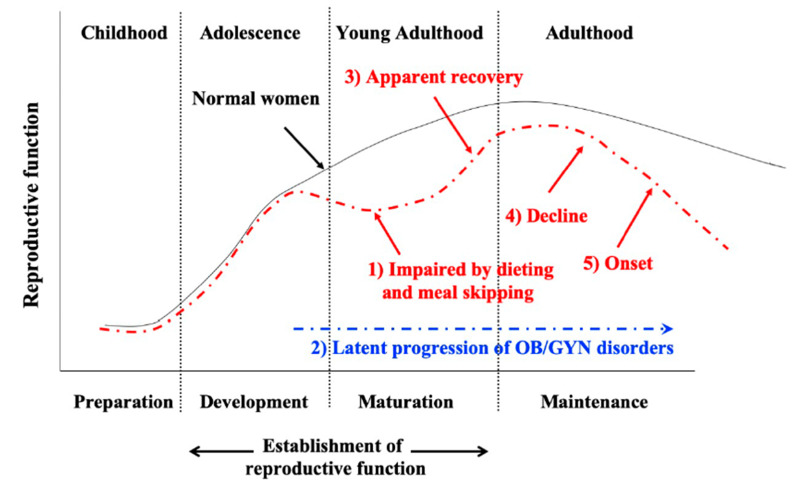
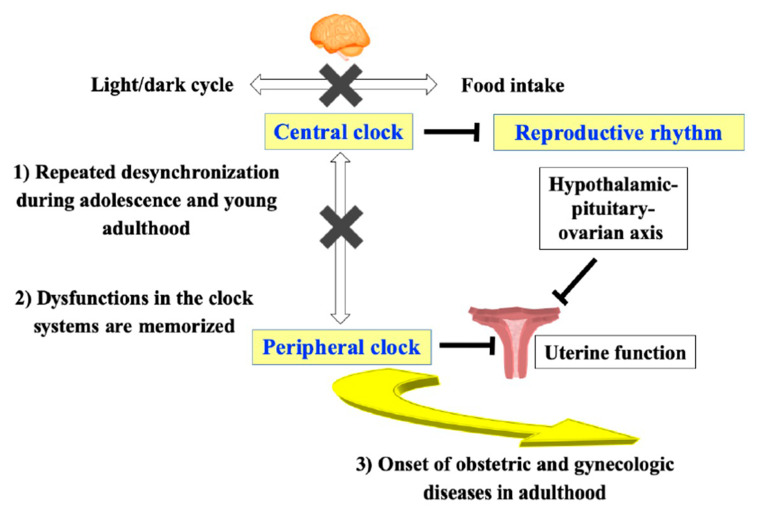
There are growing concerns that poor dietary behaviors at young ages will increase the future risk of chronic diseases in adulthood. We found that female college students who skipped breakfast had higher incidences of dysmenorrhea and irregular menstruation, suggesting that meal skipping affects ovarian and uterine functions. Since dysmenorrhea is more prevalent in those with a past history of dieting, we proposed a novel concept that inadequate dietary habits in adolescence become a trigger for the subsequent development of organic gynecologic diseases. Since inadequate feeding that was limited during the non-active phase impaired reproductive functions in post-adolescent female rats, we hypothesize that circadian rhythm disorders due to breakfast skipping disrupts the hypothalamic-pituitary-ovarian axis, impairs the reproductive rhythm, and leads to ovarian and uterine dysfunction. To explain how reproductive dysfunction is memorized from adolescence to adulthood, we hypothesize that the peripheral clock system also plays a critical role in the latent progression of reproductive diseases together with the central system, and propose naming this concept "adolescent dietary habit-induced obstetric and gynecologic disease (ADHOGD)". This theory will contribute to analyzing the etiologies of and developing prophylaxes for female reproductive diseases from novel aspects. In this article, we describe the precise outline of the above hypotheses with the supporting evidence in the literature.
人们越来越担心,年轻时不良的饮食习惯会增加成年后患慢性病的风险。我们发现,不吃早餐的女大学生痛经和月经不规律的发生率更高,这表明不规律进食会影响卵巢和子宫功能。由于痛经在有节食史的人群中更为常见,我们提出了一个新的概念,即青春期不良饮食习惯成为随后发生妇科器质性疾病的诱因。由于在非活跃期限制喂养会损害青春期后雌性大鼠的生殖功能,我们假设由于不吃早餐导致的昼夜节律紊乱会破坏下丘脑-垂体-卵巢轴,扰乱生殖节律,导致卵巢和子宫功能障碍。为了解释生殖功能障碍如何从青春期记忆到成年期,我们假设外周时钟系统也与中枢系统一起在生殖疾病的潜在进展中起着关键作用,并提出将这一概念命名为“青春期饮食相关妇科疾病(ADHOGD)”。该理论将有助于从新的角度分析女性生殖疾病的病因并开发预防措施。在本文中,我们用文献中的支持证据详细描述了上述假设的大致内容。