Schwab Angela, Meyering Shabana S, Lepene Ben, Iordanskiy Sergey, van Hoek Monique L, Hakami Ramin M, Kashanchi Fatah
Laboratory of Molecular Virology, School of Systems Biology, George Mason University , Manassas, VA, USA.
Laboratory of Molecular Virology, School of Systems Biology, George Mason University , Manassas, VA, USA ; School of Nursing and Health Studies, Georgetown University , Washington, DC, USA.
Front Microbiol. 2015 Oct 20;6:1132. doi: 10.3389/fmicb.2015.01132. eCollection 2015.
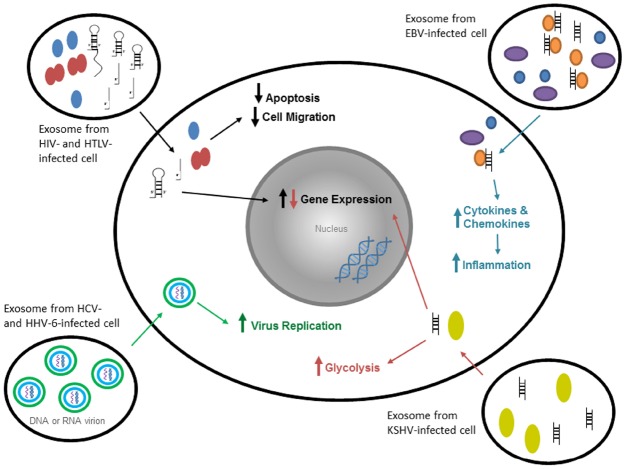
Infections that result in natural or manmade spread of lethal biological agents are a concern and require national and focused preparedness. In this manuscript, as part of an early diagnostics and pathogen treatment strategy, we have focused on extracellular vesicles (EVs) that arise following infections. Although the field of biodefense does not currently have a rich resource in EVs literature, none the less, similar pathogens belonging to the more classical emerging and non-emerging diseases have been studied in their EV/exosomal contents and function. These exosomes are formed in late endosomes and released from the cell membrane in almost every cell type in vivo. These vesicles contain proteins, RNA, and lipids from the cells they originate from and function in development, signal transduction, cell survival, and transfer of infectious material. The current review focuses on how different forms of infection exploit the exosomal pathway and how exosomes can be exploited artificially to treat infection and disease and potentially also be used as a source of vaccine. Virally-infected cells can secrete viral as well as cellular proteins and RNA in exosomes, allowing viruses to cause latent infection and spread of miRNA to nearby cells prior to a subsequent infection. In addition to virally-infected host cells, bacteria, protozoa, and fungi can all release small vesicles that contain pathogen-associated molecular patterns, regulating the neighboring uninfected cells. Examples of exosomes from both virally and bacterially infected cells point toward a re-programming network of pathways in the recipient cells. Finally, many of these exosomes contain cytokines and miRNAs that in turn can effect gene expression in the recipient cells through the classical toll-like receptor and NFκB pathway. Therefore, although exosomes do not replicate as an independent entity, they however facilitate movement of infectious material through tissues and may be the cause of many pathologies seen in infected hosts.
导致致命生物制剂自然或人为传播的感染令人担忧,需要国家层面的重点防范。在本论文中,作为早期诊断和病原体治疗策略的一部分,我们聚焦于感染后产生的细胞外囊泡(EVs)。尽管生物防御领域目前在细胞外囊泡文献方面资源并不丰富,但属于更经典的新发和非新发疾病的类似病原体的细胞外囊泡/外泌体内容物及功能已得到研究。这些外泌体在晚期内体中形成,并在体内几乎每种细胞类型中从细胞膜释放。这些囊泡包含来自其起源细胞的蛋白质、RNA和脂质,并在发育、信号转导、细胞存活及感染性物质传递中发挥作用。本综述重点关注不同形式的感染如何利用外泌体途径,以及如何人工利用外泌体治疗感染和疾病,并且它们还可能用作疫苗来源。病毒感染的细胞可在外泌体中分泌病毒及细胞蛋白和RNA,使病毒能够引起潜伏感染,并在后续感染之前将miRNA传播至附近细胞。除了病毒感染的宿主细胞外,细菌、原生动物和真菌都能释放包含病原体相关分子模式的小囊泡,从而调节邻近未感染的细胞。来自病毒和细菌感染细胞的外泌体实例都指向受体细胞中途径的重编程网络。最后,许多这些外泌体含有细胞因子和miRNA,它们进而可通过经典的Toll样受体和NFκB途径影响受体细胞中的基因表达。因此,尽管外泌体不会作为独立实体进行复制,但它们却促进感染性物质在组织中的移动,并且可能是感染宿主中许多病理现象的原因。