Awooda Elhadi Mohieldin, Ali Yasmeen Abdul-Hai
Department of Conservative Dentistry, University of Medical Sciences and Technology, Khartoum, Sudan.
J Int Soc Prev Community Dent. 2015 Sep-Oct;5(5):425-31. doi: 10.4103/2231-0762.165931.
Dento-alveolar trauma is a very common occurrence in childhood; however, there is a paucity of data about children's judgments in relation to dental status. There is a significant correlation between the children's incisor teeth status and the social judgments made by their peers.
The purpose of this study was to determine whether the social attributes of a school child would be influenced by his or her incisor teeth status. Also, it is aimed to determine the judgment between male and female children and different age groups within the same class.
A descriptive cross-sectional study conducted among 178 male and female children from year 5 (age 10-11 years) of primary school and year 2 of secondary school (age 14-15 years) within Khartoum state.
Students were invited to look at colored photographs of four different children's faces and to make a social judgment about these children's photographs. Using a previously validated child-centered questionnaire, participants rated subjects using a four-point Likert scale for three negative and six positive attributes.
Total attribute scores were tested for significant differences, according to whether the subject had visible incisor trauma or not, using t-test and analysis of variance (ANOVA) test with the level of significance set at P ≤ 0.05.
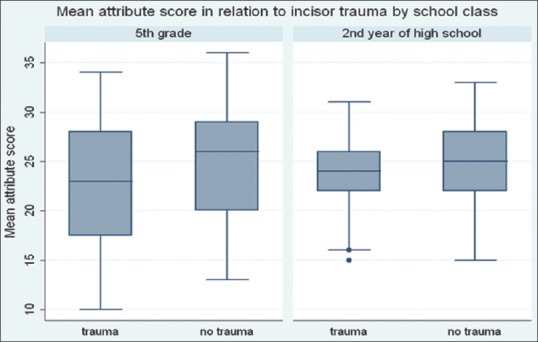
Children with visible incisor trauma were given more negative attributes than children without incisor trauma (P = 0.05). Results were similar in both genders and both school years. Younger students within the same class gave more negative attributes toward children with visible incisor trauma than their older peers, with P = 0.04 and P = 0.9 for children aged 10 years and 11 years, respectively.
The data confirmed results of previous studies that children with visible incisor trauma are seen more negatively than those without visible incisor trauma.
牙槽创伤在儿童时期非常常见;然而,关于儿童对牙齿状况的判断的数据却很匮乏。儿童门牙状况与同龄人做出的社会判断之间存在显著相关性。
本研究的目的是确定小学生的社会属性是否会受到其门牙状况的影响。此外,旨在确定同一班级中男女生以及不同年龄组之间的判断情况。
在喀土穆州对178名小学五年级(10 - 11岁)和初中二年级(14 - 15岁)的男女生进行了一项描述性横断面研究。
邀请学生观看四张不同儿童面部的彩色照片,并对这些儿童照片做出社会判断。使用先前经过验证的以儿童为中心的问卷,参与者对受试者在三个负面和六个正面属性方面使用四点李克特量表进行评分。
根据受试者是否有明显的门牙创伤,使用t检验和方差分析(ANOVA)测试总属性得分的显著差异,显著性水平设定为P≤0.05。
有明显门牙创伤的儿童比没有门牙创伤的儿童被赋予更多负面属性(P = 0.05)。在两个性别和两个学年中结果相似。同一班级中年龄较小的学生对有明显门牙创伤的儿童赋予的负面属性比年龄较大的同龄人更多,10岁和11岁儿童的P值分别为0.04和0.9。
数据证实了先前研究的结果,即有明显门牙创伤的儿童比没有明显门牙创伤的儿童被看得更负面。