Ferrara Emilio, Yang Zeyao
School of Informatics and Computing, Indiana University, Bloomington, IN, United States of America.
Information Sciences Institute, University of Southern California, Marina Del Rey, CA, United States of America.
PLoS One. 2015 Nov 6;10(11):e0142390. doi: 10.1371/journal.pone.0142390. eCollection 2015.
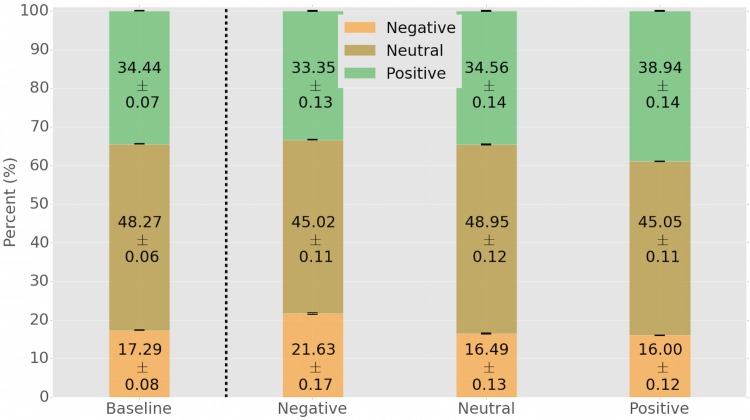
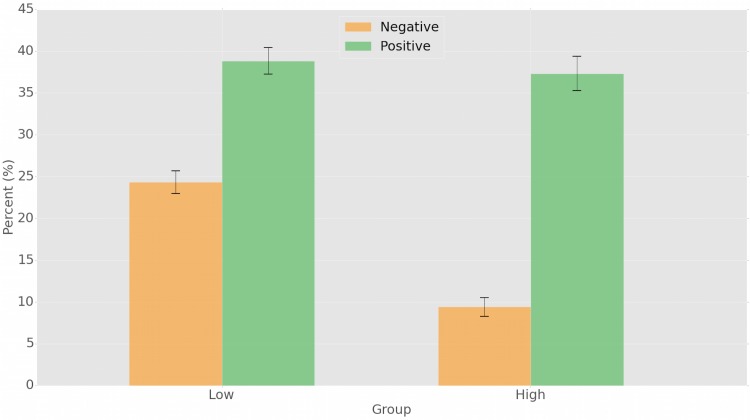
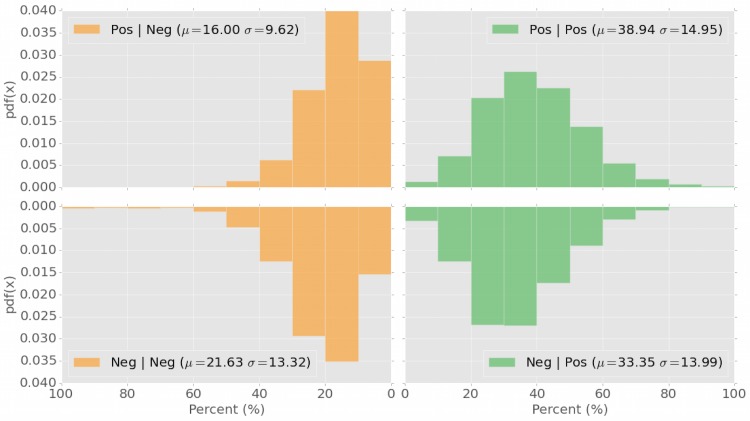
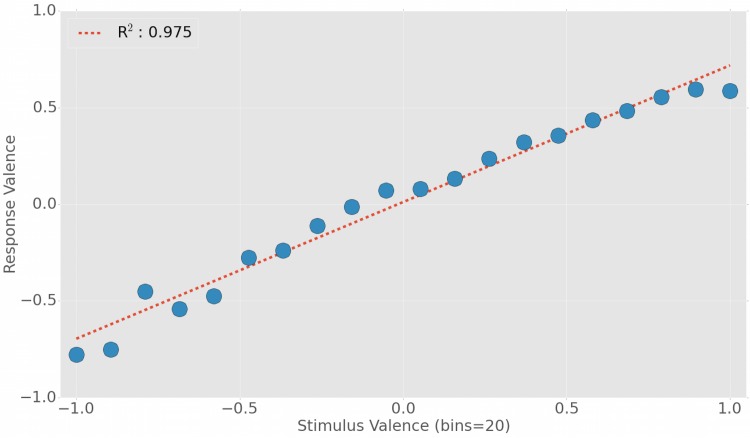
Social media are used as main discussion channels by millions of individuals every day. The content individuals produce in daily social-media-based micro-communications, and the emotions therein expressed, may impact the emotional states of others. A recent experiment performed on Facebook hypothesized that emotions spread online, even in absence of non-verbal cues typical of in-person interactions, and that individuals are more likely to adopt positive or negative emotions if these are over-expressed in their social network. Experiments of this type, however, raise ethical concerns, as they require massive-scale content manipulation with unknown consequences for the individuals therein involved. Here, we study the dynamics of emotional contagion using a random sample of Twitter users, whose activity (and the stimuli they were exposed to) was observed during a week of September 2014. Rather than manipulating content, we devise a null model that discounts some confounding factors (including the effect of emotional contagion). We measure the emotional valence of content the users are exposed to before posting their own tweets. We determine that on average a negative post follows an over-exposure to 4.34% more negative content than baseline, while positive posts occur after an average over-exposure to 4.50% more positive contents. We highlight the presence of a linear relationship between the average emotional valence of the stimuli users are exposed to, and that of the responses they produce. We also identify two different classes of individuals: highly and scarcely susceptible to emotional contagion. Highly susceptible users are significantly less inclined to adopt negative emotions than the scarcely susceptible ones, but equally likely to adopt positive emotions. In general, the likelihood of adopting positive emotions is much greater than that of negative emotions.
社交媒体每天都被数百万人用作主要的讨论渠道。个人在基于社交媒体的日常微交流中产生的内容以及其中所表达的情感,可能会影响他人的情绪状态。最近在脸书上进行的一项实验推测,情绪会在网上传播,即使在缺乏面对面互动中典型的非语言线索的情况下也是如此,而且如果个人在其社交网络中过度表达积极或消极情绪,那么他们就更有可能接受这些情绪。然而,这类实验引发了伦理问题,因为它们需要大规模地操纵内容,而这对其中涉及的个人会产生未知的后果。在这里,我们使用推特用户的随机样本研究情绪传染的动态过程,这些用户在2014年9月的一周内的活动(以及他们所接触到的刺激)都被观察到了。我们不是操纵内容,而是设计了一个零模型,以排除一些混杂因素(包括情绪传染的影响)。我们测量用户在发布自己的推文之前所接触到的内容的情感效价。我们确定,平均而言,一条负面推文在过度接触比基线多4.34%的负面内容之后出现,而正面推文则是在平均过度接触比基线多4.50%的正面内容之后出现。我们强调了用户所接触到的刺激的平均情感效价与他们所产生的回应的平均情感效价之间存在线性关系。我们还识别出两类不同的个体:对情绪传染高度敏感和几乎不敏感的个体。高度敏感的用户比几乎不敏感的用户明显更不容易接受负面情绪,但接受正面情绪的可能性相同。总体而言,接受正面情绪的可能性远大于接受负面情绪的可能性。