Macura Sherrill L, Lathrop Melissa J, Gui Jiang, Doncel Gustavo F, Asin Susana N, Rollenhagen Christiane
*Research Service, V. A. Medical Center, White River Junction, VT; †Center for Devices and Radiological Health, Food and Drug Administration, Office of Device Evaluation, Silver Spring, MD; ‡Division of Select Agents and Toxins, Centers for Disease Control and Prevention, Atlanta, GA; §Department of Biomedical Data Science, Geisel School of Medicine at Dartmouth, Lebanon, NH; ‖CONRAD, Eastern Virginia Medical School, Norfolk, VA; ¶Department of Microbiology and Immunology, Geisel School of Medicine at Dartmouth, Lebanon, NH; and #Department of Medicine, Geisel School of Medicine at Dartmouth, Lebanon, NH.
J Acquir Immune Defic Syndr. 2016 Apr 15;71(5):474-82. doi: 10.1097/QAI.0000000000000891.
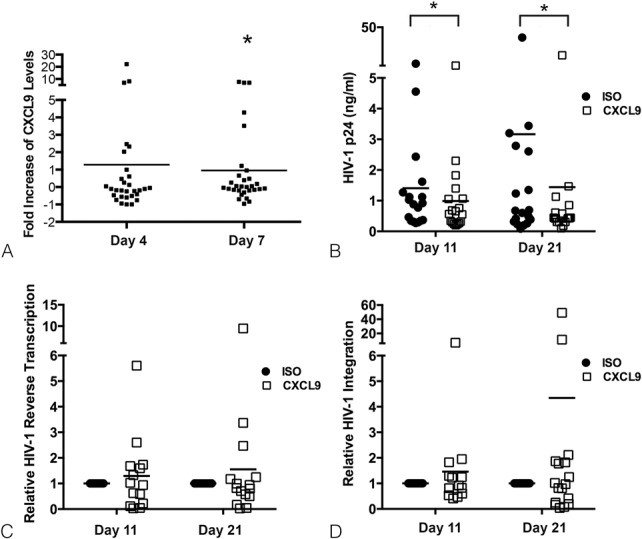
The interferon-gamma-induced chemokine CXCL9 is expressed in a wide range of inflammatory conditions including those affecting the female genital tract. CXCL9 promotes immune cell recruitment, activation, and proliferation. The role of CXCL9 in modulating HIV-1 infection of cervicovaginal tissues, a main portal of viral entry, however, has not been established. We report a link between CXCL9 and HIV-1 replication in human cervical tissues and propose CXCL9 as a potential target to enhance the anti-HIV-1 activity of prophylactic antiretrovirals.
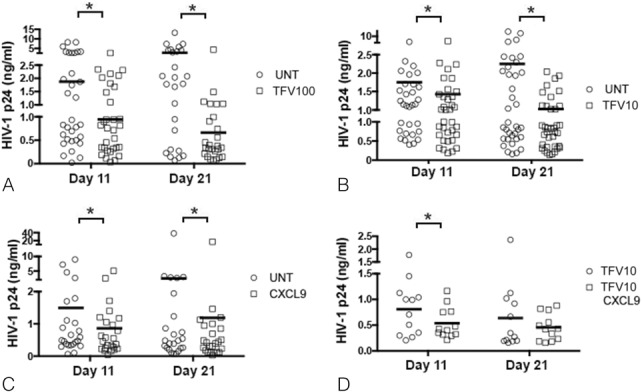
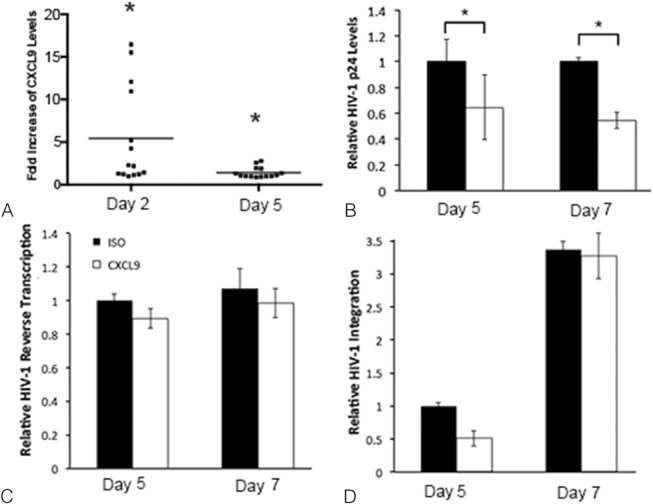
Using ex vivo infection of human cervical tissues as a model of mucosal HIV-1 acquisition, we described the effect of CXCL9 neutralization on HIV-1 gene expression and mucosal CD4 T-cell activation. The anti-HIV-1 activity of tenofovir, the leading mucosal pre-exposure prophylactic microbicide, alone or in combination with CXCL9 neutralization was also studied.
HIV-1 replication was evaluated by p24 ELISA. HIV-1 DNA and RNA, and CD4, CCR5, and CD38 transcription were evaluated by quantitative real-time polymerase chain reaction. Frequency of activated cervical CD4 T cells was quantified using fluorescence-activated cell sorting.
Antibody blocking of CXCL9 reduced HIV-1 replication by decreasing mucosal CD4 T-cell activation. CXCL9 neutralization in combination with suboptimal concentrations of tenofovir, possibly present in the cervicovaginal tissues of women using the drug inconsistently, demonstrated an earlier and greater decrease in HIV-1 replication compared with tissues treated with tenofovir alone.
CXCL9 neutralization reduces HIV-1 replication and may be an effective target to enhance the efficacy of prophylactic antiretrovirals.
干扰素γ诱导的趋化因子CXCL9在多种炎症状态下表达,包括那些影响女性生殖道的炎症。CXCL9促进免疫细胞募集、激活和增殖。然而,CXCL9在调节宫颈阴道组织(病毒进入的主要门户)的HIV-1感染中的作用尚未明确。我们报告了CXCL9与人类宫颈组织中HIV-1复制之间的联系,并提出CXCL9作为增强预防性抗逆转录病毒药物抗HIV-1活性的潜在靶点。
使用人类宫颈组织的体外感染作为黏膜HIV-1感染的模型,我们描述了CXCL9中和对HIV-1基因表达和黏膜CD4 T细胞激活的影响。还研究了替诺福韦(主要的黏膜暴露前预防性杀微生物剂)单独或与CXCL9中和联合使用时的抗HIV-1活性。
通过p24 ELISA评估HIV-1复制。通过定量实时聚合酶链反应评估HIV-1 DNA和RNA以及CD4、CCR5和CD38转录。使用荧光激活细胞分选法定量激活的宫颈CD4 T细胞频率。
CXCL9的抗体阻断通过降低黏膜CD4 T细胞激活来减少HIV-1复制。CXCL9中和与次优浓度的替诺福韦联合使用(可能存在于不规律使用该药物的女性宫颈阴道组织中),与单独用替诺福韦处理的组织相比,HIV-1复制的下降更早且更明显。
CXCL9中和可减少HIV-1复制,可能是增强预防性抗逆转录病毒药物疗效的有效靶点。