Zheng Yuanhui, Soeriyadi Alexander H, Rosa Lorenzo, Ng Soon Hock, Bach Udo, Justin Gooding J
School of Chemistry, The University of New South Wales, Sydney, New South Wales 2052, Australia.
Australian Centre for NanoMedicine, The University of New South Wales, Sydney, New South Wales 2052, Australia.
Nat Commun. 2015 Nov 9;6:8797. doi: 10.1038/ncomms9797.
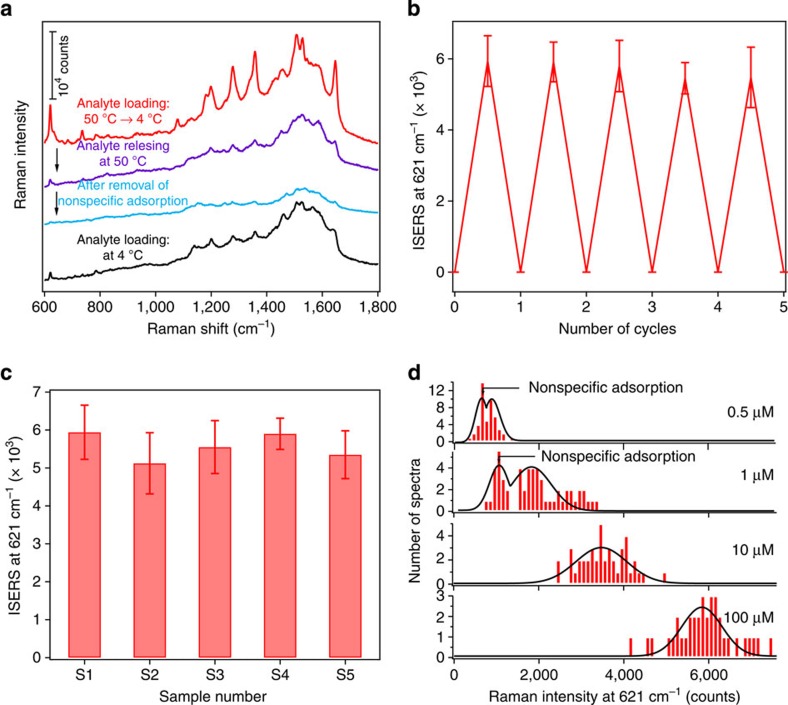
Single-molecule surface-enhanced Raman spectroscopy (SERS) has attracted increasing interest for chemical and biochemical sensing. Many conventional substrates have a broad distribution of SERS enhancements, which compromise reproducibility and result in slow response times for single-molecule detection. Here we report a smart plasmonic sensor that can reversibly trap a single molecule at hotspots for rapid single-molecule detection. The sensor was fabricated through electrostatic self-assembly of gold nanoparticles onto a gold/silica-coated silicon substrate, producing a high yield of uniformly distributed hotspots on the surface. The hotspots were isolated with a monolayer of a thermoresponsive polymer (poly(N-isopropylacrylamide)), which act as gates for molecular trapping at the hotspots. The sensor shows not only a good SERS reproducibility but also a capability to repetitively trap and release molecules for single-molecular sensing. The single-molecule sensitivity is experimentally verified using SERS spectral blinking and bianalyte methods.
单分子表面增强拉曼光谱(SERS)在化学和生化传感领域引起了越来越多的关注。许多传统基底的SERS增强效果分布广泛,这会影响重现性,并导致单分子检测的响应时间延长。在此,我们报道了一种智能等离子体传感器,它能够在热点处可逆地捕获单个分子,以实现快速单分子检测。该传感器通过将金纳米颗粒静电自组装到金/二氧化硅涂层的硅基底上制备而成,在表面产生了高产量的均匀分布热点。这些热点被一层热响应聚合物(聚(N-异丙基丙烯酰胺))隔离,该聚合物充当分子在热点处捕获的门控。该传感器不仅具有良好的SERS重现性,还具备重复捕获和释放分子以进行单分子传感的能力。单分子灵敏度通过SERS光谱闪烁和双分析物方法进行了实验验证。