Urabe Shigetoshi, Isomoto Hajime, Ishida Tetsuya, Maeda Kazumi, Inamine Tatsuo, Kondo Shinji, Higuchi Norihide, Sato Kayoko, Uehara Ryohei, Yajima Hiroyuki, Machida Haruhisa, Chen Chun Chuan, Fukuda Yasuhiro, Takeshima Fuminao, Nakao Kazuhiko, Tsukamoto Kazuhiro
Department of Gastroenterology and Hepatology, Nagasaki University Hospital, 1-7-1 Sakamoto, Nagasaki 852-8501, Japan.
Department of Gastroenterology, Oita Red Cross Hospital, 3-2-27 Chiyo-machi, Oita 870-0033, Japan.
Biomed Res Int. 2015;2015:416838. doi: 10.1155/2015/416838. Epub 2015 Oct 19.
We aimed to identify certain genes related to response to infliximab (IFX) and biomarkers to predict the IFX effect for Japanese Crohn's disease (CD) patients by performing an association study of single nucleotide polymorphisms (SNPs) in candidate genes in the interleukin- (IL-) 17 signaling pathway with response to IFX after 1 year of treatment.
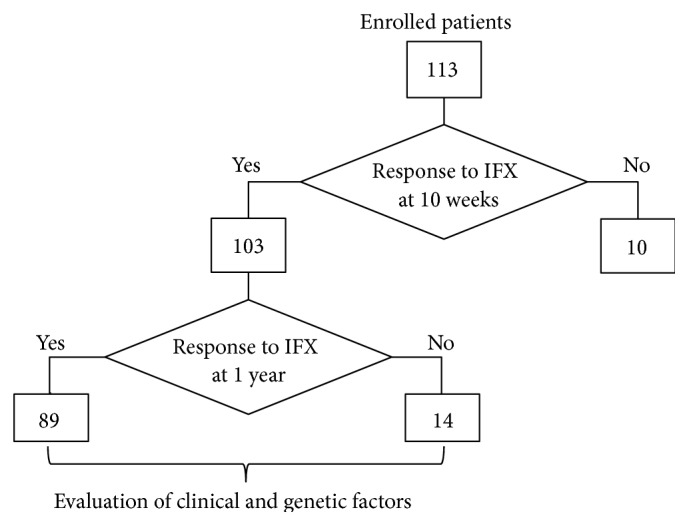
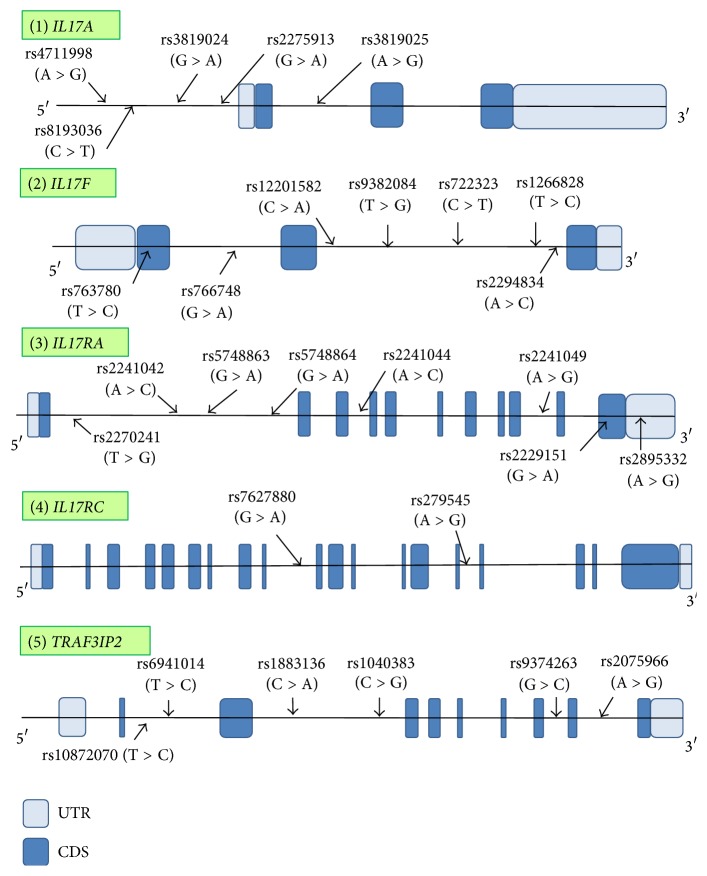
A total of 103 patients were divided into two groups, responders and nonresponders. Twenty-eight tag SNPs in 5 genes were genotyped. The frequencies of alleles and genotypes of each SNP were compared between responders and nonresponders in three different inheritance models. A genetic test was performed using a combination of the associated SNPs as biomarkers.
Multivariate logistic regression analysis indicated that the four variable factors, concomitant use of immunomodulators, penetrating disease, a G/G genotype of rs766748 in IL-17F, and a C/C or C/A genotype of rs1883136 in TRAF3IP2, independently contributed to response to IFX after 1 year of treatment. Genetic test using the polymorphisms of these genes perfectly predicted the responder and nonresponder CD patients with both concomitant use of immunomodulators and penetrating disease.
IL17F and TRAF3IP2 are one of IFX-related genes, useful as biomarkers of IFX response, and may be target molecules for new therapeutic drugs.
我们旨在通过对白细胞介素-(IL-)17信号通路中候选基因的单核苷酸多态性(SNP)与治疗1年后英夫利昔单抗(IFX)反应进行关联研究,来确定与日本克罗恩病(CD)患者对IFX反应相关的某些基因和预测IFX疗效的生物标志物。
总共103例患者被分为两组,即反应者和无反应者。对5个基因中的28个标签SNP进行基因分型。在三种不同的遗传模型中比较反应者和无反应者之间每个SNP的等位基因和基因型频率。使用相关SNP的组合作为生物标志物进行基因检测。
多变量逻辑回归分析表明,四个可变因素,即免疫调节剂的联合使用、穿透性疾病、IL-17F中rs766748的G/G基因型以及TRAF3IP2中rs1883136的C/C或C/A基因型,独立地影响治疗1年后对IFX的反应。使用这些基因的多态性进行的基因检测能够完美预测同时使用免疫调节剂和患有穿透性疾病的反应者和无反应者CD患者。
IL17F和TRAF3IP2是与IFX相关的基因之一,可作为IFX反应的生物标志物,并且可能是新型治疗药物的靶分子。