
来自中高流行国家的移民和难民中丙型肝炎抗体的血清流行率:一项系统评价和荟萃分析。
The Seroprevalence of Hepatitis C Antibodies in Immigrants and Refugees from Intermediate and High Endemic Countries: A Systematic Review and Meta-Analysis.
作者信息
Greenaway Christina, Thu Ma Ann, Kloda Lorie A, Klein Marina, Cnossen Sonya, Schwarzer Guido, Shrier Ian
机构信息
Division of Infectious Diseases, Jewish General Hospital, McGill University, Montreal, Canada.
Centre for Clinical Epidemiology, Lady Davis Research Institute for Medical Research, Jewish General Hospital, Montreal, Canada.
出版信息
PLoS One. 2015 Nov 11;10(11):e0141715. doi: 10.1371/journal.pone.0141715. eCollection 2015.
BACKGROUND & AIMS: Hepatitis C virus (HCV) infection is a significant global health issue that leads to 350,000 preventable deaths annually due to associated cirrhosis and hepatocellular carcinoma (HCC). Immigrants and refugees (migrants) originating from intermediate/high HCV endemic countries are likely at increased risk for HCV infection due to HCV exposure in their countries of origin. The aim of this study was to estimate the HCV seroprevalence of the migrant population living in low HCV prevalence countries.
METHODS
Four electronic databases were searched from database inception until June 17, 2014 for studies reporting the prevalence of HCV antibodies among migrants. Seroprevalence estimates were pooled with a random-effect model and were stratified by age group, region of origin and migration status and a meta-regression was modeled to explore heterogeneity.
RESULTS
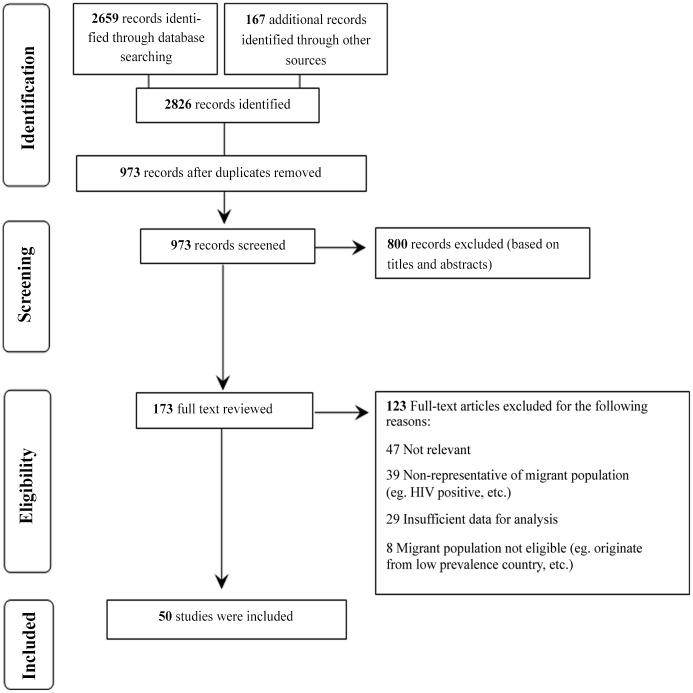
Data from 50 studies representing 38,635 migrants from all world regions were included. The overall anti-HCV prevalence (representing previous and current infections) was 1.9% (95% CI, 1.4-2.7%, I2 96.1). Older age and region of origin, particularly Sub-Saharan Africa, Asia, and Eastern Europe were the strongest predictors of HCV seroprevalence. The estimated HCV seroprevalence of migrants from these regions was >2% and is higher than that reported for most host populations.
CONCLUSION
Adult migrants originating from Asia, Sub-Saharan Africa and Eastern Europe are at increased risk for HCV and may benefit from targeted HCV screening.
背景与目的
丙型肝炎病毒(HCV)感染是一个重大的全球健康问题,每年因相关的肝硬化和肝细胞癌(HCC)导致350,000例可预防死亡。来自丙型肝炎病毒中/高流行国家的移民和难民(移民群体)由于在其原籍国接触丙型肝炎病毒,感染风险可能增加。本研究的目的是估计生活在丙型肝炎病毒低流行国家的移民群体的丙型肝炎病毒血清流行率。
方法
检索了四个电子数据库,从建库至2014年6月17日,查找报告移民中丙型肝炎病毒抗体流行率的研究。血清流行率估计值采用随机效应模型进行汇总,并按年龄组、原籍地区和移民身份进行分层,同时建立元回归模型以探讨异质性。
结果
纳入了来自全球所有地区的50项研究的数据,共38,635名移民。抗-HCV总体流行率(代表既往和当前感染)为1.9%(95%CI,1.4 - 2.7%,I² 96.1)。年龄较大以及原籍地区,特别是撒哈拉以南非洲、亚洲和东欧,是丙型肝炎病毒血清流行率的最强预测因素。来自这些地区的移民估计丙型肝炎病毒血清流行率>2%,高于大多数宿主人群报告的流行率。
结论
来自亚洲、撒哈拉以南非洲和东欧的成年移民感染丙型肝炎病毒的风险增加,可能受益于针对性的丙型肝炎病毒筛查。



 Zotero 插件