Mewes Janne C, Steuten Lotte M G, Groeneveld Iris F, de Boer Angela G E M, Frings-Dresen Monique H W, IJzerman Maarten J, van Harten Wim H
Health Technology and Services Research, Faculty of Behavioural, Management and Social Sciences, University of Twente, PO Box 217, 7500 AE, Enschede, The Netherlands.
Hutchinson Institute for Cancer Outcomes Research, University of Washington, 1110 Fairview Avenue North, 98109 WA, Seattle, USA.
BMC Cancer. 2015 Nov 12;15:899. doi: 10.1186/s12885-015-1912-7.
Return-to-work (RTW)-interventions support cancer survivors in resuming work, but come at additional healthcare costs. The objective of this study was to assess the budget impact of a RTW-intervention, consisting of counselling sessions with an occupational physician and an exercise-programme. The secondary objective was to explore how the costs of RTW-interventions and its financial revenues are allocated among the involved stakeholders in several EU-countries.
The budget impact (BI) of a RTW-intervention versus usual care was analysed yearly for 2015-2020 from a Dutch societal- and from the perspective of a large cancer centre. The allocation of the expected costs and financial benefits for each of the stakeholders involved was compared between the Netherlands, Belgium, England, France, Germany, Italy, and Sweden.
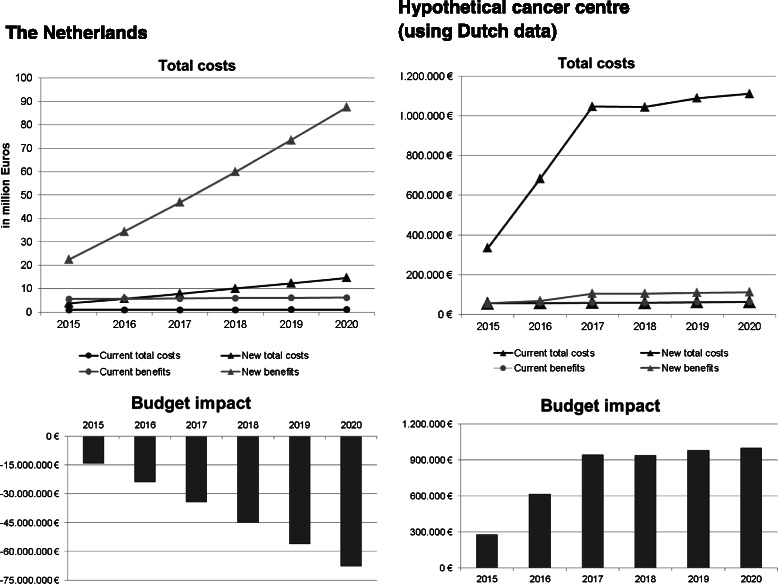
The average intervention costs in this case were €1,519/patient. The BI for the Netherlands was €-14.7 m in 2015, rising to €-71.1 m in 2020, thus the intervention is cost-saving as the productivity benefits outweigh the intervention costs. For cancer centres the BI amounts to €293 k in 2015, increasing to €1.1 m in 2020. Across European countries, we observed differences regarding the extent to which stakeholders either invest or receive a share of the benefits from offering a RTW-intervention.
The RTW-intervention is cost-saving from a societal perspective. Yet, the total intervention costs are considerable and, in many European countries, mainly covered by care providers that are not sufficiently reimbursed.
重返工作岗位(RTW)干预措施有助于癌症幸存者恢复工作,但会带来额外的医疗保健成本。本研究的目的是评估一项RTW干预措施的预算影响,该措施包括与职业医生进行咨询和开展一项锻炼计划。次要目的是探讨RTW干预措施的成本及其财政收入在几个欧盟国家的相关利益相关者之间如何分配。
从荷兰社会角度以及一家大型癌症中心的角度,对2015 - 2020年期间RTW干预措施与常规护理的预算影响(BI)进行年度分析。比较了荷兰、比利时、英国、法国、德国、意大利和瑞典涉及的每个利益相关者的预期成本和财政收益分配情况。
在这种情况下,平均干预成本为每位患者1519欧元。荷兰2015年的BI为 - 1470万欧元,到2020年升至 - 7110万欧元,因此该干预措施节省成本,因为生产力收益超过了干预成本。对于癌症中心,2015年的BI为29.3万欧元,到2020年增至110万欧元。在欧洲各国,我们观察到利益相关者在提供RTW干预措施时投入或获得收益份额的程度存在差异。
从社会角度来看,RTW干预措施节省成本。然而,干预总成本相当可观,而且在许多欧洲国家,主要由未得到充分补偿的医疗服务提供者承担。