Eriksson Crommert M, Halvorsen K, Ekblom M M
Faculty of Medicine and Health, Örebro University, Örebro, Sweden.
The Swedish School of Sport and Health Sciences (GIH), Stockholm, Sweden.
PLoS One. 2015 Nov 12;10(11):e0141777. doi: 10.1371/journal.pone.0141777. eCollection 2015.
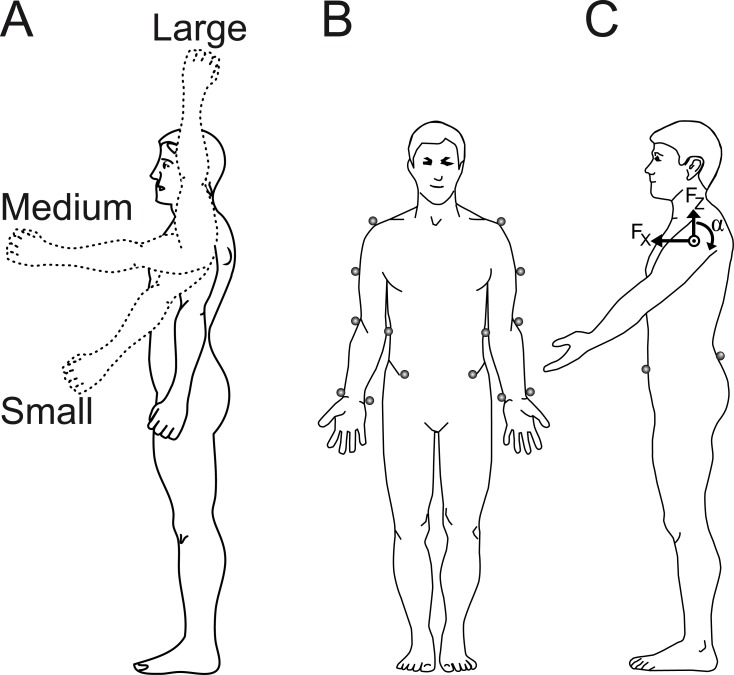
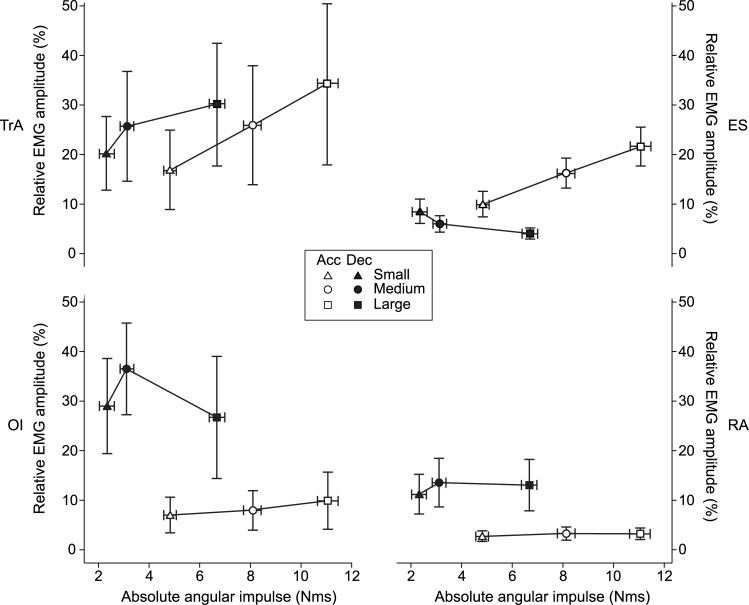
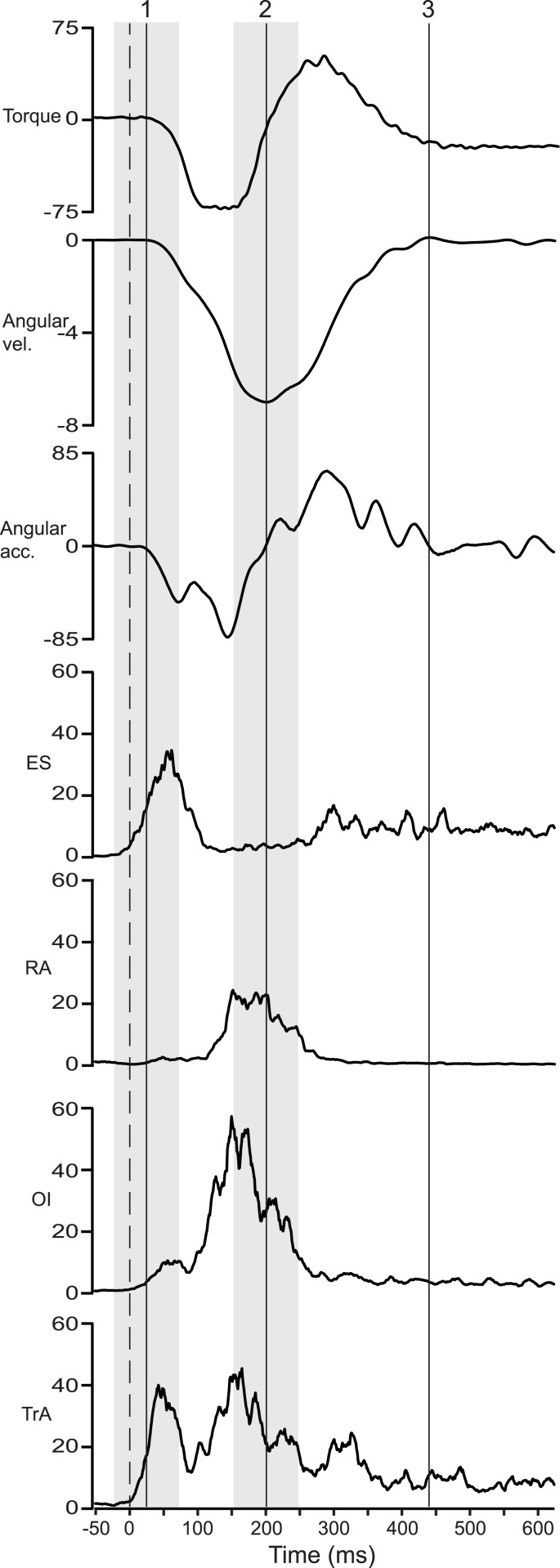
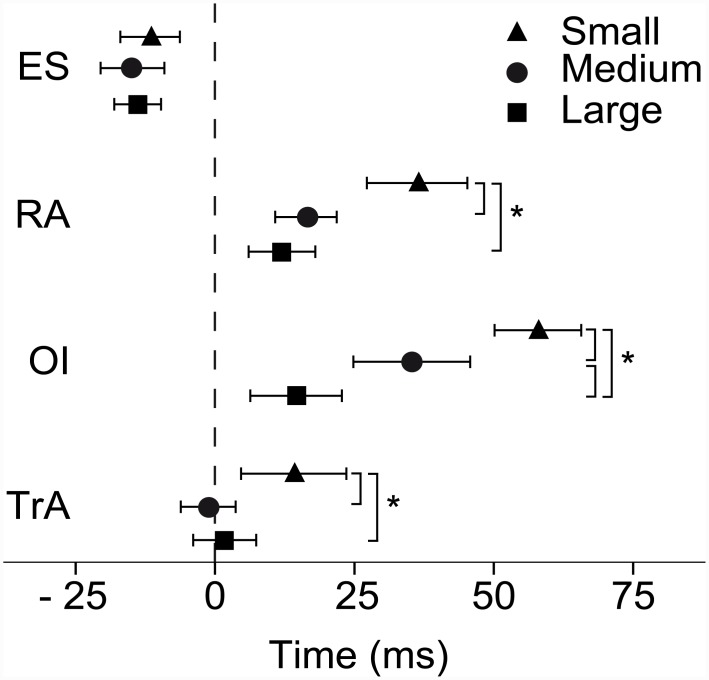
The aim of this study was to investigate if trunk muscle activation patterns during rapid bilateral shoulder flexions are affected by movement amplitude. Eleven healthy males performed shoulder flexion movements starting from a position with arms along sides (0°) to either 45°, 90° or 180°. EMG was measured bilaterally from transversus abdominis (TrA), obliquus internus (OI) with intra-muscular electrodes, and from rectus abdominis (RA), erector spinae (ES) and deltoideus with surface electrodes. 3D kinematics was recorded and inverse dynamics was used to calculate the reactive linear forces and torque about the shoulders and the linear and angular impulses. The sequencing of trunk muscle onsets at the initiation of arm movements was the same across movement amplitudes with ES as the first muscle activated, followed by TrA, RA and OI. All arm movements induced a flexion angular impulse about the shoulders during acceleration that was reversed during deceleration. Increased movement amplitude led to shortened onset latencies of the abdominal muscles and increased level of activation in TrA and ES. The activation magnitude of TrA was similar in acceleration and deceleration where the other muscles were specific to acceleration or deceleration. The findings show that arm movements need to be standardized when used as a method to evaluate trunk muscle activation patterns and that inclusion of the deceleration of the arms in the analysis allow the study of the relationship between trunk muscle activation and direction of perturbing torque during one and the same arm movement.
本研究的目的是调查在快速双侧肩部屈曲过程中,躯干肌肉激活模式是否受运动幅度的影响。11名健康男性进行肩部屈曲运动,起始姿势为双臂沿身体两侧(0°),运动幅度分别为45°、90°或180°。使用肌内电极双侧测量腹横肌(TrA)、腹内斜肌(OI)的肌电图,使用表面电极测量腹直肌(RA)、竖脊肌(ES)和三角肌的肌电图。记录三维运动学数据,并使用逆动力学计算肩部的反应性线性力和扭矩以及线性和角冲量。在不同运动幅度下,手臂运动开始时躯干肌肉起始的顺序相同,首先激活的肌肉是ES,随后是TrA、RA和OI。所有手臂运动在加速过程中都会引起肩部的屈曲角冲量,在减速过程中该角冲量会反转。运动幅度增加导致腹部肌肉的起始潜伏期缩短,TrA和ES的激活水平增加。TrA在加速和减速过程中的激活幅度相似,而其他肌肉则分别在加速或减速过程中具有特异性激活。研究结果表明,当将手臂运动用作评估躯干肌肉激活模式的方法时,手臂运动需要标准化,并且在分析中纳入手臂的减速过程,有助于研究在同一次手臂运动中躯干肌肉激活与干扰扭矩方向之间的关系。