Lu Yang, Liu Xianming, Wang Weixiao, Cheng Jinbing, Yan Hailong, Tang Chengchun, Kim Jang-Kyo, Luo Yongsong
Key Laboratory of Advanced Micro/Nano Functional Materials, School of Physics and Electronic Engineering, Xinyang Normal University, Xinyang, P. R. China.
School of Material Science and Engineering, Hebei University of Technology, Tianjin, P. R. China.
Sci Rep. 2015 Nov 16;5:16584. doi: 10.1038/srep16584.
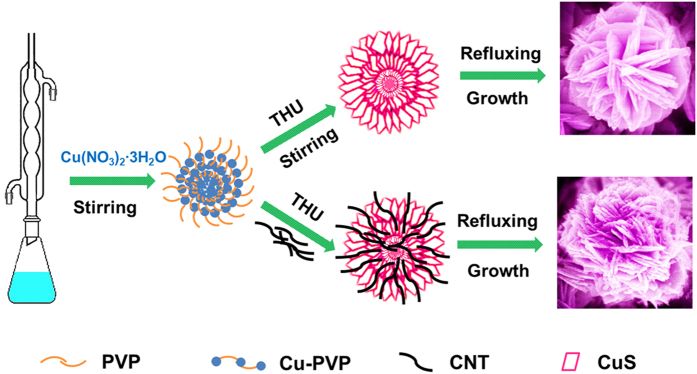
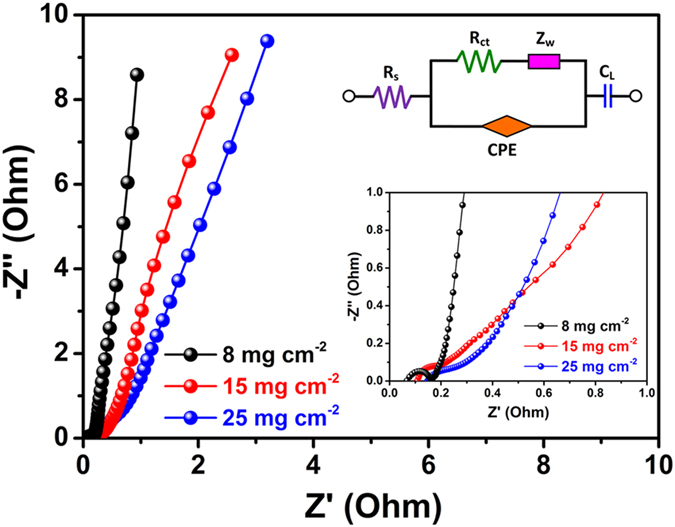
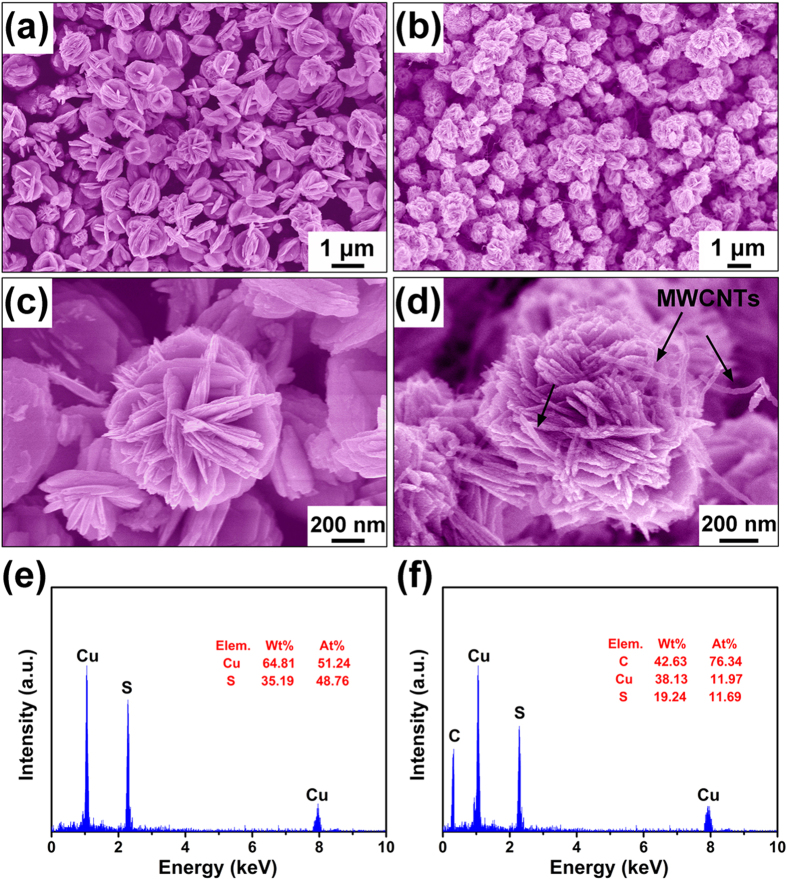
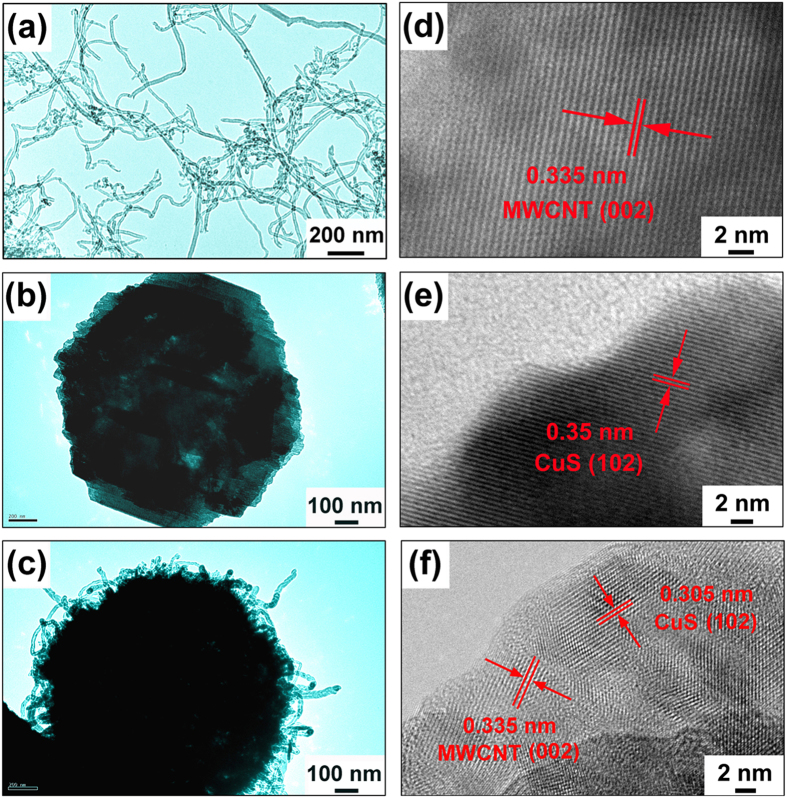
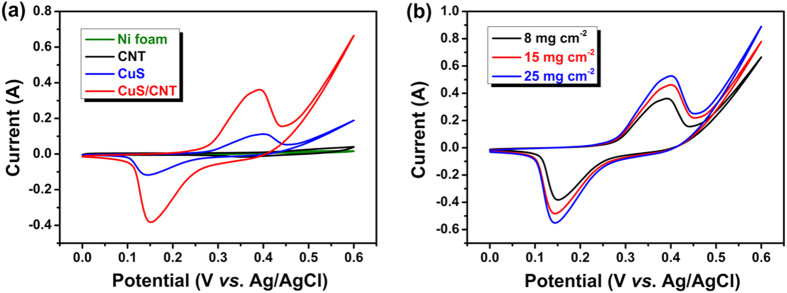
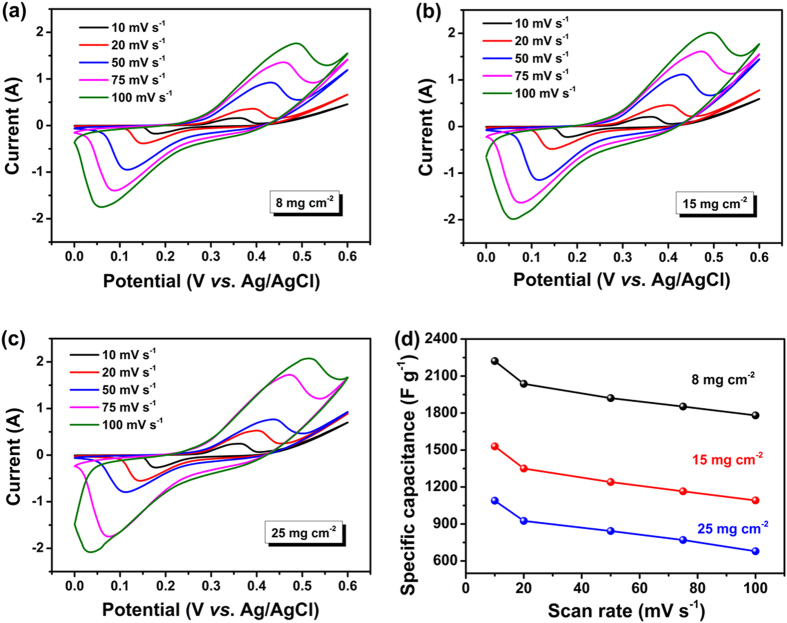
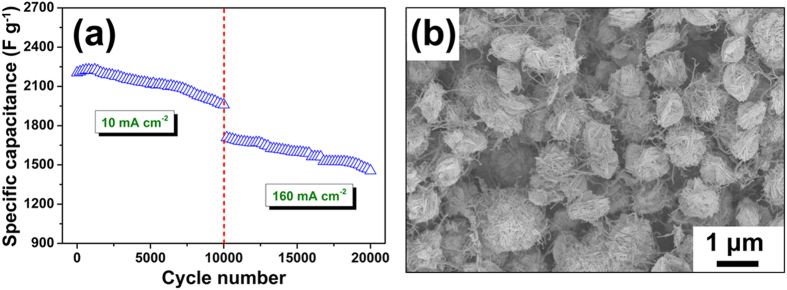
Carbon nanotubes (CNTs) incorporated porous 3-dimensional (3D) CuS microspheres have been successfully synthesized via a simple refluxing method assisted by PVP. The composites are composed of flower-shaped CuS secondary microspheres, which in turn are assembled with primary nanosheets of 15-30 nm in thickness and fully integrated with CNT. The composites possess a large specific surface area of 189.6 m(2) g(-1) and a high conductivity of 0.471 S cm(-1). As electrode materials for supercapacitors, the nanocomposites show excellent cyclability and rate capability and deliver an average reversible capacitance as high as 1960 F g(-1) at a current density of 10 mA cm(-2) over 10000 cycles. The high electrochemical performance can be attributed to the synergistic effect of CNTs and the unique microstructure of CuS. The CNTs serve as not only a conductive agent to accelerate the transfer of electrons in the composites, but also as a buffer matrix to restrain the volume change and stabilize the electrode structure during the charge/discharge process. The porous structure of CuS also helps to stabilize the electrode structure and facilitates the transport for electrons.
通过聚乙烯吡咯烷酮(PVP)辅助的简单回流法,成功合成了碳纳米管(CNT)复合的多孔三维(3D)硫化铜微球。该复合材料由花状的硫化铜次级微球组成,这些次级微球又由厚度为15 - 30纳米的初级纳米片组装而成,并与碳纳米管完全整合。该复合材料具有189.6 m² g⁻¹的大比表面积和0.471 S cm⁻¹的高电导率。作为超级电容器的电极材料,该纳米复合材料表现出优异的循环稳定性和倍率性能,在10 mA cm⁻²的电流密度下经过10000次循环,平均可逆电容高达1960 F g⁻¹。这种高电化学性能可归因于碳纳米管与硫化铜独特微观结构的协同效应。碳纳米管不仅作为导电剂加速复合材料中电子的转移,还作为缓冲基质抑制体积变化并在充放电过程中稳定电极结构。硫化铜的多孔结构也有助于稳定电极结构并促进电子传输。