DeVaughn S, Müller-Oehring E M, Markey B, Brontë-Stewart H M, Schulte T
Bioscience Division, Neuroscience Program, SRI International, 333 Ravenswood Ave, Menlo Park, CA, USA.
Pacific Graduate School of Psychology, Palo Alto University, Palo Alto, CA, USA.
Neuropsychol Rev. 2015 Dec;25(4):424-38. doi: 10.1007/s11065-015-9305-x. Epub 2015 Nov 17.
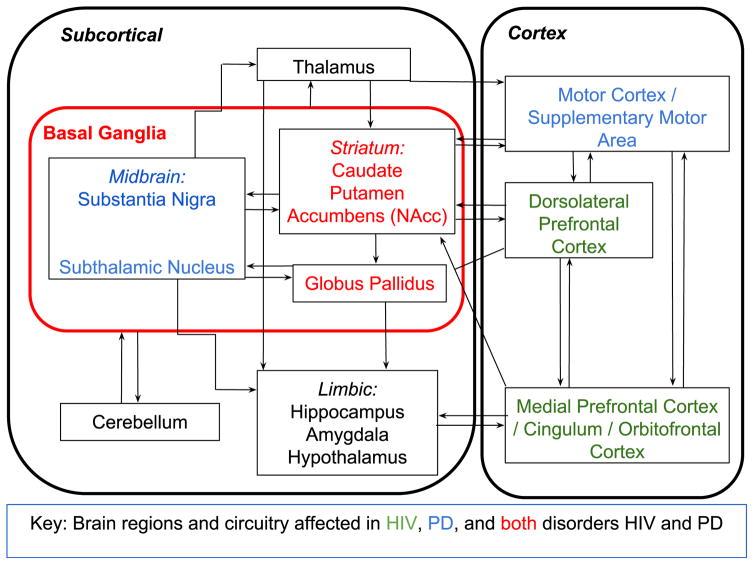
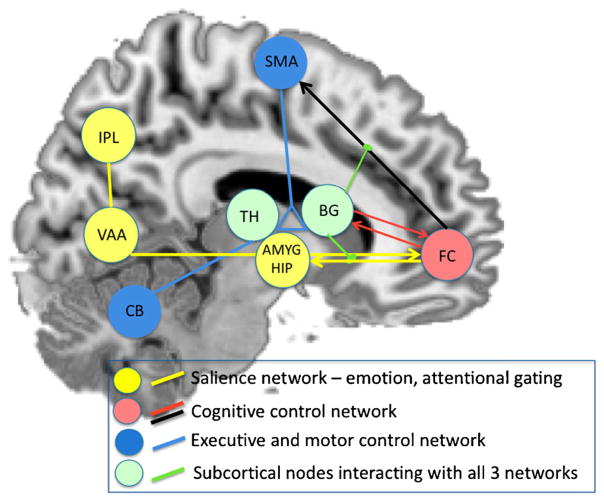
Recent advances in highly active anti-retroviral therapy (HAART) in their various combinations have dramatically increased the life expectancies of HIV-infected persons. People diagnosed with HIV are living beyond the age of 50 but are experiencing the cumulative effects of HIV infection and aging on brain function. In HIV-infected aging individuals, the potential synergy between immunosenescence and HIV viral loads increases susceptibility to HIV-related brain injury and functional brain network degradation similar to that seen in Parkinson's disease (PD), the second most common neurodegenerative disorder in the aging population. Although there are clear diagnostic differences in the primary pathology of both diseases, i.e., death of dopamine-generating cells in the substantia nigra in PD and neuroinflammation in HIV, neurotoxicity to dopaminergic terminals in the basal ganglia (BG) has been implied in the pathogenesis of HIV and neuroinflammation in the pathogenesis of PD. Similar to PD, HIV infection affects structures of the BG, which are part of interconnected circuits including mesocorticolimbic pathways linking brainstem nuclei to BG and cortices subserving attention, cognitive control, and motor functions. The present review discusses the combined effects of aging and neuroinflammation in HIV individuals on cognition and motor function in comparison with age-related neurodegenerative processes in PD. Despite the many challenges, some HIV patients manage to age successfully, most likely by redistribution of neural network resources to enhance function, as occurs in healthy elderly; such compensation could be curtailed by emerging PD.
高效抗逆转录病毒疗法(HAART)各种组合的最新进展显著提高了HIV感染者的预期寿命。被诊断出感染HIV的人活到了50岁以上,但正经历着HIV感染和衰老对脑功能的累积影响。在感染HIV的老年个体中,免疫衰老与HIV病毒载量之间的潜在协同作用增加了对HIV相关脑损伤和功能性脑网络退化的易感性,这与帕金森病(PD)(老年人群中第二常见的神经退行性疾病)所见情况相似。尽管这两种疾病的主要病理学存在明显的诊断差异,即PD中黑质产生多巴胺的细胞死亡和HIV中的神经炎症,但基底神经节(BG)中多巴胺能终末的神经毒性在HIV发病机制中有所暗示,而神经炎症在PD发病机制中也有体现。与PD相似,HIV感染会影响BG的结构,BG是相互连接的神经回路的一部分,包括连接脑干核与BG以及负责注意力、认知控制和运动功能的皮质的中脑皮质边缘通路。本综述讨论了HIV感染者衰老和神经炎症对认知和运动功能的综合影响,并与PD中与年龄相关的神经退行性过程进行了比较。尽管存在诸多挑战,但一些HIV患者仍能成功衰老,很可能是通过重新分配神经网络资源来增强功能,就像健康老年人那样;而新出现的PD可能会削弱这种代偿作用。