Yang Jielai, Zhu Bin, Fu Kai, Yang Qingcheng
Department of Orthopedics, Shanghai Jiao Tong University Affiliated Sixth People's Hospital, Shanghai, 200233, China.
J Orthop Surg Res. 2015 Nov 17;10:177. doi: 10.1186/s13018-015-0324-3.
Biological reconstruction surgery is a tough but alluring option for treating primary malignant musculoskeletal tumors. In this article, we evaluate the clinical outcomes of primary malignant musculoskeletal tumors treated with inactivated autograft using alcohol.
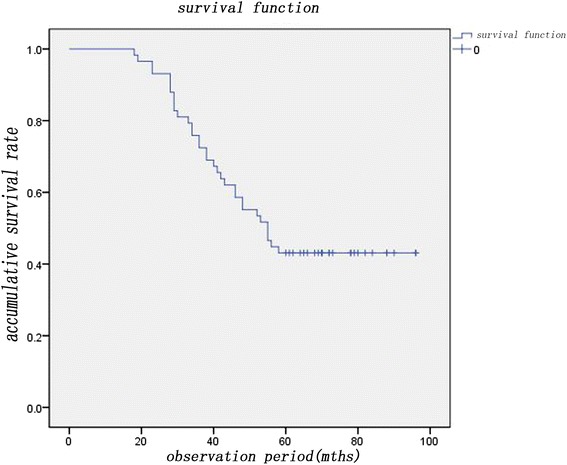
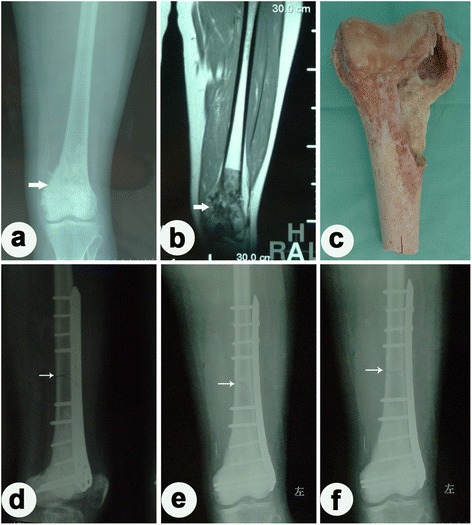
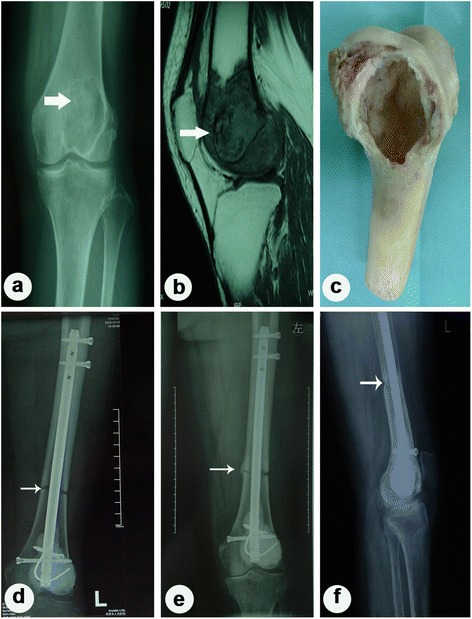
In this article, we include 58 patients who had primary malignant bone tumors treated with wide resection and recycling autograft reconstruction using alcohol between January 2003 and January 2013. The outcomes were measured by recurrence, functional status, and complications. Functional status was assessed according to the Musculoskeletal Tumor Society Score (MSTSS). The Kaplan-Meier survival curve was used to evaluate the survival rate of the patient.
The most common tumor was osteosarcoma (31 cases) followed by chondrosarcoma (10 cases). The tibia was the most frequently involved skeletal site (27 cases) followed by femur (26 cases). The median follow-up period was 54 months, ranging from 18 to 96 months. In 58 patients, 12 were with local recurrence (20.7 %), 16 with lung metastasis (27.6 %), and 13 with complications (22.4 %). The main complication was infection (8 cases). The autografts survived in 49 patients (84.5 %). The mean MSTSS score was 78.5 %, ranging from 47 to 98 %.
Recycling autograft reconstruction using alcohol had favorable clinical outcomes to some degree; however, the recurrence and complication rates seem to be high. Thus, we should apply this method with caution and choose the patients with strict surgical indication.
生物重建手术是治疗原发性恶性肌肉骨骼肿瘤的一种艰难但诱人的选择。在本文中,我们评估了使用酒精灭活自体移植治疗原发性恶性肌肉骨骼肿瘤的临床结果。
本文纳入了2003年1月至2013年1月期间58例接受广泛切除并用酒精进行自体移植再循环重建治疗原发性恶性骨肿瘤的患者。通过复发、功能状态和并发症来衡量结果。根据肌肉骨骼肿瘤学会评分(MSTSS)评估功能状态。采用Kaplan-Meier生存曲线评估患者的生存率。
最常见的肿瘤是骨肉瘤(31例),其次是软骨肉瘤(10例)。胫骨是最常受累的骨骼部位(27例),其次是股骨(26例)。中位随访期为54个月,范围为18至96个月。58例患者中,12例局部复发(20.7%),16例肺转移(27.6%),13例出现并发症()。主要并发症是感染(8例)。49例患者(84.5%)的自体移植存活。MSTSS平均评分为78.5%,范围为47%至98%。
使用酒精进行自体移植再循环重建在一定程度上具有良好的临床结果;然而,复发率和并发症发生率似乎较高。因此,我们应谨慎应用此方法,并严格选择手术适应症的患者。 22.4%