
使用多光谱磁共振图像对皮质下脑结构进行自训练监督分割
Self-Trained Supervised Segmentation of Subcortical Brain Structures Using Multispectral Magnetic Resonance Images.
作者信息
Larobina Michele, Murino Loredana, Cervo Amedeo, Alfano Bruno
机构信息
Istituto di Biostrutture e Bioimmagini, CNR, Via Tommaso De Amicis 95, 80145 Napoli, Italy.
Istituto per le Applicazioni del Calcolo "Mauro Picone", CNR, Via Pietro Castellino 111, 80131 Napoli, Italy.
出版信息
Biomed Res Int. 2015;2015:764383. doi: 10.1155/2015/764383. Epub 2015 Oct 25.
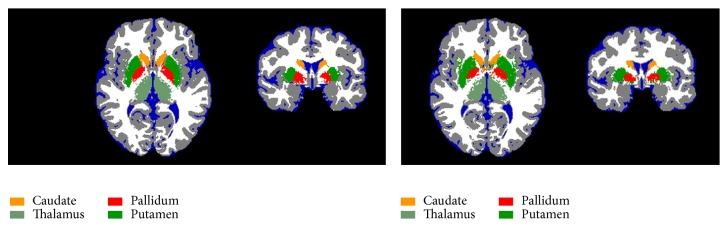
The aim of this paper is investigate the feasibility of automatically training supervised methods, such as k-nearest neighbor (kNN) and principal component discriminant analysis (PCDA), and to segment the four subcortical brain structures: caudate, thalamus, pallidum, and putamen. The adoption of supervised classification methods so far has been limited by the need to define a representative training dataset, operation that usually requires the intervention of an operator. In this work the selection of the training data was performed on the subject to be segmented in a fully automated manner by registering probabilistic atlases. Evaluation of automatically trained kNN and PCDA classifiers that combine voxel intensities and spatial coordinates was performed on 20 real datasets selected from two publicly available sources of multispectral magnetic resonance studies. The results demonstrate that atlas-guided training is an effective way to automatically define a representative and reliable training dataset, thus giving supervised methods the chance to successfully segment magnetic resonance brain images without the need for user interaction.
本文旨在研究自动训练监督方法(如k近邻算法(kNN)和主成分判别分析(PCDA))的可行性,并对四种皮质下脑结构(尾状核、丘脑、苍白球和壳核)进行分割。迄今为止,监督分类方法的应用受到定义代表性训练数据集需求的限制,而这一操作通常需要操作员的干预。在这项工作中,通过配准概率图谱,以完全自动化的方式在待分割的受试者上进行训练数据的选择。对结合体素强度和空间坐标的自动训练的kNN和PCDA分类器进行了评估,评估是在从两个公开可用的多光谱磁共振研究源中选择的20个真实数据集上进行的。结果表明,图谱引导训练是自动定义具有代表性和可靠性的训练数据集的有效方法,从而使监督方法有机会在无需用户交互的情况下成功分割磁共振脑图像。



 Zotero 插件