
蓝光诱导全视锥小鼠视网膜出现视网膜病变、视网膜内血管渗漏和水肿形成。
Blue light-induced retinal lesions, intraretinal vascular leakage and edema formation in the all-cone mouse retina.
作者信息
Geiger P, Barben M, Grimm C, Samardzija M
机构信息
Laboratory for Retinal Cell Biology, Department Ophthalmology, USZ, University of Zurich, Switzerland.
出版信息
Cell Death Dis. 2015 Nov 19;6(11):e1985. doi: 10.1038/cddis.2015.333.
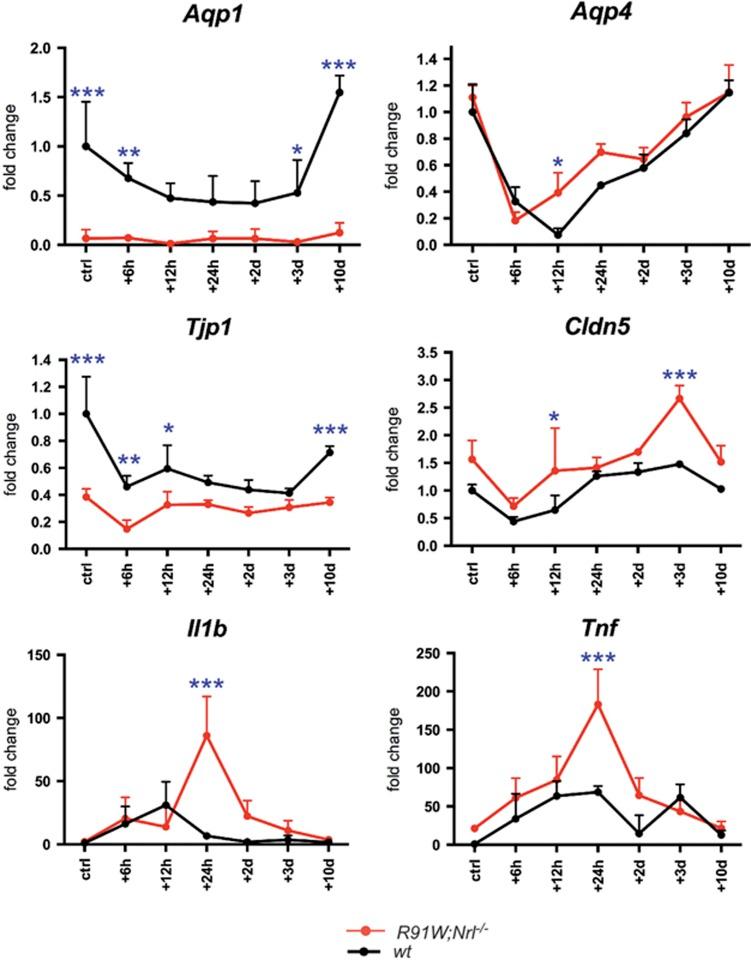
Little is known about the mechanisms underlying macular degenerations, mainly for the scarcity of adequate experimental models to investigate cone cell death. Recently, we generated R91W;Nrl(-/-) double-mutant mice, which display a well-ordered all-cone retina with normal retinal vasculature and a strong photopic function that generates useful vision. Here we exposed R91W;Nrl(-/-) and wild-type (wt) mice to toxic levels of blue light and analyzed their retinas at different time points post illumination (up to 10 days). While exposure of wt mice resulted in massive pyknosis in a focal region of the outer nuclear layer (ONL), the exposure of R91W;Nrl(-/-) mice led to additional cell death detected within the inner nuclear layer. Microglia/macrophage infiltration at the site of injury was more pronounced in the all-cone retina of R91W;Nrl(-/-) than in wt mice. Similarly, vascular leakage was abundant in the inner and outer retina in R91W;Nrl(-/-) mice, whereas it was mild and restricted to the subretinal space in wt mice. This was accompanied by retinal swelling and the appearance of cystoid spaces in both inner and ONLs of R91W;Nrl(-/-) mice indicating edema in affected areas. In addition, basal expression levels of tight junction protein-1 encoding ZO1 were lower in R91W;Nrl(-/-) than in wt retinas. Collectively, our data suggest that exposure of R91W;Nrl(-/-) mice to blue light not only induces cone cell death but also disrupts the inner blood-retinal barrier. Macular edema in humans is a result of diffuse capillary leakage and microaneurysms in the macular region. Blue light exposure of the R91W;Nrl(-/-) mouse could therefore be used to study molecular events preceding edema formation in a cone-rich environment, and thus potentially help to develop treatment strategies for edema-based complications in macular degenerations.
关于黄斑变性的潜在机制,人们了解甚少,主要原因是缺乏足够的实验模型来研究视锥细胞死亡。最近,我们培育出了R91W;Nrl(-/-)双突变小鼠,其视网膜全由视锥细胞构成,排列有序,视网膜血管正常,具有强大的明视觉功能,能产生有效的视觉。在此,我们将R91W;Nrl(-/-)和野生型(wt)小鼠暴露于有毒剂量的蓝光下,并在光照后的不同时间点(长达10天)对其视网膜进行分析。野生型小鼠暴露于蓝光后,在外核层(ONL)的一个局部区域出现大量核固缩,而R91W;Nrl(-/-)小鼠暴露于蓝光后,在内核层检测到额外的细胞死亡。R91W;Nrl(-/-)小鼠全视锥视网膜损伤部位的小胶质细胞/巨噬细胞浸润比野生型小鼠更明显。同样,R91W;Nrl(-/-)小鼠视网膜内外血管渗漏严重,而野生型小鼠的血管渗漏较轻,且仅限于视网膜下间隙。这伴随着R91W;Nrl(-/-)小鼠视网膜肿胀以及内外核层出现囊样间隙,表明受影响区域出现水肿。此外,编码ZO1的紧密连接蛋白-1在R91W;Nrl(-/-)小鼠中的基础表达水平低于野生型视网膜。总体而言,我们的数据表明,R91W;Nrl(-/-)小鼠暴露于蓝光不仅会诱导视锥细胞死亡,还会破坏视网膜内屏障。人类黄斑水肿是黄斑区弥漫性毛细血管渗漏和微动脉瘤的结果。因此,R91W;Nrl(-/-)小鼠暴露于蓝光可用于研究富含视锥细胞环境中水肿形成之前的分子事件,从而可能有助于开发针对黄斑变性中基于水肿的并发症的治疗策略。


 Zotero 插件