Polo Gina, Labruna Marcelo Bahia, Ferreira Fernando
Laboratory of Epidemiology and Biostatistics, Department of Preventive Veterinary Medicine and Animal Health, University of São Paulo, São Paulo, Brazil.
Laboratory of Parasitic Diseases, Department of Preventive Veterinary Medicine and Animal Health, University of São Paulo, São Paulo, Brazil.
PLoS One. 2015 Nov 24;10(11):e0143736. doi: 10.1371/journal.pone.0143736. eCollection 2015.
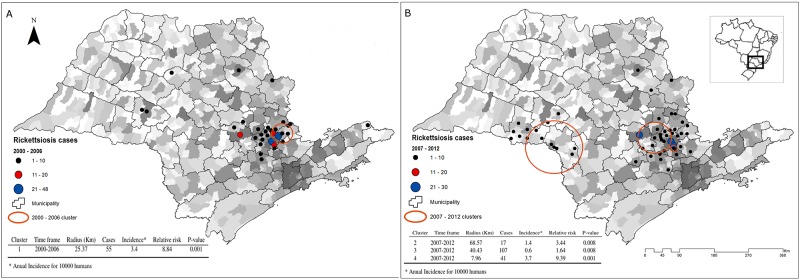
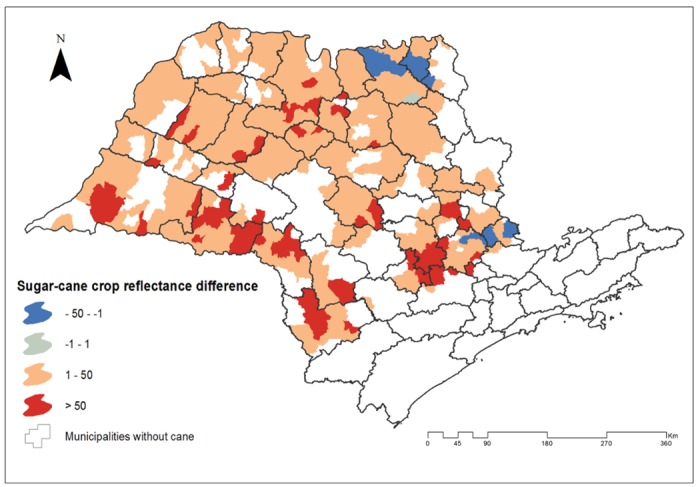
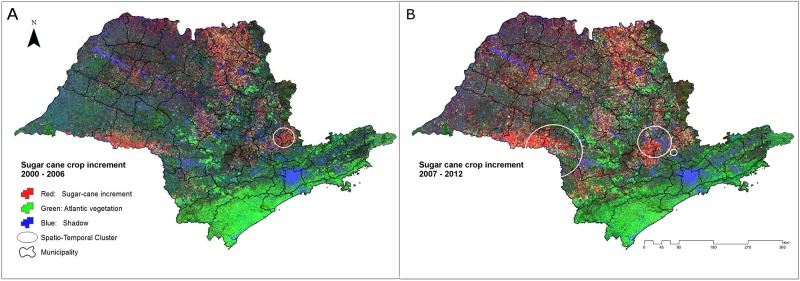
This study proposed the use of satellite hyperspectral imagery to support tick-borne infectious diseases surveillance based on monitoring the variation in amplifier hosts food sources. To verify this strategy, we used the data of the human rickettsiosis occurrences in southeastern Brazil, region in which the emergence of this disease is associated with the rising capybara population. Spatio-temporal analysis based on Monte Carlo simulations was used to identify risk areas of human rickettsiosis and hyperspectral moderate-resolution imagery was used to identify the increment and expansion of sugarcane crops, main food source of capybaras. In general, a pixel abundance associated with increment of sugarcane crops was detected in risk areas of human rickettsiosis. Thus, the hypothesis that there is a spatio-temporal relationship between the occurrence of human rickettsiosis and the sugarcane crops increment was verified. Therefore, due to the difficulty of monitoring locally the distribution of infectious agents, vectors and animal host's, satellite hyperspectral imagery can be used as a complementary tool for the surveillance of tick-borne infectious diseases and potentially of other vector-borne diseases.
本研究提出利用卫星高光谱图像,通过监测放大器宿主食物来源的变化来支持蜱传传染病监测。为验证这一策略,我们使用了巴西东南部人类立克次体病发病数据,该地区这种疾病的出现与水豚数量增加有关。基于蒙特卡罗模拟的时空分析用于确定人类立克次体病的风险区域,高光谱中分辨率图像用于确定甘蔗作物(水豚的主要食物来源)的增加和扩张情况。总体而言,在人类立克次体病的风险区域检测到了与甘蔗作物增加相关的像素丰度。因此,关于人类立克次体病的发生与甘蔗作物增加之间存在时空关系的假设得到了验证。所以,由于在当地监测传染源、传播媒介和动物宿主分布存在困难,卫星高光谱图像可作为蜱传传染病以及潜在的其他媒介传播疾病监测的补充工具。