Roizenblatt Suely, Souza Altay L, Palombini Luciana, Godoy Luciana M, Tufik Sergio, Bittencourt Lia Rita A
Department of Internal Medicine, UNIFESP, São Paulo, Brazil.
Department of Psychobiology, UNIFESP, São Paulo, Brazil.
PLoS One. 2015 Nov 24;10(11):e0142726. doi: 10.1371/journal.pone.0142726. eCollection 2015.
We are witnessing the growth of urban populations, particularly in the developing world. São Paulo, the largest city in South America, continues to grow, and this growth is dramatically effecting the environment and human health. The aim of this study was to estimate the point prevalence of chronic pain in São Paulo city dwellers and to explore the influence of aspects related to urbanicity.
A two-stage cluster randomized sample included 1100 individuals of the city of Sao Paulo, representing the population proportionally in terms of gender, age and social classes in 2007. For this observational cross-sectional study, the household sample was interviewed using validated questionnaires for sociodemographic aspects, the Beck inventories for anxiety and depression, the WHOQoL-REF for quality of life, the Chalder Fatigue Scale. Musculoskeletal pain was defined as diffuse pain or pain located in the back, joints or limbs. Data regarding sleep complaints and polysomnography were obtained from the Epidemiologic Sleep Study conducted in São Paulo city in 2007.
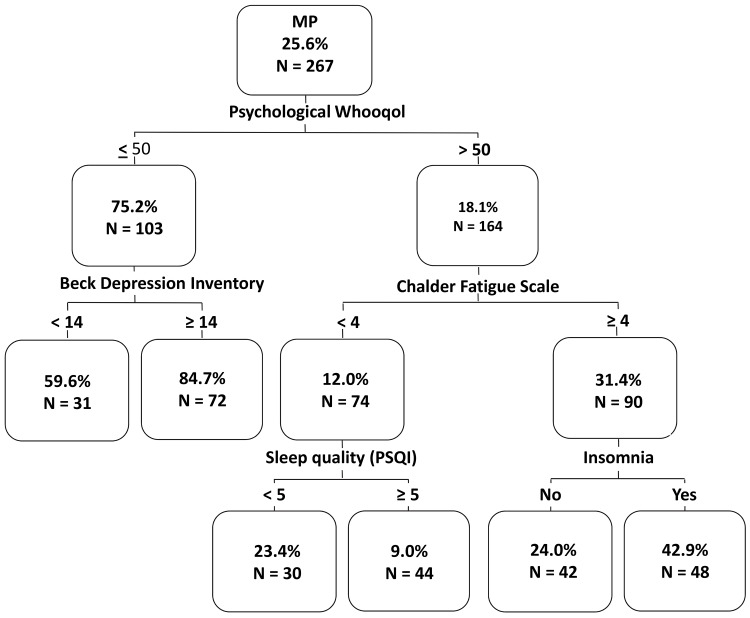
The prevalence estimate of chronic musculoskeletal pain was approximately 27%, with a female/male ratio of approximately 2.6/1. The predictors were being in the age-range of 30-39 years, low socioeconomic and schooling levels, obesity, sedentarism, fatigue, non-restorative sleep, daytime sleepiness, poor sleep quality, poor life quality, anxiety and depression symptoms. Psychological wellbeing was the main discriminator between responders with chronic musculoskeletal pain and the controls, followed by depression for the participants with poor psychological wellbeing, and fatigue, for the remaining ones. Insomnia syndrome was the third-level discriminator for those with fatigue, whereas sleep quality for those without fatigue.
Musculoskeletal pain was frequently reported by São Paulo city dwellers and its correlates with psychological and sleep aspects are suggestive of a response to urbanicity.
ClinicalTrials.gov NCT00596713.
我们正在目睹城市人口的增长,尤其是在发展中国家。南美洲最大的城市圣保罗仍在持续发展,这种增长正在对环境和人类健康产生巨大影响。本研究的目的是估计圣保罗城市居民慢性疼痛的时点患病率,并探讨与城市化相关的各个方面的影响。
采用两阶段整群随机抽样,纳入了1100名圣保罗市居民,按2007年的性别、年龄和社会阶层比例代表总体人群。在这项观察性横断面研究中,通过使用经过验证的问卷对家庭样本进行访谈,内容涉及社会人口学方面、贝克焦虑和抑郁量表、世界卫生组织生活质量简表、查尔德疲劳量表。肌肉骨骼疼痛定义为弥漫性疼痛或位于背部、关节或四肢的疼痛。关于睡眠投诉和多导睡眠图的数据来自2007年在圣保罗市进行的流行病学睡眠研究。
慢性肌肉骨骼疼痛的患病率估计约为27%,女性/男性比例约为2.6/1。预测因素包括年龄在30 - 39岁之间、社会经济和教育水平低、肥胖、久坐不动、疲劳、非恢复性睡眠、白天嗜睡、睡眠质量差、生活质量差、焦虑和抑郁症状。心理健康是慢性肌肉骨骼疼痛应答者与对照组之间的主要区分因素,其次,心理健康状况不佳的参与者中抑郁是区分因素,其余参与者中疲劳是区分因素。失眠综合征是有疲劳者的第三级区分因素,而无疲劳者的区分因素是睡眠质量。
圣保罗城市居民经常报告肌肉骨骼疼痛,其与心理和睡眠方面的关联表明是对城市化的一种反应。
ClinicalTrials.gov NCT00596713