Okada Jun-Ichi, Yoshinaga Takashi, Kurokawa Junko, Washio Takumi, Furukawa Tetsushi, Sawada Kohei, Sugiura Seiryo, Hisada Toshiaki
Graduate School of Frontier Sciences, The University of Tokyo, 5-1-5 Kashiwanoha, Kashiwa, Chiba 277-8563, Japan. ; UT-Heart Inc., 3-25-8 Nozawa, Setagaya-ku, Tokyo 154-0003, Japan.
Global CV Assessment, Eisai Co. Ltd., Tokodai 5-1-3, Tsukua-shi, Ibaraki 300-2635, Japan.
Sci Adv. 2015 May 1;1(4):e1400142. doi: 10.1126/sciadv.1400142. eCollection 2015 May.
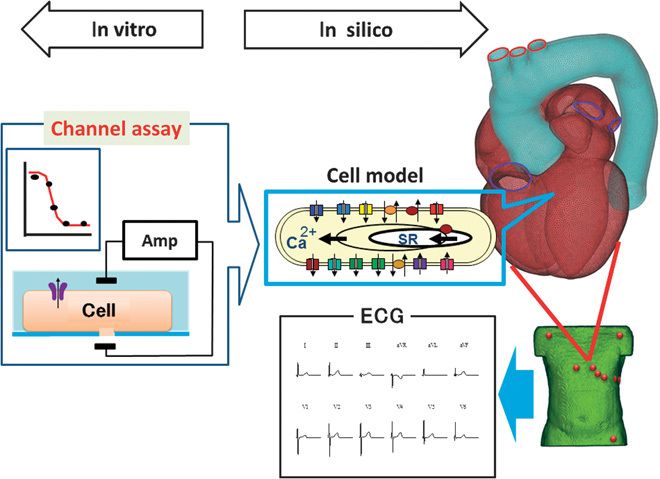
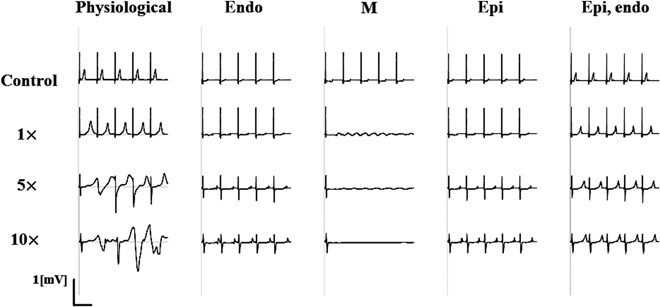
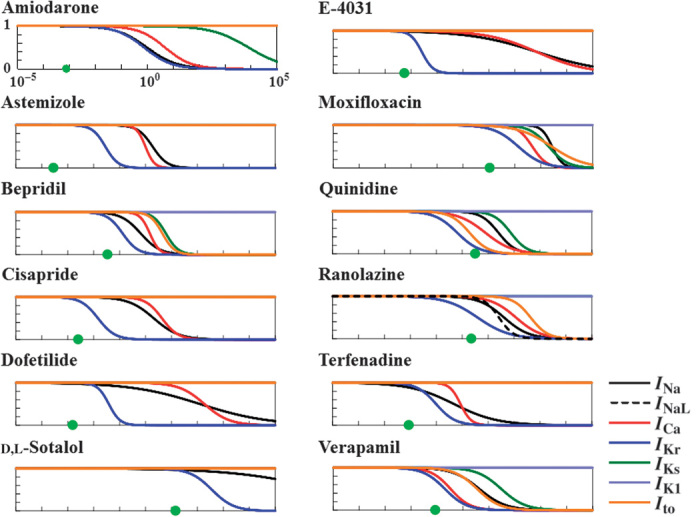
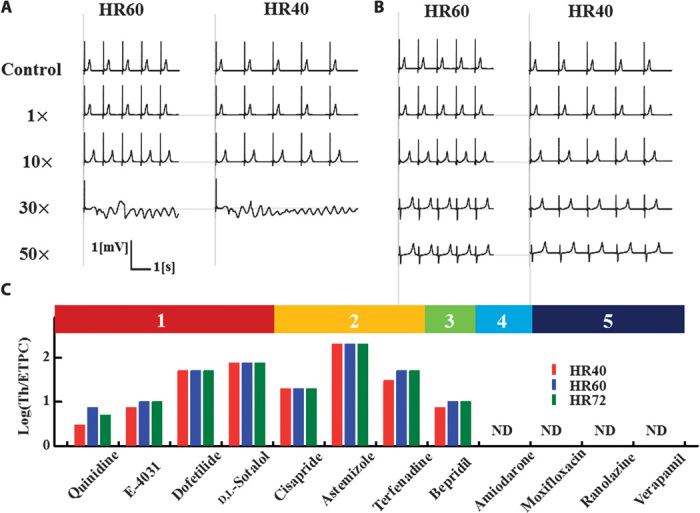
To save time and cost for drug discovery, a paradigm shift in cardiotoxicity testing is required. We introduce a novel screening system for drug-induced arrhythmogenic risk that combines in vitro pharmacological assays and a multiscale heart simulator. For 12 drugs reported to have varying cardiotoxicity risks, dose-inhibition curves were determined for six ion channels using automated patch clamp systems. By manipulating the channel models implemented in a heart simulator consisting of more than 20 million myocyte models, we simulated a standard electrocardiogram (ECG) under various doses of drugs. When the drug concentrations were increased from therapeutic levels, each drug induced a concentration-dependent characteristic type of ventricular arrhythmia, whereas no arrhythmias were observed at any dose with drugs known to be safe. We have shown that our system combining in vitro and in silico technologies can predict drug-induced arrhythmogenic risk reliably and efficiently.
为了在药物研发中节省时间和成本,心脏毒性测试需要进行范式转变。我们引入了一种用于药物致心律失常风险的新型筛选系统,该系统结合了体外药理学分析和多尺度心脏模拟器。对于12种据报道具有不同心脏毒性风险的药物,使用自动膜片钳系统测定了六种离子通道的剂量抑制曲线。通过操纵在由超过2000万个心肌细胞模型组成的心脏模拟器中实现的通道模型,我们模拟了不同药物剂量下的标准心电图(ECG)。当药物浓度从治疗水平增加时,每种药物都会诱导出浓度依赖性的特征性室性心律失常类型,而已知安全的药物在任何剂量下均未观察到心律失常。我们已经表明,我们结合体外和计算机技术的系统能够可靠且高效地预测药物致心律失常风险。