Jin Liqun, Tolentino Daniel R, Melaimi Mohand, Bertrand Guy
UCSD-CNRS Joint Research Chemistry Laboratory (UMI 3555), Department of Chemistry, University of California San Diego, La Jolla, CA 92093-0343, USA.
Sci Adv. 2015 Jun 12;1(5):e1500304. doi: 10.1126/sciadv.1500304. eCollection 2015 Jun.
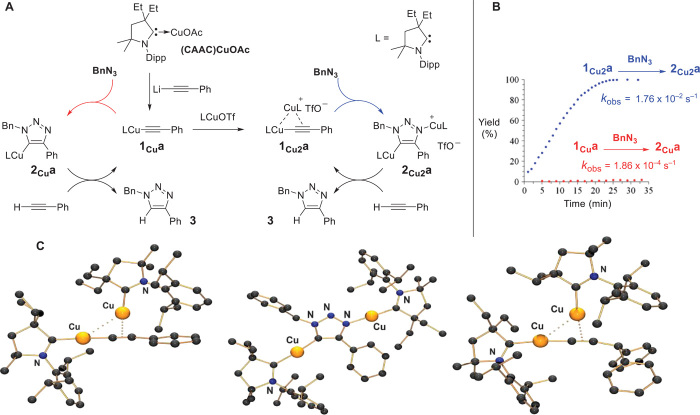
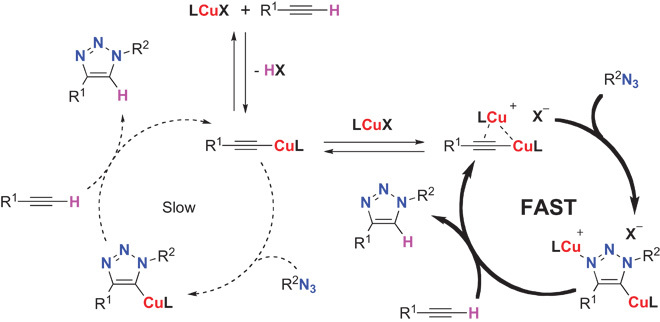
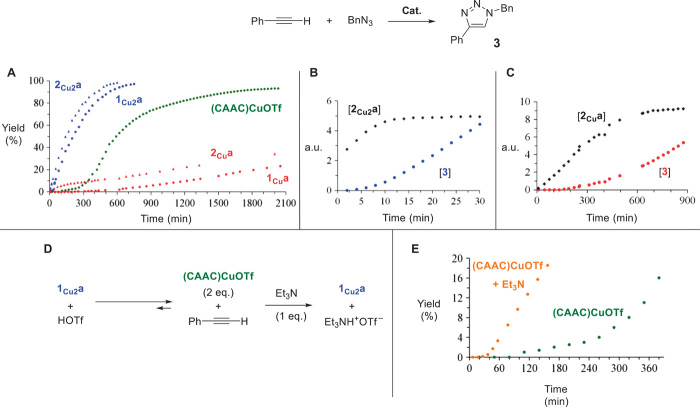
The copper-catalyzed 1,3-dipolar cycloaddition of an azide to a terminal alkyne (CuAAC) is one of the most popular chemical transformations, with applications ranging from material to life sciences. However, despite many mechanistic studies, direct observation of key components of the catalytic cycle is still missing. Initially, mononuclear species were thought to be the active catalysts, but later on, dinuclear complexes came to the front. We report the isolation of both a previously postulated π,σ-bis(copper) acetylide and a hitherto never-mentioned bis(metallated) triazole complex. We also demonstrate that although mono- and bis-copper complexes promote the CuAAC reaction, the dinuclear species are involved in the kinetically favored pathway.
叠氮化物与末端炔烃的铜催化1,3-偶极环加成反应(CuAAC)是最常用的化学转化反应之一,其应用范围涵盖材料科学和生命科学领域。然而,尽管已经开展了许多机理研究,但催化循环关键组分的直接观测仍付诸阙如。最初,单核物种被认为是活性催化剂,但后来双核配合物成为了研究焦点。我们报道了分离得到先前推测的π,σ-双(铜)乙炔化物和一种此前从未提及的双(金属化)三唑配合物。我们还证明,尽管单核和双核铜配合物均可促进CuAAC反应,但动力学上有利的反应途径涉及双核物种。