Yoshimura Eiichi, Sawada Susumu S, Lee I-Min, Gando Yuko, Kamada Masamitsu, Matsushita Munehiro, Kawakami Ryoko, Ando Ryosuke, Okamoto Takashi, Tsukamoto Koji, Miyachi Motohiko, Blair Steven N
Department of Food and Health Science, Prefectural University of Kumamoto.
J Epidemiol. 2016;26(3):131-6. doi: 10.2188/jea.JE20150049. Epub 2015 Nov 28.
In Japan, the incidence of kidney stones has increased markedly in recent decades. Major causes of kidney stones remain unclear, and limited data are available on the relationship between overweight/obesity and the incidence of kidney stones. We therefore evaluated body mass index (BMI) and the incidence of kidney stones in Japanese men.
Of the workers at a gas company, 5984 males aged 20-40 years underwent a medical examination in 1985 (baseline). This study includes 4074 of the men, who were free of kidney stones at baseline and underwent a second medical examination performed between April 2004 and March 2005. BMI was calculated from measured height and weight in 1985, and men were categorized into tertiles. The development of kidney stones during follow-up was based on self-reports from questionnaires at the second medical examination.
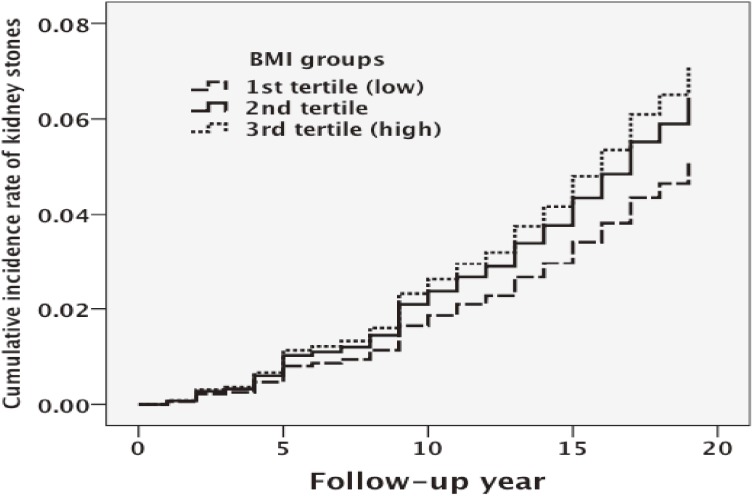
The average duration of follow-up was 19 years, with 258 participants developing kidney stones during this period. Using the lowest BMI (1st tertile) group as a reference, the hazard ratios (95% confidence intervals [CIs]) for the 2nd and 3rd BMI tertiles were: 1.26 (95% CI, 0.92-1.73) and 1.44 (95% CI, 1.06-1.96), respectively (P for trend = 0.019). After additionally adjusting for potential confounders, such as age, systolic blood pressure, cardiorespiratory fitness, cigarette smoking, and alcohol consumption, the hazard ratios were 1.28 (95% CI, 0.93-1.76) and 1.41 (95% CI, 1.02-1.97), respectively (P for trend = 0.041).
These results suggest that increased BMI is a risk factor for kidney stones in Japanese men.
在日本,近几十年来肾结石的发病率显著上升。肾结石的主要病因仍不明确,关于超重/肥胖与肾结石发病率之间的关系,现有数据有限。因此,我们评估了日本男性的体重指数(BMI)与肾结石发病率之间的关系。
1985年(基线),一家燃气公司的5984名20至40岁男性员工接受了体检。本研究纳入了其中4074名男性,他们在基线时无肾结石,并于2004年4月至2005年3月期间接受了第二次体检。根据1985年测量的身高和体重计算BMI,并将男性分为三个三分位数组。随访期间肾结石的发生情况基于第二次体检问卷中的自我报告。
平均随访时间为19年,在此期间有258名参与者患上了肾结石。以最低BMI(第一三分位数)组为参照,第二和第三BMI三分位数组的风险比(95%置信区间[CI])分别为:1.26(95%CI,0.92 - 1.73)和1.44(95%CI,1.06 - 1.96)(趋势P值 = 0.019)。在进一步调整了年龄、收缩压、心肺功能、吸烟和饮酒等潜在混杂因素后,风险比分别为1.28(95%CI,0.93 - 1.76)和1.41(95%CI,1.02 - 1.97)(趋势P值 = 0.041)。
这些结果表明,BMI升高是日本男性患肾结石的一个危险因素。