Rembe Julian-Dario, Böhm Julia K, Fromm-Dornieden Carolin, Schäfer Nadine, Maegele Marc, Fröhlich Matthias, Stuermer Ewa K
Institute for Research in Operative Medicine (IFOM), Witten/Herdecke University, Ostmerheimer Str. 200, 51109, Cologne, Germany.
Department of Traumatology, Orthopaedic Surgery and Sports Traumatology, Cologne-Merheim Medical Centre (CMMC), Witten/Herdecke University, Campus Cologne-Merheim, Ostmerheimer Str. 200, 51109, Cologne, Germany.
J Transl Med. 2015 Nov 30;13:375. doi: 10.1186/s12967-015-0740-5.
Due to demographical changes the number of elderly patients depending on oral anticoagulation is expected to rise. Prolonged bleeding times in case of traumatic injuries represent the drawback of these medications, not only in major trauma, but also in superficial wounds. Therefore, dressings capable of accelerating coagulation onset and shortening bleeding times are desirable for these patients.
The hemostatic potential and physical properties of different types of superficial wound dressings (standard wound pad, two alginates, chitosan, collagen (Lyostypt(®)), oxidized cellulose, and QuikClot(®)) were assessed in vitro. For this purpose the clotting times of blood under the influence of the named hemostatics from healthy volunteers were compared with Marcumar(®) or ASS(®) treated patients. For that, a newly developed coagulation assay based on spectrophotometric extinction measurements of thrombin activity was used.
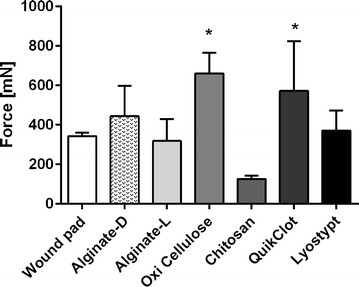
The fastest coagulation onset was observed for oxidized cellulose (Ø 2.47 min), Lantor alginate-L (Ø 2.50 min) and QuikClot(®) (Ø 3.01 min). Chitosan (Ø 5.32 min) and the collagen Lyostypt(®) (Ø 7.59 min) induced clotting comparatively late. Regarding physical parameters, QuikClot(®) showed the lowest absorption capacity and speed while chitosan and both alginates achieved the highest. While oxidized cellulose displayed the best clotting times, unfortunately it also revealed low absorption capacity.
All tested specimens seem to induce clotting independently from the administered type of oral anticoagulant, providing the possibility to neglect the disadvantage in clotting times arising from anticoagulation on a local basis. QuikClot(®), oxidized cellulose and unexpectedly alginate-L were superior to chitosan and Lyostypt(®). Due to its additional well-known positive effect on wound healing alginate-L should be considered for further investigations.
由于人口结构变化,依赖口服抗凝治疗的老年患者数量预计会增加。创伤性损伤时出血时间延长是这些药物的缺点,不仅在严重创伤中如此,在浅表伤口中也是如此。因此,对于这些患者来说,能够加速凝血起始并缩短出血时间的敷料是很有必要的。
在体外评估了不同类型的浅表伤口敷料(标准伤口垫、两种藻酸盐、壳聚糖、胶原蛋白(立止血®)、氧化纤维素和快凝止血纱布®)的止血潜力和物理特性。为此,将健康志愿者血液在上述止血剂作用下的凝血时间与接受华法林®或苯丙香豆素®治疗的患者进行了比较。使用了一种基于分光光度法测量凝血酶活性的新开发的凝血测定法。
氧化纤维素(平均2.47分钟)、蓝托藻酸盐-L(平均2.50分钟)和快凝止血纱布®(平均3.01分钟)的凝血起始最快。壳聚糖(平均5.32分钟)和胶原蛋白立止血®(平均7.59分钟)诱导凝血相对较晚。在物理参数方面,快凝止血纱布®的吸收能力和速度最低,而壳聚糖和两种藻酸盐的吸收能力和速度最高。虽然氧化纤维素的凝血时间最佳,但遗憾的是其吸收能力也较低。
所有测试样本似乎都能独立于所服用的口服抗凝剂类型诱导凝血,这使得有可能忽略局部抗凝导致的凝血时间方面的劣势。快凝止血纱布®、氧化纤维素以及出人意料的藻酸盐-L优于壳聚糖和立止血®。由于藻酸盐-L对伤口愈合还有其他众所周知的积极作用,应考虑对其进行进一步研究。