Kober Silvia Erika, Schweiger Daniela, Witte Matthias, Reichert Johanna Louise, Grieshofer Peter, Neuper Christa, Wood Guilherme
Department of Psychology, University of Graz, Universitaetsplatz 2/III, Graz, 8010, Austria.
BioTechMed-Graz, Graz, Austria.
J Neuroeng Rehabil. 2015 Dec 1;12:107. doi: 10.1186/s12984-015-0105-6.
Using EEG based neurofeedback (NF), the activity of the brain is modulated directly and, therefore, the cortical substrates of cognitive functions themselves. In the present study, we investigated the ability of stroke patients to control their own brain activity via NF and evaluated specific effects of different NF protocols on cognition, in particular recovery of memory.
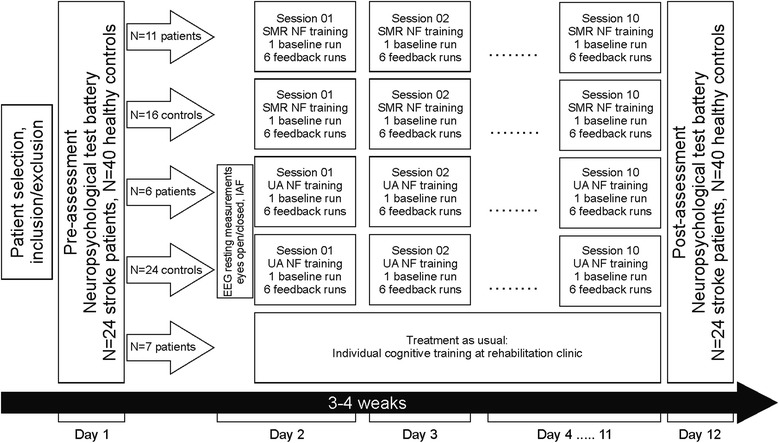
N = 17 stroke patients received up to ten sessions of either SMR (N = 11, 12-15 Hz) or Upper Alpha (N = 6, e.g. 10-12 Hz) NF training. N = 7 stroke patients received treatment as usual as control condition. Furthermore, N = 40 healthy controls performed NF training as well. To evaluate the NF training outcome, a test battery assessing different cognitive functions was performed before and after NF training.
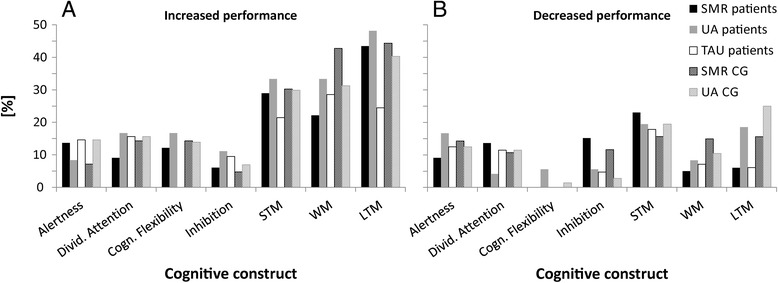
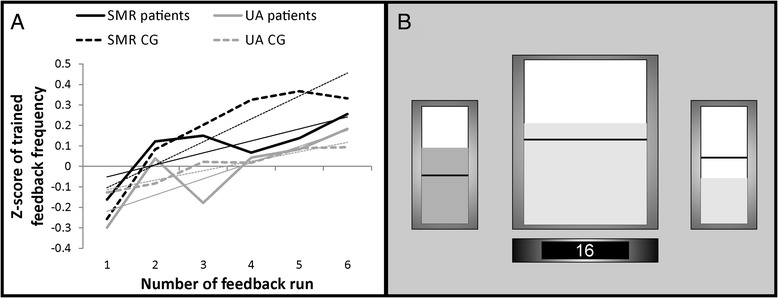
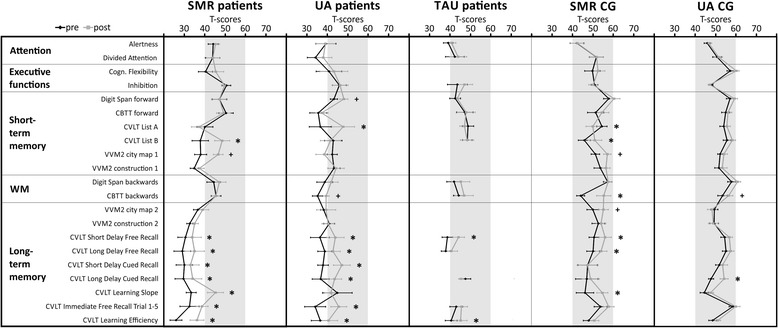
About 70 % of both patients and controls achieved distinct gains in NF performance leading to improvements in verbal short- and long-term memory, independent of the used NF protocol. The SMR patient group showed specific improvements in visuo-spatial short-term memory performance, whereas the Upper Alpha patient group specifically improved their working memory performance. NF training effects were even stronger than effects of traditional cognitive training methods in stroke patients. NF training showed no effects on other cognitive functions than memory.
Post-stroke victims with memory deficits could benefit from NF training as much as healthy controls. The used NF training protocols (SMR, Upper Alpha) had specific as well as unspecific effects on memory. Hence, NF might offer an effective cognitive rehabilitation tool improving memory deficits of stroke survivors.
基于脑电图的神经反馈(NF)可直接调节大脑活动,进而调节认知功能本身的皮质基质。在本研究中,我们调查了中风患者通过NF控制自身大脑活动的能力,并评估了不同NF方案对认知,特别是记忆恢复的特定影响。
17名中风患者接受了多达十次的SMR(N = 11,12 - 15赫兹)或上α波(N = 6,例如10 - 12赫兹)NF训练。7名中风患者接受常规治疗作为对照。此外,40名健康对照也进行了NF训练。为了评估NF训练结果,在NF训练前后进行了一组评估不同认知功能的测试。
患者和对照中约70%在NF表现上有显著提高,从而改善了言语短期和长期记忆,这与所使用的NF方案无关。SMR患者组在视觉空间短期记忆表现上有特定改善,而上α波患者组则特别改善了其工作记忆表现。NF训练效果甚至比中风患者传统认知训练方法的效果更强。NF训练对除记忆外的其他认知功能没有影响。
有记忆缺陷的中风患者与健康对照一样能从NF训练中受益。所使用的NF训练方案(SMR、上α波)对记忆有特定和非特定影响。因此,NF可能提供一种有效的认知康复工具,改善中风幸存者的记忆缺陷。