Department of Epidemiology and Health Monitoring , Robert Koch Institute , Berlin , Germany.
King's College London , Faculty of Life Sciences and Medicine , London , UK.
BMJ Open Diabetes Res Care. 2015 Nov 19;3(1):e000135. doi: 10.1136/bmjdrc-2015-000135. eCollection 2015.
To investigate changes in type 2 diabetes care indicators over time in Germany.
Adults aged 45-79 years with type 2 diabetes were identified from two national health examination surveys conducted in 1997-1999 (GNHIES98, n=333) and in 2008-2011 (DEGS1, n=526). We examined diabetes care indicators including treatment and preventive targets (glycemic control, blood pressure (BP), total cholesterol (TC), smoking, weight reduction, sports activity), self-management and care process measures (glucose self-monitoring, holding a diabetes passport, annual foot and eye examination; statin use), and the presence of diabetes-specific complications (diabetic nephropathy, retinopathy, neuropathy, diabetic foot, amputations) and comorbid cardiovascular disease (CVD) or chronic kidney disease (CKD). We calculated proportions of persons meeting these care indicators by survey and examined unadjusted and adjusted changes between surveys.
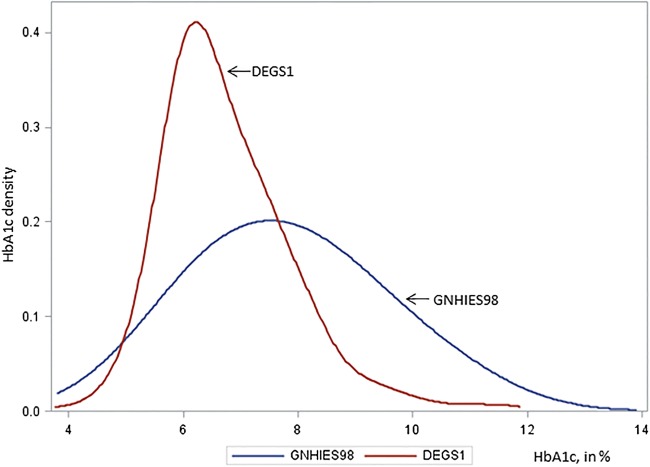
Significant improvement (GNHIES98 vs DEGS1) over time was observed for glycated hemoglobin (HbA1c) <7.0% (53 mmol/mol) (32.4% vs 65.4%), BP <130/80 mm Hg (32.0% vs 47.2%), TC <190 mg/dL (13.5% vs 41.9%), statin use (11.7% vs 35.9%), eye (51.1% vs 78.4%) and foot (48.0% vs 61.4%) examination within the past 12 months, diabetes-specific complications (29.7% vs 21.8%), and CVD (44.5% vs 37.1%). Blood glucose self-monitoring significantly increased (37.4% vs 62.8%), while holding a diabetes passport did not change. Current smoking did not change and obesity rose, although sports activity significantly increased over time. Proportions of adults achieving combination goals of HbA1c, BP, TC, and smoking cessation were low in both surveys in spite of significant improvement.
In Germany, the quality of diabetes care improved over time. There is much room for improvement, in particular regarding preventive goals and diabetes self-management.
研究德国 2 型糖尿病护理指标随时间的变化。
从 1997-1999 年(GNHIES98,n=333)和 2008-2011 年(DEGS1,n=526)两项国家健康检查调查中确定年龄在 45-79 岁之间患有 2 型糖尿病的成年人。我们检查了包括治疗和预防目标(血糖控制、血压(BP)、总胆固醇(TC)、吸烟、减肥、运动)、自我管理和护理过程措施(血糖自我监测、持有糖尿病护照、每年进行足部和眼部检查;他汀类药物的使用)以及糖尿病特异性并发症(糖尿病肾病、视网膜病变、神经病变、糖尿病足、截肢)和合并心血管疾病(CVD)或慢性肾病(CKD)在内的糖尿病护理指标。我们通过调查计算符合这些护理指标的人数,并检查调查之间未经调整和调整后的变化。
随着时间的推移,糖化血红蛋白(HbA1c)<7.0%(53mmol/mol)(32.4%比 65.4%)、血压<130/80mmHg(32.0%比 47.2%)、总胆固醇<190mg/dL(13.5%比 41.9%)、他汀类药物使用(11.7%比 35.9%)、过去 12 个月内的眼部(51.1%比 78.4%)和足部(48.0%比 61.4%)检查、糖尿病特异性并发症(29.7%比 21.8%)和心血管疾病(44.5%比 37.1%)显著改善。血糖自我监测显著增加(37.4%比 62.8%),而持有糖尿病护照没有变化。虽然运动活动显著增加,但目前吸烟没有改变,肥胖增加。尽管有显著改善,但在两项调查中,实现 HbA1c、BP、TC 和戒烟联合目标的成年人比例仍然很低。
在德国,糖尿病护理质量随时间推移而提高。特别是在预防目标和糖尿病自我管理方面,仍有很大的改进空间。