Berteau Cecile, Filipe-Santos Orchidée, Wang Tao, Rojas Humberto E, Granger Corinne, Schwarzenbach Florence
Becton-Dickinson Medical Pharmaceutical Systems, Le Pont de Claix, France.
Eli Lilly and Company, Indianapolis, IN, USA.
Med Devices (Auckl). 2015 Nov 11;8:473-84. doi: 10.2147/MDER.S91019. eCollection 2015.
The primary objective of this study was to evaluate the impact of fluid injection viscosity in combination with different injection volumes and flow rates on subcutaneous (SC) injection pain tolerance.
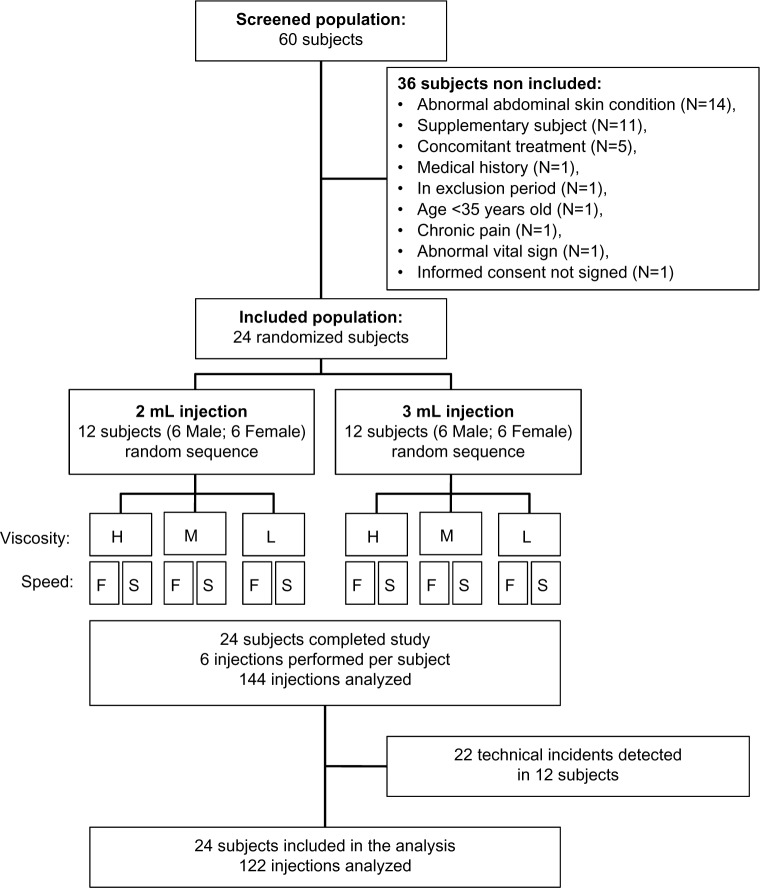
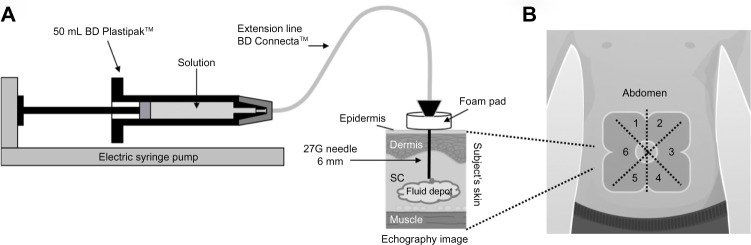
The study was a single-center, comparative, randomized, crossover, Phase I study in 24 healthy adults. Each participant received six injections in the abdomen area of either a 2 or 3 mL placebo solution, with three different fluid viscosities (1, 8-10, and 15-20 cP) combined with two different injection flow rates (0.02 and 0.3 mL/s). All injections were performed with 50 mL syringes and 27G, 6 mm needles. Perceived injection pain was assessed using a 100 mm visual analog scale (VAS) (0 mm/no pain, 100 mm/extreme pain). The location and depth of the injected fluid was assessed through 2D ultrasound echography images.
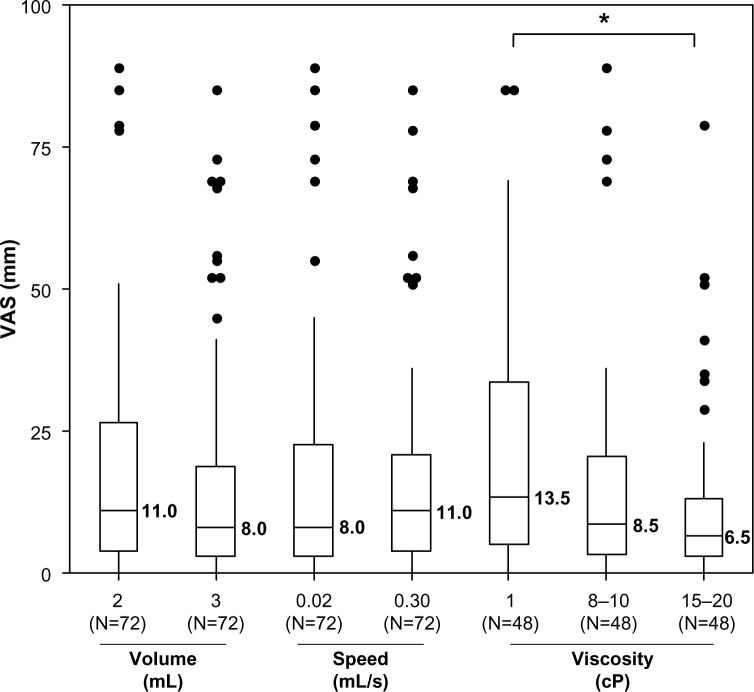
Viscosity levels had significant impact on perceived injection pain (P=0.0003). Specifically, less pain was associated with high viscosity (VAS =12.6 mm) than medium (VAS =16.6 mm) or low (VAS =22.1 mm) viscosities, with a significant difference between high and low viscosities (P=0.0002). Target injection volume of 2 or 3 mL was demonstrated to have no significant impact on perceived injection pain (P=0.89). Slow (0.02 mL/s) or fast (0.30 mL/s) injection rates also showed no significant impact on perceived pain during SC injection (P=0.79). In 92% of injections, the injected fluid was located exclusively in SC tissue whereas the remaining injected fluids were found located in SC and/or intradermal layers.
The results of this study suggest that solutions of up to 3 mL and up to 15-20 cP injected into the abdomen within 10 seconds are well tolerated without pain. High viscosity injections were shown to be the most tolerated, whereas injection volume and flow rates did not impact perceived pain.
本研究的主要目的是评估注射液体粘度与不同注射体积和流速相结合对皮下(SC)注射疼痛耐受性的影响。
该研究是一项针对24名健康成年人的单中心、比较性、随机、交叉I期研究。每位参与者在腹部区域接受6次注射,注射的是2毫升或3毫升的安慰剂溶液,有三种不同的液体粘度(1、8 - 10和15 - 20厘泊),并结合两种不同的注射流速(0.02和0.3毫升/秒)。所有注射均使用50毫升注射器和27G、6毫米的针头。使用100毫米视觉模拟量表(VAS)(0毫米/无疼痛,100毫米/极度疼痛)评估注射时的疼痛感受。通过二维超声图像评估注射液体的位置和深度。
粘度水平对注射时的疼痛感受有显著影响(P = 0.0003)。具体而言,高粘度(VAS = 12.6毫米)注射产生的疼痛低于中粘度(VAS = 16.6毫米)或低粘度(VAS = 22.1毫米)注射,高粘度和低粘度之间存在显著差异(P = 0.0002)。2毫升或3毫升的目标注射体积对注射时的疼痛感受无显著影响(P = 0.89)。慢流速(0.02毫升/秒)或快流速(0.30毫升/秒)对皮下注射时的疼痛感受也无显著影响(P = 0.79)。在92%的注射中,注射液体仅位于皮下组织,而其余注射液体位于皮下和/或真皮层。
本研究结果表明,在10秒内将最多3毫升、粘度高达15 - 20厘泊的溶液注入腹部时,耐受性良好且无疼痛。高粘度注射显示出耐受性最佳,而注射体积和流速对疼痛感受无影响。